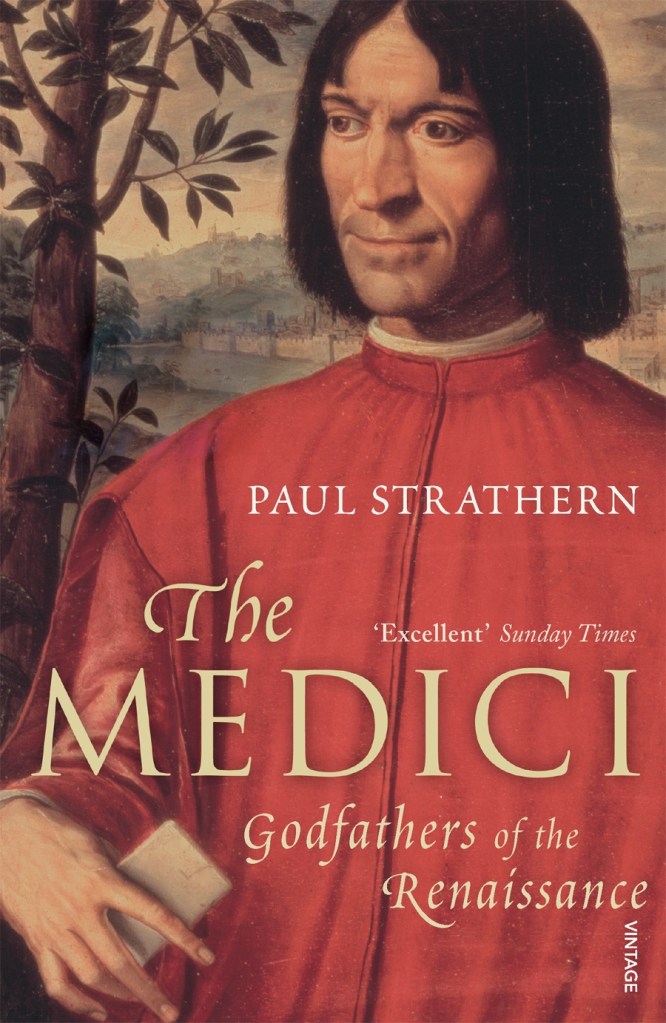
Review: The Medici by Paul Strathern

The Medici [2003] – ★★★★1/2

Continue reading “Review: The Medici by Paul Strathern”

Review: King, Queen, Knave by Vladimir Nabokov

Continue reading “Review: King, Queen, Knave by Vladimir Nabokov”

Nabokov’s Pale Fire: An Illusion Within an Illusion

Pale Fire [1962] – ★★★★★

Continue reading “Nabokov’s Pale Fire: An Illusion Within an Illusion”

Review: The Man Who Died Seven Times by Yasuhiko Nishizawa

Continue reading “Review: The Man Who Died Seven Times by Yasuhiko Nishizawa”

Review: Grand Hotel by Vicki Baum

Continue reading “Review: Grand Hotel by Vicki Baum”

Review: Gourmet Rhapsody by Muriel Barbery

Continue reading “Review: Gourmet Rhapsody by Muriel Barbery”

Mini-Review: The Cabinet by Kim Un-Su

Continue reading “Mini-Review: The Cabinet by Kim Un-Su”

Review: The Kingdom of This World by Alejo Carpentier

Continue reading “Review: The Kingdom of This World by Alejo Carpentier”

Damascus Nights by Rafik Schami + Reading Around the World (Vol. 2)

Continue reading “Damascus Nights by Rafik Schami + Reading Around the World (Vol. 2)”

Chabouté: To Build a Fire

Continue reading “Chabouté: To Build a Fire”

Review: The Rainbow by Yasunari Kawabata

Continue reading “Review: The Rainbow by Yasunari Kawabata”

Review: Burning Secret by Stefan Zweig

Continue reading “Review: Burning Secret by Stefan Zweig”

Japanese Fiction: Schoolgirl, & The Little House

Continue reading “Japanese Fiction: Schoolgirl, & The Little House”

Review: The Liar by Martin A. Hansen

Continue reading “Review: The Liar by Martin A. Hansen”

Review: Antidote to Venom by Freeman Wills Crofts

Continue reading “Review: Antidote to Venom by Freeman Wills Crofts”

Review: Dandelions by Yasunari Kawabata 

Continue reading “Review: Dandelions by Yasunari Kawabata “

Graphic Novels: Onward Towards Our Noble Death, & Trashed

Continue reading “Graphic Novels: Onward Towards Our Noble Death, & Trashed”

Review: Lies and Sorcery by Elsa Morante

Continue reading “Review: Lies and Sorcery by Elsa Morante”

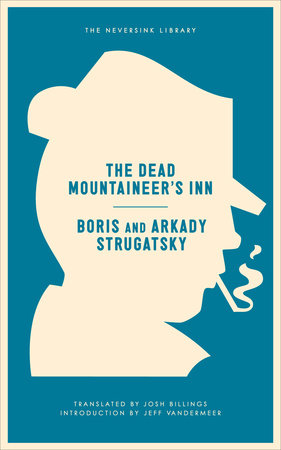
Review: The Dead Mountaineer’s Hotel by Boris & Arkady Strugatsky

Continue reading “Review: The Dead Mountaineer’s Hotel by Boris & Arkady Strugatsky”

Review: Alien Hearts by Guy de Maupassant

Continue reading “Review: Alien Hearts by Guy de Maupassant”

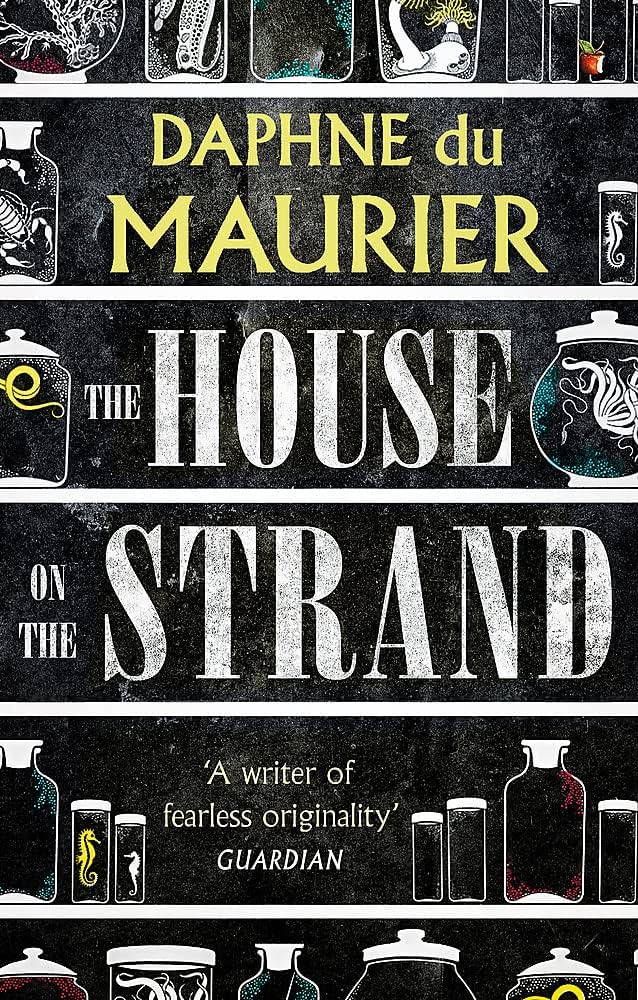
Review: The House on the Strand by Daphne du Maurier

Continue reading “Review: The House on the Strand by Daphne du Maurier”

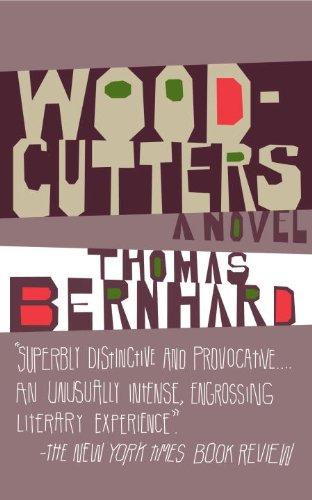
Mini-Reviews: Bernhard’s Woodcutters, & Coetzee’s Life & Times of Michael K

Continue reading “Mini-Reviews: Bernhard’s Woodcutters, & Coetzee’s Life & Times of Michael K”

Shin Kyung-Sook’s “Violets”: Both Tender & Unflinching

Violets [2001/22] – ★★★★

There is a Chinese proverb that states “a child’s life is like a piece of paper on which every person leaves a mark”. Acclaimed South Korean author Shin Kyung-Sook may agree with this statement, seeing that her sixth novel titled Violets (2001), translated from the Korean by Anton Hur in 2022, is all about a girl who is determined to overcome her traumatic childhood experiences while trying to find her calling in the buzzing capital of the country – Seoul. San is first introduced to us as a little girl born into a poverty-stricken family with one wayward father and not-so-very-responsible mother, and San’s only ray of sunshine seems to be another girl her age named Namae. It is the 1970s, and the two girls spend their time together, bonding over their respective families’ poverty and inadequacies, until one incident puts an unbridgeable distance between the girls. Then, we follow San, who is already aged twenty-two, as she seeks a job in Seoul, presumably in the 1980s, and, after unsuccessful applications to various publishing houses, lands the job of a flower seller.

It is in this, at first unenviable, position of a “flower girl” that shy San starts discovering things about herself and others, first making a connection with the mute shop-keeper and then friends with strong-willed and bold co-worker Su-ae. However, what was planted in childhood is bound to shoot up in adolescence and adulthood. San may be attempting to find fulfilment in her new job and friendship with Su-ae, but her painful past, her persistent isolation and her growing inward despair, may just get the better of her. San’s uncertain condition and need for attachment culminate in her obsessive love for one magazine photographer and then in further trauma as her search for comfort and understanding leads to some thoughtless and erratic actions. Shin’s tender, dream-like narrative puts our heroine in juxtaposition to the elements of her brash immediate environment, including the misogynistic attitude towards women, the competitive job market of the 1980s’ Seoul and the lonely disillusionment of “big city” dreams. The message is clear – San represents those ordinary, anonymous women in society, whose pitiful circumstances and trauma were systematically shut down and ignored[1]. The novel in our hands ensures that their voices are heard and remembered.

Continue reading “Shin Kyung-Sook’s “Violets”: Both Tender & Unflinching”

Mini-Reviews: Steinbeck’s To a God Unknown, & Ariyoshi’s The Twilight Years

To a God Unknown [1933] by John Steinbeck – ★★★1/2

John Steinbeck’s third novel follows Joseph Wayne, who leaves his family in Vermont and makes for sunny California in hope of obtaining cheap land there. Taken by the “pioneer fever”, he desires nothing more than some acres of land to call his own, and soon, his three brothers back home, animal-loving Thomas, religious Burton and wayward Benjamin follow suit, establishing a big inter-connected farm in their new place – the valley of Nuestra Señora. Wayne makes friends with Mexican Juanito, who helps him build his house, and even woos local school-teacher Elisabeth McGreggor. The combination of Joseph’s obsessive veneration of one large tree (a symbol of promise and renewal), problems with his alcoholic brother Benjamin and then fears about some uncharacteristic weather conditions slowly sets the scene for tragedies to come.

Continue reading “Mini-Reviews: Steinbeck’s To a God Unknown, & Ariyoshi’s The Twilight Years”

Review: The Toilers of the Sea by Victor Hugo

The Toilers of the Sea [1866] – ★★★★1/2

A novel of quiet, unassuming and yet extraordinary beauty, as well as a moving tribute to the sea and its people.

There is a pleasure in the pathless woods,/ There is a rapture on the lonely shore,/ There is society where none intrudes,/By the deep Sea, and music in its roar:/I love not Man the less, but Nature more… (Lord Byron). Reading this almost forgotten novel by Victor Hugo reminded me of this verse by Lord Byron which celebrates the nature’s hold on man like no human society can match. In The Toilers of the Sea, Victor Hugo pays a beautiful tribute to the Channel Islands archipelago, where he spent some 15 years in exile. His story is set in Guernsey, the second largest island of the archipelago, and, there, a small, rather superstitious community prides itself on having businessman Mess Lethierry, a pillar of the society, his beautiful niece Déruchette and Lethierry’s steamship Durande. When one skilful, but disliked seaman Gilliatt falls in love with Déruchette, his love seems hopeless, but when ship Durande suffers an unprecedented trouble in waters, Gilliatt may finally have a glimmer of hope in winning Déruchette’s hand. This tale of a shipwreck and betrayals is Victor Hugo’s less dynamic novel, but where it lacks in narrative vigour, it certainly makes up for in awe-inspiring nature descriptions and memorable characters, instilling a sense of wonder for the Channel Islands and its inhabitants.

Continue reading “Review: The Toilers of the Sea by Victor Hugo”

The Croatian Freethinker

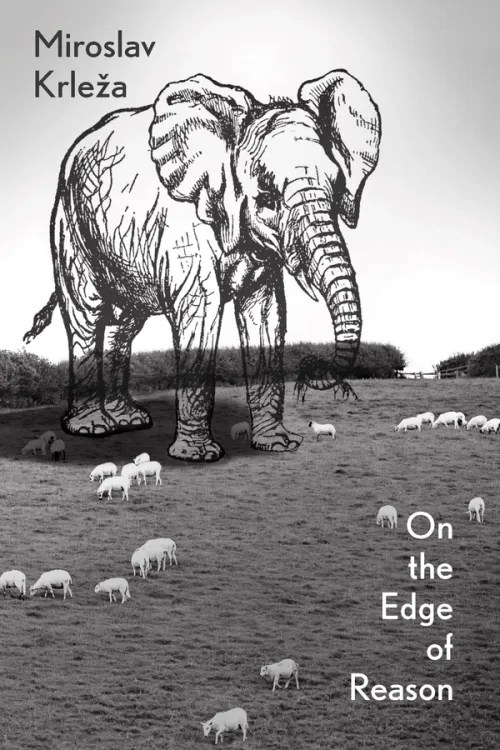
On the Edge of Reason re-issue is newly out from New Directions

What classic story first comes to your mind when you think of a satire on the hypocrisy of the bourgeoisie or ruling majority? George Orwell’s Animal Farm? J. B. Priestley’s An Inspector Calls? Henrik Ibsen’s An Enemy of the People? Charles Dickens’s Little Dorrit? Edith Wharton’s The House of Mirth? French literature has a long tradition of such stories, so, perhaps, some story by Molière, Honoré de Balzac, Émile Zola, or Guy de Maupassant? The choice is numerous, but, whatever it is, chances are it would not be Miroslav Krleža’s novel On the Edge of Reason (1938). And, yet – it should be. This novel by one of the greatest Croatian writers of the twentieth century should be on everyone’s lips when evoking stories about the challenge to that prevailing social order that curbs individual freedoms and rights, leading to injustice.

Prolific and versatile author Miroslav Krleža (1893 – 1981), who wrote novels, essays, poems, plays and short stories, was aptly placed to tackle the theme. His stark criticism of the ruling elite’s egoism, greed and the perpetration of social injustice in his fiction is the reflection of his country’s turbulent political history and his own innate desire to challenge the status quo. While being an officer in the Austro-Hungarian Army, Krleža once unsuccessfully deflected to the Serbian Army, and his embittered experience as a soldier on the frontlines during the World War I culminated in his powerful anti-war writings, including a short story collection titled Croatian God Mars (1922). After the World War I, Krleža emerged as a talented writer promoting socialism, and because of his leftist views, his books, publications and left-wing magazine Plamen had been banned in the inter-war period. In 1939, Krleža was expelled from the country’s Communist Party as his opinions on art contrasted with the social realist principles, and this further cemented his independent, “anti-establishment” public image.

Continue reading “The Croatian Freethinker”

Review: Waiting for the Barbarians by J. M. Coetzee

Waiting for the Barbarians [1980] ★★★★

What does J. M. Coetzee’s third book Waiting for the Barbarians have in common with Dino Buzzati’s novel The Tartar Steppe (1940)? Arguably, much more than their shared source of inspiration – C.P. Cavafy’s poem titled Waiting for the Barbarians (1904), whose first two lines go like this: “What is it that we are waiting for, gathered in the square?/The Barbarians are supposed to arrive today.” The ironic poem tells of the idleness and passivity of authorities who wait for the realisation of their grandiose expectations – the coming of the Barbarians. While Buzzati’s book primarily focuses on the self-imposed inertia and what it may mean to an individual spirit, similar to Mann’s novel The Magic Mountain, Coetzee book emphasises the ignorance of a blood-thirsty, ruthless power out of touch with reality and the way of life of its own people, but adamant to prove itself in the face of any, however slight and imaginary, hint of an external threat.
Continue reading “Review: Waiting for the Barbarians by J. M. Coetzee”

Review: Medicine & Society in Later Medieval England by Carole Rawcliffe

Medicine & Society in Later Medieval England [1995] – ★★★★

Magic was…an integral component of medieval medicine”, tells us historian Carole Rawcliffe in this book on the state of medicine in later medieval England. And, not only magic. Religion, astrology and even art were all tied up in the practice of medicine in the Middle Ages, and this non-fiction sheds much light on how the medieval society in England viewed illness, and its diagnosis and treatment. What was the difference between the medieval professions of physician, surgeon, apothecary and barber? Why the state of medicine in England at that time lagged behind other European countries? What was the general attitude towards women connected to the practice of medicine? And, what methods were used when no proper methods of anaesthesia and sanitation were yet available to the medical personnel? Relying much on the contemporary accounts, Rawcliffe proves to be an expert guide on these questions and many more, and her book is a scholarly, but also highly readable, journey into England’s medieval past.

Continue reading “Review: Medicine & Society in Later Medieval England by Carole Rawcliffe”

Review: The Films of Michael Powell & The Archers by Scott Salwolke

The Films of Michael Powell and The Archers [1997]★★★1/2

A good, introductory book on The Archers’ craft, and how the times in which the directors worked impacted their cinematic masterworks.

In my films, images are everything” (Michael Powell).

The Red Shoes (1948), The Life & Death of Colonel Blimp (1943), Black Narcissus (1947), A Matter of Life & Death (1946) – these are some of the greatest films ever produced, but how did one unlikely duo of British film-makers, Michael Powell (1905-1990) and Emeric Pressburger (1902-1988), better known as The Archers, manage to achieve such level of cinematic mastery, while also working in a tricky political and economic situation, and more amazingly, without the support from Hollywood? In his bibliographical non-fiction, Scott Salwolke may not be unveiling all the keys to the mysteries of The Archers’ craft, but he certainly provides a fascinating historical background to many of their cinematic masterworks, focusing on the film-makers’ influencers and revealing how their films emerged to be so different from those of their contemporaries.

Continue reading “Review: The Films of Michael Powell & The Archers by Scott Salwolke”

Review: An Episode in the Life of a Landscape Painter by César Aira

An Episode in the Life of a Landscape Painter [2000/06] ★★★★

A curious novella which is part travelogue, part biography, part historical fiction, part meditation on art, and part tribute to the beauty of Argentinian landscape.

What a landscape artist would be capable of doing for the love of art? Can they be capable of risking their life? What is human life in comparison to the eternity which is art?, they may ask. In today’s world of extravagant selfies, some taken in exotic locations and maybe even under relatively dangerous conditions, this short novella by Argentinian fiction writer César Aira may even feel ironically relevant again. Aira takes the real story of German landscape artist Johann Moritz Rugendas (1802 – 1858) and re-imagines one of the episodes from his life when Rugendas travelled as a documentary painter across tropical jungles and mountainous scenery of South America. César Aira’s 90 page-book surprises with its simplicity, humour and insights into the craft of an artist.

Continue reading “Review: An Episode in the Life of a Landscape Painter by César Aira”

Manga: Opus, The Strange Tale of Panorama Island, & The Solitary Gourmet

I. Opus [1995/96] by Satoshi Kon★★★★

I am a huge admirer of Japanese director Satoshi Kon (1963-2010). In his animations Perfect Blue [1997], Millennium Actress [2001] and Paprika [2006], he created worlds that fuse reality and fantasy, playing with such concepts as memory, identity and perception. Opus is his manga work that was released before his first animated debut, and it also mixes up reality and make-believe to a curious effect. In this story, Chikara Nagai is a manga artist who is creating a manga series titled Resonance. One of his characters is special agent Satoko who has telepathic powers and who is set to bring down the leader of a mysterious cult known only as the Masque, who, in turn, has a goal to “brainwash” the Earth’s population. Nagai draws the ending to his manga instalment, but then realises that one of his characters does not want to submit to his sad fate, as Nagai’s real-life and fantasy worlds collide. This is a tale of a creator who “lives and breathes” his work, and, in consequence, is becoming lost in his own creation (similar to A-ha’s music video Take on Me), but the focus is also the characters, who all start to experience an existential crisis.

Continue reading “Manga: Opus, The Strange Tale of Panorama Island, & The Solitary Gourmet”

Review: A Strangeness in My Mind by Orhan Pamuk

A Strangeness in My Mind [2014/15] – ★★★★

“Street vendors are the songbirds of the streets, they are the life and soul of Istanbul” [Orhan Pamuk/Ekin Oklap, Faber & Faber, 2014/15: 33].  

Shortlisted for the Man Booker International Prize 2016, A Strangeness in My Mind tells the story of Mevlut Karataş, a street-seller in Istanbul. From his childhood in a poor village to his children’s marriages, we are taken on the literary journey of his life, introduced to his uneasy relationship with his cousins Korkut and Süleyman, his stoic friendship with rebellious Ferhat, and, more importantly, to his marriage with Rayiha, which occurred under rather peculiar circumstances. The main aim of Pamuk in this book seems to capture a life and a way of life through the years, showing the daily happiness and struggles or ordinary people living in Istanbul, while demonstrating the changes that Istanbul has undergone through time, including its socio-economic and political situation, expansion and modernisation. Translated from the Turkish by Ekin Oklap, A Strangeness in My Mind is closer to an overlong “docu-fiction” and over-indulgent bibliographical non-fiction and, in truth, is a bit far from that exciting literary novel that would make the reader hungrily turning the pages or would impart to them some true insight or reveal some Pamukian complexity. However, where the book truly shines is in a loving, nostalgic and painstaking reveal of the life of a street-seller, a profession that is rapidly dying in large cities. Pamuk’s emphasis on the mysteries and intricacies of this moribund craft, together with his touching tribute to Istanbul of the past, is to what makes this novel so compelling – ultimately.

Continue reading “Review: A Strangeness in My Mind by Orhan Pamuk”

Review: The Garden of the Finzi-Continis by Giorgio Bassani

The Garden of the Finzi-Continis [1962/2005] – ★★★★

Nothing I know matters more / than what never happened.” John Burnside

This Italian classic tells the story of the prominent and aristocratic Finzi-Contini family in the Italian city of Ferrara in the 1920-30s through the eyes of a boy and then a man hopelessly in love with this family’s beautiful daughter Micòl. Our narrator’s family and that of Micòl could not be more apart on a societal standing, but they are both Jewish, and our narrator is soon admitted to Micòl’s entourage, making friends not only with Micòl, but also with her brother Alberto. A well-kept tennis court in the garden of the Finzi-Contini becomes the central point of the young people’s existence, and also, as it turns out, a sort of a safe haven, as anti-Semitic forces are tightening their grip on Italy on the eve of the World War II. Unbeknown to all, the ground is already set for the ultimate tragedy. This sensitive novel does not have the clearest of narratives, but it is still a touching coming-of-age story of lost love and opportunities, where emotions of first-love and tender friendship learn to co-exist with such feelings as pride and shame.

Continue reading “Review: The Garden of the Finzi-Continis by Giorgio Bassani”

Visualizing Spheres & Branches of Knowledge: “The Book of Circles”, & “The Book of Trees”

I. The Book of Circles [2017] by Manuel Lima – ★★★★

This illustrated non-fiction is all about the human presentation of knowledge through circles. The author states how natural it is for humans to try to classify and systematise all sorts of knowledge, and the circle serves as a perfect vehicle for doing so because it is a perfect geometrical figure standing for the Sun, among other things, and representing a multitude of other concepts, including movement, unity, wholeness, perfection and infinity. Being a shape that is omnipresent in nature, the circle may also be attracting our attention because of our innate evolutionary tendency to seek out human faces/eyes.

A large chunk of this book is devoted to showing various circles being used to illustrate and explain all sorts of concepts and progressions, from the presentations of the solar system, scientific theorems and alchemical tables to city maps, world economics and online engagements. There are things in this book which I never thought have been or could have been analysed using a circle, including the “Lineage of Sin in the Bible” (2009) by Anna Filipova and the changing colour of Lego sets (2015) by David Eaton.

Continue reading “Visualizing Spheres & Branches of Knowledge: “The Book of Circles”, & “The Book of Trees””

Review: Hogenberg & Braun’s Cities of the World by Stephan Füssel (ed.)

Cities of the World by Frans Hogenberg and Georg Braun

Cities of the World [1617/2015] – ★★★★1/2

Travelling – it gives you home in thousand strange places, then leaves you a stranger in your own land” (Ibn Battuta (1303 – 1377), a Berber Maghrebi scholar and explorer, who “travelled more than any other explorer in pre-modern history”, covering some 117.000 km over a 30 year-long journey).

This Taschen edition encyclopaedic book compiles engravings and original texts with commentaries from the Civitates orbis terrarum, a collection of town maps produced between 1572 and 1617 by Frans Hogenberg, a Flemish engraver, and Georg Braun, a German Catholic cleric, among other contributors. The book is often referred to as “the most important cartographic work of sixteenth-century Europe”, and includes town plans, bird’s-eye views of cities and stunning landscape illustrations of various cities’ domestic activities. Since these date from the sixteenth century and come from European authors, the book naturally talks predominantly about the cities of Europe (though it does include such cities as Constantinople (Istanbul), Cairo, Alexandria, Jerusalem, Cuzco and Mexico City, too), and retains its original title – Cities of the World. Below are just snippets from this fascinating illustrated book that spans some 750 pages and covers more than 450 cities.

Continue reading “Review: Hogenberg & Braun’s Cities of the World by Stephan Füssel (ed.)”

Review: Laura by Vera Caspary

Book Cover of Novel Laura by Vera Caspary

Laura [1943] ★★★★★

To solve the puzzle of [Laura’s death], [one] must first resolve the mystery of Laura’s life” [Vera Caspary, Houghton Mifflin/Vintage: 1942/2012: 16].

Beautiful, aspiring socialite Laura Hunt is found murdered in her apartment in New York City. She allegedly opened the door to her murderer. A veteran detective Mark McPherson starts to investigate this tricky case, but soon finds out that few things make sense in Laura’s murder. Worse still, McPherson finds himself falling under the charms of Laura’s personality and her world as a number of possible murder suspects emerge, including Laura’s low-paid fiancé Shelby Carpenter and Laura’s friend, eccentric columnist Waldo Lydecker. It soon turns out that Shelby is a possible insurance beneficiary upon Laura’s death, and, then, someone also buys Laura’s portrait that hung on her apartment wall …could it have been the murderer? Clues are scattered throughout this clever mystery-noir, which also has a twist “to die for”.

Continue reading “Review: Laura by Vera Caspary”

Review: Fryderyk Chopin by Alan Walker

Fryderyk Chopin: A Life and Times [2018] – ★★★1/2

A comprehensive biography of Chopin, though also a tad over-written and insensitive.

This book on Polish composer Fryderyk Chopin is the culmination of a ten years’ research project. Fryderyk or Frédéric Chopin is considered to be the greatest composer of the Romantic period, and this biography details his life from his early education and success in native Poland to his move and conquest of Paris through salon appearances, concerts and published works. Much in this book is about Chopin’s long-term relationship with female French novelist George Sand, but Chopin’s musical masterpieces, technique and piano theories are also dissected. Walker employs an engaging story-format to tell us about Chopin, a composer who was also largely self-taught and perpetually ill, providing invaluable insights into Chopin’s relationships with others. And, this well-researched book would have been a “must-read” biography if not for the fact that it is also over-written, with the author making some insensitive faux pas as he proceeds with his over-zealous narration.

Continue reading “Review: Fryderyk Chopin by Alan Walker”

Review: Talking Music by William Duckworth

Talking Music: Conversations with John Cage, Philip Glass, Laurie Anderson, & Five Generations of American Experimental Composers [1995]★★★★

A “must-read” for any music fan interested in the nature of music, its experimental forms and its boundaries.

Experimental music is defined as “any music that pushes existing boundaries and genre definitions“. Though the term originated in the 1950s, the US of the 1960s saw certain music artists emerging that can be said to be loosely associated with the “experimental music” movement. This book by American composer and educator William Duckworth compiles the author’s interviews with experimental composers and performers from the US, including John Cage, Philip Glass, Lou Harrison, Conlon Nancarrow, Meredith Monk and Laurie Anderson. The interviews shed light on the artists’ backgrounds, major works and inspirations, and many of the interviews are frank, interesting and inspirational.

Continue reading “Review: Talking Music by William Duckworth”

Review: Shell-Shock by Anthony Babington

Shell-Shock: A History of the Changing Attitudes to War Neurosis [1997] – ★★★★

“…They broke his body and his mind/And yet They made him live,/And They asked more of My Mother’s Son/Than any man could give...” (from Rudyard Kipling’s poem The Mother’s Son).

“…Men who went out to battle, grim and glad;/ Children, with eyes that hate you, broken and mad…” (Siegfried Sassoon, October 1917).

This is an insightful book about the history of “shell-shock”, a type of post-traumatic stress disorder suffered by soldiers after a prolonged combat. Anthony Babington is neither a medical professional nor strictly a trained historian, but his book still provides a thought-provoking overview of one very misunderstood illness. From wars described by Herodotus (484-425 BC) to the Gulf War of 1990/91, the account touches on every major war conflict to explain how “shell-shock” and combat stress were perceived and treated through history.

Continue reading “Review: Shell-Shock by Anthony Babington”

The Aztec Account of the Conquest of Mexico

The Broken Spears: The Aztec Account of the Conquest of Mexico [1959/97] – ★★★★

The Aztecs…thought the strangers were Quetzalcoatl, and other gods returning from over the sea, while the Spaniards, despite their amazement at the splendours of Tenochtitlan, considered the Aztecs barbarians and thought only of seizing their riches and of forcing them to become Christians and Spanish subjects” (León-Portilla/Kemp, Beacon Press, 1959/97: xxxiii).

On 22 April 1519, Spaniard Don Hernán Cortés landed in Mexico, and on 13 August 1521, the Aztecs, one of the greatest civilisations of South America, fell. The Aztecs, a nation possessing an intricate culture and complex political organisation, were destroyed and plundered beyond all recognition. In this book, Mexican anthropologist Miguel León-Portilla aims to show the invasion of Mexico by the Spaniards in 1519 from the point of view of the native Aztecs. The non-fiction, translated from the Spanish by Lysander Kemp, compiles a number of first-hand account writings from indigenous people, giving the voice to the victims of this unprecedented encounter between two very distinct military powers and cultures.

Continue reading “The Aztec Account of the Conquest of Mexico”

Review: The Ladies’ Paradise by Émile Zola

The Ladies’ Paradise [1883/1995]★★★★1/2

In this French classic translated by Brian Nelson, Denise Baudu, a young woman from the Valognes countryside, arrives to Paris with her two younger brothers, orphaned and destitute, looking to get employment at her uncle Mr Baudu’s small drapery shop. However, the moment Denise arrives, she becomes entranced by The Ladies’ Paradise, a magnificent shopping establishment that entices its customers with its extravagant window displays, personalised service, constant sales and affordable luxury. Since Mr Baudu’s small shop is on the brink of bankruptcy and Denise has to feed and clothe her two brothers, she feels she has no choice but to attempt working at this glittering shopping monstrosity that has already devoured many small businesses in the area, shutting them down. The proprietor of The Ladies’ Paradise is “brilliant” and ruthless Octave Mouret, an enigmatic figure, whose money-making schemes are already revolutionising the city’s shopping space. Can Denise, with her innocence and simplicity, navigate this complex, often immoral, commercial world so that she and her brothers survive? Zola masterfully and perceptively captures the changing Paris of the 1850-1860s that starts undergoing drastic urban transformations and changes in customer trends, seeing the rise of the “temples to Fashion’s madness for spending”, that are huge department stores.

Continue reading “Review: The Ladies’ Paradise by Émile Zola”

Review: The Sea and Poison by Shūsaku Endō

The Sea and Poison [1958/92] – ★★★★

The world will not be destroyed by those who do evil, but by those who watch them without doing anything” (Albert Einstein).

Go where the pain is” (Anne Rice).

Japan, the last months of the World War II. The city of Fukuoka, nestling in the Hakata Bay, has been experiencing air raids for quite some time, and its hospital finds itself stretched to the limits as its never-ending line of mostly dying patients is always at the door, riddled with many diseases, worsened by hunger and despair. But one day is no ordinary day for this hospital. Unbeknown to many, the Second Surgery is preparing for a secret vivisection operation on American soldiers taken prisoners by the Japanese, and the goal is to test the limits of air and saline that can be injected into humans before they die. Those who are involved in the operation are not some evil monsters or serial killers on the loose, though. They are some of the most respected people in the institution, as well as their dedicated supporting medical personnel. Through the perspectives of two interns – sensitive Suguro and cynical Toda, as well as haunted-by-traumatic-past Nurse Ueda, Endō shows us how easily the unimaginable can unfold when conditions are led by war-time nihilism and actions are prompted by apathy, despair, helplessness and self-interest. Based on a true story (see this article), Shūsaku Endō’s book is as intense as it is disturbing, but at its core is still a touching message to always preserve the spirit of humanity and compassion even in the most highly-pressured and hopeless environments.

Continue reading “Review: The Sea and Poison by Shūsaku Endō”

Review: How Do You Live? by Genzaburo Yoshino

How Do You Live? [1937/82/2021] – ★★★★★

Often compared to Antoine de Saint-Exupéry’s The Little Prince [1943], How Do You Live? is an unforgettable book with a heart and a soul.

This story focuses on naturally inquisitive high-school student Junichi Honda (nicknamed “Copper”) and his three friends: quiet Mizutani, outspoken Kitami and kind Uragawa. With his uncle acting as a guide, Copper learns important life lessons and discovers things that would enable him to become a better human being in future. We are shown little episodes in Copper’s life as the boy starts to understand the importance of friendship, kindness, thankfulness and acceptance, and the wrongs of bullying, cowardice and discrimination.

In an often typical Japanese literary style, there is hardly any “action” narrative in Yoshino’s book. Rather, the main “action” takes place inside Copper as he finds himself at “moral crossroads” in his life, forced to make decisions, and matures, learning certain things in life which can only be understood through experience. One such life lesson concerns the importance of humility and the need to be thankful for small things in one’s life. Copper’s uncle explains to our hero how there is a general human tendency to view oneself at the very centre of the world. This view is mistaken. We are all people who think, feel and dream, and are all connected to each other in a multitude of different ways, even if we do not see this directly. Only by thinking “globally” and from the point of view of other people, can we understand this life’s true nature, as well as become better human beings, making a positive impact on this world. Everything is inter-connected in nature and society, and no matter how small a thing or a person is, or how small their actions, its/their impact can still be felt on others/environment.

Continue reading “Review: How Do You Live? by Genzaburo Yoshino”

Review: Am I Dreaming? by James Kingsland

Am I Dreaming? The New Science of Consciousness and How Altered States Reboot the Brain [2019] – ★★★

From lucid dreaming and hallucinations to hypnotism and various effects of LSD and DMT, science journalist James Kingsland takes the reader on a journey explaining the altered states of consciousness and the present state of knowledge in this field, making his case that inducing altered states of consciousness is beneficial, and much can be gained by experimenting with psychoactive substances. Am I Dreaming? is an unnecessarily chaotic book, but if you are prepared to sift through the author’s more obvious statements on consciousness and his not-always-so-clear scientific explanations, there is some insight gained as the author talks about more recent studies and people’s first-hand experiences.

Continue reading “Review: Am I Dreaming? by James Kingsland”

Review: The Faithful Executioner by Joel F. Harrington

The Faithful Executioner: Life and Death, Honour and Shame in the Turbulent Sixteenth Century [2013] – ★★★1/2

A technically proficient and reliable executioner was himself the very embodiment of the sword of justice in action – swift, unwavering, deadly, but never appearing susceptible to arbitrary or gratuitous cruelty” [Harrington, Farrar, Straus and Giroux Publications, 2013: 67].

This book is a biography of Franz Schmidt (1555-1634), a public executioner who lived in what is now Germany in the Renaissance period. He kept a diary for the majority of his professional life, which lasted some forty-five years and included the execution of at least three hundred and sixty one people. Harrington traces Schmidt’s life, from his apprenticeship to him becoming a master of his craft, a healer, a family man and, finally, “an honourable member of society”, grounding his research in Schmidt’s dairy. After gaining technical skills, Schmidt travelled several years across the country, performing executions for a fee (as was customary), and though associating with a dishonourable profession, always tried to challenge the social stigma and strived to be part of the honourable society, taking pains to avoid associating with the world of immorality, including gambling, drinking and fighting. Harrington’s non-fiction is not for the squeamish and the biography presented is a bit misguided, but those who are interested in the history of criminal punishment will find much here to consider at length.

Continue reading “Review: The Faithful Executioner by Joel F. Harrington”

Review: Arturo’s Island by Elsa Morante

Arturo’s Island [1957/2019] – ★★★★

This coming-of-age story won the 1957 Strega Prize, Italy’s most prestigious literary award, but this review is of a newer translation by Ann Goldstein. The book tells of a fourteen-year-old boy Arturo Gerace living in Procida, Bay of Naples, Italy some time before the World War II. Growing up without his mother and with often absent father Wilhelm Gerace, Arturo is still happy to spend his days without rules or schedules running wild around the island, imagining being an adult and embarking on some sea adventure that would bring him eternal glory. That is until his father, whom Arturo idolises, brings home his new sixteen-year-old bride Nunziata. From that point on, Arturo’s world will never be the same and the shift in the household’s dynamics means that Arturo can finally confront his deepest subconscious traumas with a chance to experience both the joys and sorrows of secret love. Morante’s tale is deceptively simple, and is more psychological than first assumed. It evokes all the delights of childhood wonder and the longings of adolescence, the feelings of endless summers and the atmosphere of mysterious, isolated lands surrounded by aquamarine seas.

Continue reading “Review: Arturo’s Island by Elsa Morante”

Review: The City and the Mountains by Eça de Queiróz

The City and the Mountains [1901/2008] – ★★★★★

“…and in life, only the soul matters” [Eça de Queiroz/Costa, Dedalus, 1901/2008: 174].

Translated from the Portuguese by Margaret Jull Costa, The City and the Mountains is de Queiroz’s much later novel about the life of Portuguese nobleman Jacinto de Tormes, as told from the perspective of his best friend Zé Fernandes. The novel starts in Paris, France (the City) and ends in Tormes, Portugal (the Mountains), presenting a vivid contrast between the busy, money and technology-driven Parisian lifestyle, on the one hand, and the quiet, simple, filled with natural beauty, mode of life in the countryside, on the other. As important as this duality is also the psychology of Jacinto de Tormes, a man of great means and even bigger opportunities. However, it turns out that it is not so easy to figure out the purpose of a thing called Life and the quest for ultimate knowledge may not lie in the most obvious of places. Thus, this charming book on duality and human transformation is many things: a delicate city satire, a study of fin de siècle societal eccentricities, a heart-warming presentation of lifelong friendship, and, finally, a lyrical tribute to the beauty of Portuguese countryside.

Continue reading “Review: The City and the Mountains by Eça de Queiróz”

Recent History Non-Fiction Reads: The Electric Chair, & Empireland

I. The Electric Chair: An Unnatural American History [1999/2009] by Craig Brandon – ★★★★

This book is on the history of one of “the elephants in the room” in the US – death penalty by electrocution. It talks in depth about the case of William Kemmler, a vegetable peddler from Buffalo, who became the first person to be executed by electric chair in America on 6 August 1890. Previously, Kemmler was convicted of murdering his common law wife Tillie Ziegler. It is this man, or rather his death, that became a pawn in the complex business and political game of inventors, investors, entrepreneurs and politicians, at the centre of which was the so-called “current war” waged by Edison (a proponent of the direct current (DC)) and Westinghouse (a proponent of the alternative current (AC)), both eager to prove that only their patented electricity was the way forward for American society, both for domestic and penal purposes.

Continue reading “Recent History Non-Fiction Reads: The Electric Chair, & Empireland”

Review: The Luzhin Defense by Vladimir Nabokov

The Luzhin Defense [1929] – ★★★★★

Of all my Russian books, The Luzhin Defense contains and diffuses the greatest “warmth”, which may seem odd seeing how supremely abstract Chess is supposed to be” (Vladimir Nabokov).

This was an audio-book which I listened to in its original language, Russian. This is Vladimir Nabokov’s only third novel in Russian (he wrote his last series of books in English), but it impressed me hugely. In this book, the author imagines the life of once chess prodigy and now respected retired man Alexander Luzhin, and, while the first part of the book is a touching coming-of-age story of one talented but misunderstood and lonely boy, the second half of the story is a penetrating study of one eccentric, increasingly confused man who still tries to accustom himself to the society that, surprisingly to him, is far from chess rules and boards. Through this character study, which is both tender and ironic, tragic and farcical, Nabokov underscores the parasitic relationship of madness to genius, as he also unveils a deeply sympathetic situation of one man always in the midst of a battle to lead a life which seems natural to him.

Continue reading “Review: The Luzhin Defense by Vladimir Nabokov”

Review: A Day in the Life of Ancient Rome by Alberto Angela

A Day in the Life of Ancient Rome [2007/09] ★★★★

This book about ancient Rome is written in a conversational style, and we walk through the ancient city with the author who acts as our guide, pointing to us various curiosities we encounter in our journey through the day. From 6:00 a.m., the time to explore one as yet silent domus of a wealthy Roman citizen, to 9:00 p.m., the time when, ordinarily, a Roman banquet nears its end, we spend the day exploring the lives of the wealthy, the poor and the slaves in the world’s most populous city in the year 115 CE, while the author also comments on such topics as Roman religion, professions, education, money, games and food. The book, translated from the Italian by Gregory Conti, is quite introductory, but still wondrous, and even those who are familiar with the lives of Romans are bound to pick up some interesting facts to explore further.

Continue reading “Review: A Day in the Life of Ancient Rome by Alberto Angela”

“The Great Pianists” Non-Fiction: Lang Lang’s Memoir & Van Cliburn’s Biography – “Moscow Nights”

This month I intensified my piano-learning (I have finally finished all the piano method books I once started and jumped on Duvernoy, Schytte and Lemoine’s studies) and listened to a lot of piano music (Godowsky’s Java Suite ), so I have also decided to share a couple of piano-related books I have been reading recently: Lang Lang’s memoir and a book on Van Cliburn.

Journey of a Thousand Miles: My Story [2008] by Lang Lang – ★★★★1/2

Chinese pianist Lang Lang is considered one of the leading figures of today’s classical music world and one of the most accomplished pianists of our modern time. This is his memoir in which he tells his story, from his birth in 1982 in China’s north-eastern city of Shenyang, his early musical education and upbringing, to his hard-work and his family sacrificing everything to see him become “the world’s no. 1”. It is a moving autobiography of a child once living in near-poverty, but always working hard and dreaming “big”, and then of a young man, not always believing in himself, but always being clear in his mind what he wants to achieve next, overcoming his tricky family life and the Chinese competitive system. There are no “self-indulgent” paragraphs in this memoir. It is clear and to the point, with very short chapters, in which Lang Lang, first and foremost, pays tribute to his family and his teachers, who always believed in him and enabled him to become what he is now – an immensely popular classical pianist.  

Continue reading ““The Great Pianists” Non-Fiction: Lang Lang’s Memoir & Van Cliburn’s Biography – “Moscow Nights””

Review: Little Dorrit by Charles Dickens

Little Dorrit [1857] ★★★★

In this classic story, Arthur Clennam returns home from China after many years of absence and finds the same dull and uninviting London house with the same resentful mother inside. While he meditates on what to do next with his life, his attention is drawn to a very timid seamstress of his mother– Amy Dorrit (nicknamed “Little Dorrit”). This young woman is hard-working, kind and is blindly devoted to her imprisoned family members. This makes Arthur wonder about her life, and his first step to make poor Amy his friend leads him to the discovery of another world – the world of London’s poor. Arthur is amazed to find that the absurd workings of the notorious Marshalsea prison for debtors, where Amy was born and her father is now imprisoned, should have a symbiotic relationship with the bureaucratic realm of the complacent and Kafkaesque Circumlocution Office, a governmental institution designed to keep the needy poor and the desperate for answers – even more confused.

Set in England, Italy and France, Dickens’s episodic novel may not have the clarity and subtlety of the narrative expositions of Bleak House [1852] or Dombey and Son [1857], but it still contains all the entertaining Dickensian components. There is: a plot with long-buried family secrets and unforeseen reversals of fortune; perceptive and humoristic satire on the government (Dickens was once a Parliament Reporter) and the unfairness of the British class system; and a line of unforgettable characters, whose destinies inexplicably criss-cross and among whom are a couple of sinister personages lurking in the background and pulling the strings. Still, the “heart” of this novel is one shy young woman whose quiet resilience in the face of immense oppression moves all, as she champions the power of introversion and self-sacrificing love.

Continue reading “Review: Little Dorrit by Charles Dickens”

Review: The Jungle by Upton Sinclair/Kristina Gehrmann

The Jungle [1906/2018] ★★★★★

 “The opposite of poverty is not wealth, the opposite of poverty is enough” (Dr. Wess Stafford).

Sometimes even to live is an act of courage” (Seneca).

This graphic novel is based on a classic novel by Upton Sinclair The Jungle [1906] that tells of a Lithuanian family of immigrants who arrive to Chicago, Illinois in 1899 and find their hopes slowly turning to dust as they all take jobs exploiting them and their desperate need to survive in the foreign country. Jurgis Rudkus is a twenty-one year old man eager to work at any job in America and soon finds himself in a meat-processing factory, working in very unhygienic and even horrifying environment. His fiancée Ona starts working in packaging, while her cousin Marija begins painting cans, and even Jurgis’s elderly father tries to land some job in order not to be dependent on others, among other family members. This family comprising of three generations is soon hit very hard by the “hidden costs” of their American Dream, which becomes very hard to bear, especially when most factories close in winter and the mercilessness of the family’s employers and landlords leads to traumatic experiences. Though I have not yet read the original novel by Sinclair, I found this graphic adaptation deeply moving, offering an uncomfortable, yet valuable insight into Sinclair’s vision and the conditions of blue-collar workers in early twentieth-century Chicago.

Continue reading “Review: The Jungle by Upton Sinclair/Kristina Gehrmann”

Review: Crossing the Mangrove by Maryse Condé

Crossing the Mangrove [1989/95] – ★★★★

The novel uncovers for us the very soul of Guadeloupe, beautiful, yes, but also as enigmatic, battered and toughened as the spirit of the central character.

Maryse Condé is an award-winning author from Guadeloupe, French overseas region, whose history, culture and tradition takes the centre stage in her book Crossing the Mangrove. In this simple narrative, written from multiple perspectives, the usual life of people in one small village of Rivière au Sel is shuttered by the arrival of one handsome and enigmatic man from Cuba – Francis Sancher. Little is known about this talkative stranger, but he soon manages to bring out the very best and the very worst in villagers, being showered with love and hate alike. And, then, his unnatural death raises even more questions than his life ever did. Vividly and poetically, Condé presents to us a small community in one forgotten village torn by passion, jealousy and hopelessness, with its people being as ready to move forward with life as content to settle into permanent inaction.

Continue reading “Review: Crossing the Mangrove by Maryse Condé”

Review: Music in the Castle of Heaven by John Eliot Gardiner 

Music in the Castle of Heaven: A Portrait of Johann Sebastian Bach [2013] – ★★★★

In this biography, Gardiner strikes at the very heart of J. S. Bach’s genius, presenting to us a complex and sometimes contradictory musician who was also a very empathetic man.

I was obliged to be industrious. Whoever is equally industrious will succeed equally well“. Johann Sebastian Bach

The music of Bach is complex, inventive, awe-inspiring and brimming with mathematical precision and religious fervour. The man behind it appears equally stern and unapproachable. But, who was Johann Sebastian Bach really and how it came about that a cantor operating in a small region of Germany managed to compose music of such brilliant contours, imaginative force and spiritual depth? In this non-fiction, British conductor John Eliot Gardiner aims to shed light on these puzzling questions. Music in the Castle of Heaven is an illuminating account of Bach’s life and music that starts from the premise that to understand Bach’s art, we have to first immerse ourselves in the very essence of his time and place of birth. Numerous factors influenced Bach and made him into a musician we know today – familial, historic, socio-economic, cultural, educational – and without knowing these we cannot even begin to fathom the workings of Bach’s mind.

Continue reading “Review: Music in the Castle of Heaven by John Eliot Gardiner “

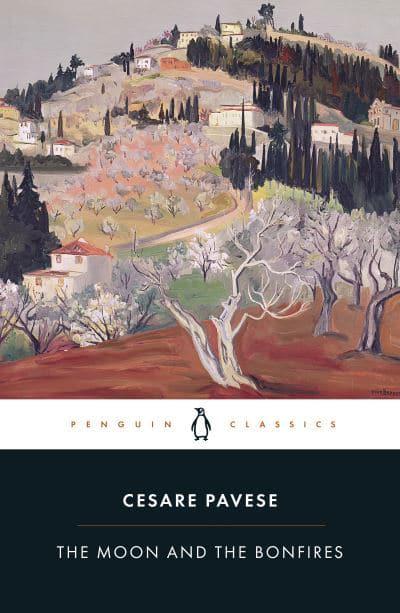
Review: The Moon and The Bonfire by Cesare Pavese

The Moon and The Bonfire [1949/68/2002] – ★★★★

“You can take the boy out of the country, but you can’t take the country out of the boy”, so a proverb states. The Moon and The Bonfire is a deeply personal final novel by Italian author Cesare Pavese in which he tells the story of Anguila, a successful businessman, who returns from California to his native country Italy after years and years of absence. Never knowing his real mother and father, Anguila grew up in a foster family in one Piedmontese village near river Belbo in the north of Italy. Abandoned from birth and poor, he had to endure a rough childhood that was only somewhat brightened by his friendship with an older boy Nuto and his fascination with the beautiful daughters of his later master. Now, after years of absence, Anguila decides to reconnect with the land he once called home because after all – “there is no place like home”, or is there? Poverty, war and moral degradation had all left their mark on the region that was once Anguila’s whole world and his detailed re-evaluation of the past, spent desires and dashed hopes leads to surprising conclusions.  

Continue reading “Review: The Moon and The Bonfire by Cesare Pavese”

Review: The Three-Cornered World by Natsume Sōseki

The Three-Cornered World [1906/65] – ★★★★1/2

Thank heaven for all those who, in devious ways by their art, bring tranquillity to the world, and enrich men’s hearts.

In this novel by Natsume Sōseki (1867 – 1916), a young painter travels the country in search of a source of true artistic inspiration, tying to be completely dispassionate about everything he sees. In his journey “to rise above emotions” and conquer his earthy desires he has the aim to reach the state of total objectivity so that his brush will be able to paint only the “truth” and “bare life”.

However, when he stops briefly at a guesthouse of one Shioda in a hot-spring village of Nakoi, he encounters there a woman who may put a stop to all of his pretences to be an unemotional observer and a mere spectator of life. O-Nami is a beautiful and enigmatic young woman who has recently escaped her impoverished husband and may have had an affair with a local Buddhist priest. Intrigued by this woman and engulfed in the sheer beauty of the nature around him, our narrator plunges deep into the very heart of the meaning of art, poetry and life itself. The Three-Cornered World is a gentle novel of deep insights with intimate meditations on life and art, its secrets and manifestations.

Continue reading “Review: The Three-Cornered World by Natsume Sōseki”

Recent American True Crime Non-Fiction Reads

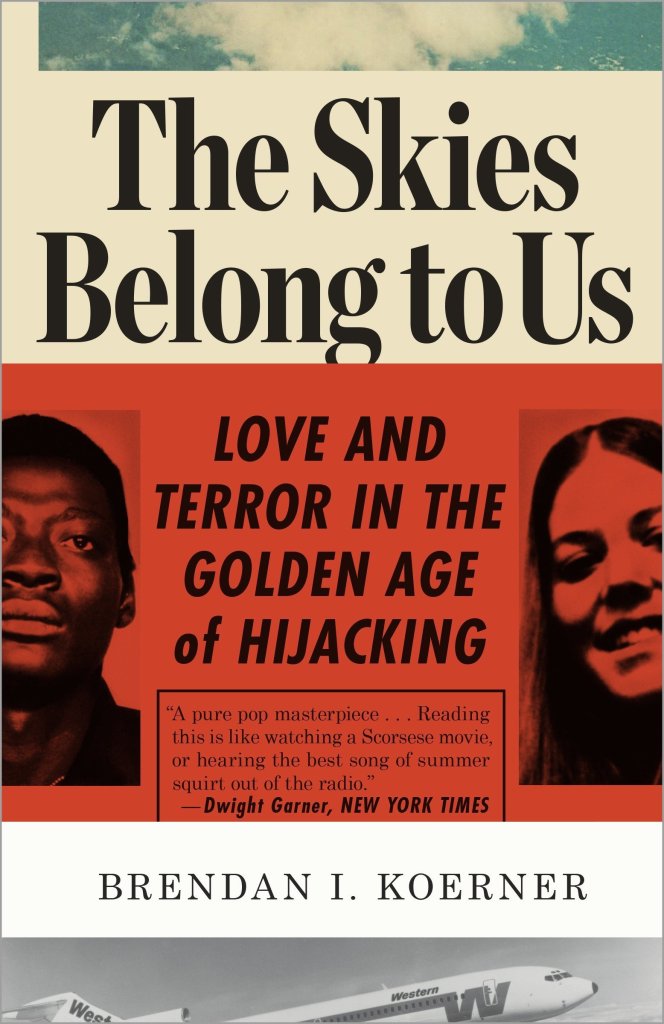
I. The Skies Belong to Us: Love and Terror in the Golden Age of Hijacking [2013] by Brendan I. Koerner – ★★★★

This book by journalist Brendan I. Koerner focuses on the “Golden Age of Aircraft Hijacking” and on a peculiar case of an airplane hijacking operation carried out by Vietnam veteran William Roger Holder and his girlfriend Cathy Kerkow in 1972. Before airport X-ray machines and the careful vetting of all passengers, Holder and Kerkow had accomplished a crime feat in the air of unbelievable proportions, later escaping to and from Algeria and much later even becoming “celebrities” in France, mingling with the elite. This book is not only a fascinating story of their case that often reads like an exciting thriller, but also a deep insight into the most unbelievable period in the American commercial aviation history when airplane hijacking was so common people thought of it as just “one of those annoying inconveniences of flying” similar to jet lag.

Continue reading “Recent American True Crime Non-Fiction Reads”

Review: Havoc by Tom Kristensen

Havoc [1930/68] – ★★★★1/2

With a razor-sharp prose, Kristensen paints a vivid picture of an ordinary man on a swift ride to hell.

Franz Kafka wrote: “a book must be the axe for the frozen sea within us.” If we take this definition of a book then Kristensen’s Havoc comes out on top. Havoc is now considered a classic of Danish literature and, accordingly to one author, “one of the best novels to ever come out of Scandinavia”. The main character here is Ole Jastrau, a thirty-something literary critic living with his wife and small child in Copenhagen, Denmark, a city that is going through some kind of a political upheaval. Disillusioned with his work and desperately searching for meaning in his day-to-day existence, Jastrau starts to slowly succumb to the rhetoric of his eccentric friends (Catholics, communists and poets) and also to the only thing that starts to make sense in his life – alcohol. Jastrau sees his apartment being taken over by others, his addiction to the popular Bar des Artistes growing daily and his faithfulness to the core moral principles of life crumbling before his eyes. Will there be a limit to Jastrau’s “fall” and humiliation? Can there be hope amidst all the boundless despair?

Continue reading “Review: Havoc by Tom Kristensen”

Review: The Magic Mountain by Thomas Mann

The Magic Mountain [1924/27] – ★★★★★

But mind, the mountain’s magic-mad tonight,
And if you choose a will-o’-the-wisp to light
Your path, take care, ’twill lead you all astray

(Goethe, Faust (tran. H. T. Lowe-Porter)).

Hans Castorp is a young man on a threshold of a very successful career of an engineer at a prestigious shipping firm in Germany when he enters an international sanatorium Berghof in the picturesque Swiss Alps for three weeks and only to support Joachim Ziemssen, his sick cousin, and keep him company. Little does Castorp suspect that the sanatorium, with its orderly routine and confused sense of time, will start working insidiously on his mind the moment he steps onto its premises and he will end up living there for the next 7 years. During that time, Castorp will make friends with the most extraordinary individuals, engage almost daily in deep philosophical discussions on virtually every topic under the sun, fall hopelessly in love, and in that whole process entangle his body, mind and spirit so deeply in this “enchanted” place with its own particular passage of Time that any disentanglement will become out of the question. In this story, matters of science and spirituality converge, forces of time sweep people off their feet and then the re-consideration of what is Life and what is Death, and what is to be healthy and what is to be sick, may lead to some divine insights and instances of ultimate self-discovery. Translated from the German, The Magic Mountain is a masterpiece of the world literature, a splendid study of a man undergoing inner transformations in an environment of perpetual unchangeability.

Continue reading “Review: The Magic Mountain by Thomas Mann”

Non-Fiction Reviews: “Making Movies”, “Gomorrah”, & “Pure Invention”

I. Making Movies [1995] by Sidney Lumet ★★★★

This book on movie-making is by American director Sidney Lumet (1924 – 2011) who was probably best known for directing a number of “legal” films including 12 Angry Men [1957], Murder on the Orient Express [1974] and The Verdict [1982]. It provides a deep insight into the “magical” process of making movies, from deciding whether to do a movie (Lumet almost always decided “instinctively”) to the final editing process and running previews. Lumet was a “trier” and a “doer”. He tells us in his book that he did not believe in waiting around for opportunities and liked to create his own luck. His eagerness to create chances reflected the sheer variety of films he directed. Cinematic success is hard to pin down, he states. That is also his first lesson to us: “nobody knows what that magic combination is that produces a first-rate piece of work” [Vintage, 1995: 9]. Even a great script or a great star-actor does not guarantee success.

Continue reading “Non-Fiction Reviews: “Making Movies”, “Gomorrah”, & “Pure Invention””

Review: The History of Chess in Fifty Moves by Bill Price

The History of Chess in Fifty Moves [2015] ★★★1/2

I got inspired to read this book because of the World Chess Championship 2021 currently held in Dubai where now the defending champion Magnus Carlsen of Norway is playing Ian Nepomniachtchi of Russia. This book by Bill Price traces the history of chess from its very likely origin in northern India circa 7th century to the game’s expansion in Muslim countries, and then to it making its way to the heart of the Christian community through Islamic ports. Chess was then a game played by the royalty and was seen as “an expression of social standing, rather than an intellectual pursuit” [Price, Apple Press 2015: 56]. Certain historical and other developments then led to it being played by a wide variety of people and the game spread rapidly across Europe, played in coffeehouses across the continent in the 17th century. Though this book is more on a superficial side, it is still an entertaining journey into chess, offering some curious insights into the game, for example, into the women’s chess and into the origin of certain chess terms, such as a gambit.

Continue reading “Review: The History of Chess in Fifty Moves by Bill Price”

Review: Shamans, Healers & Medicine Men by Holger Kalweit

Shamans, Healers, and Medicine Men [1987/92]★★★★★

A comprehensive, endlessly perceptive, & inspiring book on shamanism.

“Shamanism…is not a somehow obscure or incomprehensible or mysterious magical path, but a simple heightening of the emotional experience of the world; “the goal of the shamanic path of initiation is to broaden and deepen the normal emotionality that we all know” [Kalweit, Shambhala Publications, 1987/92: 219].

This book, translated from the German, is by Holger Kalweit, a German ethnologist and psychologist who studied shamans and shamanism in different corners of the world, including Hawaii, the American Southwest, Mexico and Tibet. With concrete examples drawn from the Ainu, Siberian, Yahgan and other shamanic traditions, Kalweit delves into the very heart of shamanism and explains detailly the nature of being a shaman, “a possessor of profound knowledge that cannot be grasped in words”. From shamanic training, testing and rituals inducing trance to shamanic healing powers, and duels and competitions, Kalweit touches on many topics and hardly stops there, elucidating further on such concepts as consciousness, reality, dreaming and on a variety of parapsychological phenomena, including “magic”, visions and near-death experience.

Continue reading “Review: Shamans, Healers & Medicine Men by Holger Kalweit”

Review: I Am Jonathan Scrivener by Claude Houghton

I Am Jonathan Scrivener [1930] ★★★★

London, the 1920s. James Wrexham is a lonely thirty-eight year old man just barely bearing his daily job and with no enviable prospects before him. A merely “spectator of life”, he has already resigned to just watch his life go by when he notices an advertisement in The Times. A certain wealthy gentleman, Jonathan Scrivener, seeks a personal secretary for himself and Wrexham applies on a whim. To his delight, he is accepted for an interview with one lawyer and soon given the position despite never having met the man. Scrivener is allegedly abroad and Wrexham starts his duties in his luxurious apartment on a very generous salary. If these circumstances were not odd enough already, a number of Scrivener’s supposed friends then come barging through the door and each has their own incredulous story to tell about Scrivener. Wrexham’s life turns upside down in a matter of weeks as he transforms from a lonely and desperate man to a social butterfly enjoying a life that only the very wealthy can afford. But, questions still remain – who is Jonathan Scrivener, a supposedly brilliant eccentric? Why is he hiding? What purpose may he have in hiring Wrexham? And why do Scrivener’s friends all give contradictory accounts about the man? I am Jonathan Scrivener is a deeply psychological mystery novel, “a hall of broken mirrors”-type of a book whose many elements need careful reassembling.

Continue reading “Review: I Am Jonathan Scrivener by Claude Houghton”

Novellas in November: Daisy Miller by Henry James

Cover of book Daisy Miller by Henry James

Daisy Miller [1879] ★★★1/2

Daisy…continued to present herself as an inscrutable combination of audacity and innocence [Henry James, 1879: 44]. In this story, young and wealthy American living abroad Frederick Winterbourne becomes infatuated with Daisy Miller, an unmarried American girl touring Europe with her mother and brother. Daisy Miller is a bold and flirtatious girl who continues to mystify Winterbourne daily since their fateful meeting in Switzerland. Now, in Rome, Italy, Winterbourne’s puzzlement turns into true incredulity and then horror as he watches Daisy’s interactions with one handsome Italian Giovanelli. But who is Daisy Miller, really, and how “common” she really is and how “innocent”, or not? Henry James (The Turn of the Screw [1898]) penned a novella which showcases the societal power of prejudice to the fullest, even if it also gives the feeling of being generic and predictable.

Continue reading “Novellas in November: Daisy Miller by Henry James”

Mini-Review: The Genius of Birds by Jennifer Ackerman 

The Genius of Birds [2016] – ★★★★

November is a “Non-Fiction” month, so I am trying to read more non-fiction books. Nature books are something I have been neglecting for some years now, so I have picked up Ackerman’s 2016 bestseller The Genius of Birds. Birds are some of the most remarkable animals on earth, but they have also been very misunderstood and it was only in the second half of the previous century that the scientific community had finally started realising their full complexity and intelligence. Now, in lists (for example, see list 1 and list 2) of the most intelligent animals in the world, birds (parrots, crows and pigeons) take their places alongside such animals as chimpanzees, gorillas, dolphins and octopuses. Some birds are capable of inventing new solutions to problems, making and using tools, leading active social lives, recognising themselves in a mirror, remembering people or places they have not seen in months or years, and reproducing up to sixty different songs which they have heard only a few times. Ackerman’s book explores the technical, inventive, musical, artistic, spatial and social abilities of birds, opening up a side of birds and their intelligence you never knew existed.

Continue reading “Mini-Review: The Genius of Birds by Jennifer Ackerman “

Review: Foucault’s Pendulum by Umberto Eco

Foucault’s Pendulum [1988/89] – ★★★★

“…the important thing is not the finding, it is the seeking, it is the devotion with which one spins the wheel of prayer and scripture, discovering the truth little by little” [Umberto Eco/William Weaver, Vintage Press: 1988/89: 33].

Continue reading “Review: Foucault’s Pendulum by Umberto Eco”

Review: Aquagenesis by Richard Ellis

Aquagenesis: The Origin and Evolution of Life in the Sea [2001] – ★★★★

May be on an academic side and now a bit dated, but the book is still a perceptive and engaging account of the mysteries that still surround the evolution of life in the sea.

That we live on land is, in the grander scheme of things, best regarded as an anomaly, or even an eccentricity – albeit with sound evolutionary justification. The story of life is, if we retain a true sense of proportion, a story of life at sea(Philip Ball).

After I read Monarchs of the Sea by Danna Staaf last year, I wanted to read a deeper work on this topic and chose Aguagenesis by marine biologist Richard Ellis. The author aims to demonstrate how life originated in water some 3.9 billion years ago, what species evolved first in water and why, what species followed them and how evolution changed courses multiple times with various animals choosing to dwell on land next and then returning to waters. Richard Ellis starts his book by discussing the origin of water itself and a 2 inch-long shrimp-like creature without eyes capable of subsisting on hydrogen sulphide alone, which is poisonous to most living creatures, before talking about more complex and diverse marine life that roamed the oceans in the final stages of the Cretaceous period, some 65 million years ago. “More than 99% of all the species that have ever lived on Earth are [now] extinct” [Ellis, 2001: 22], says the author, and that makes that extinct life even more fascinating, especially in what it can tell us about the diversity of life and our own, human, origin.

Continue reading “Review: Aquagenesis by Richard Ellis”

Review: The Erasers by Alain Robbe-Grillet

Continue reading “Review: The Erasers by Alain Robbe-Grillet”

Mini-Review: The Tartar Steppe by Dino Buzzati

The Tartar Steppe [1940/2018] – ★★★★1/2

First published in 1940 and translated from the Italian by Stuart Hood, this novel is about young and idealistic Giovanni Drogo, a newly appointed Officer to Fort Bastiani, an obscure mountainous place near the country’s frontier. Drogo is excited about his first posting and hurries to his destination eagerly wanting to put to the test his soldiery skills, valour and discipline, as well as begin his new life. However, what awaits him is the unexpected: “the desolate steppe…which had mystery, but no meaning”, where “people [have] no knowledge of time” and where “everything [speaks] of renunciation” [Buzzati/Hood, 1945/1973: 22, 72, 82]. Fort Bastiani is a place in the middle of nowhere where no enemy has been seen since the time immemorial. Drogo soon feels rebellious, then depressed and lonely, and is finally completely enchanted by nothingness.

The Tartar Steppe is a masterful and subtle work which echoes the best work of Franz Kafka. It is a story about the traps that time lays to a man, about dashed hopes and missed life opportunities, and is a profound meditation on prisons that reside in the recesses of our own minds, in our beloved habits and dear ideals which we can never seem to cast aside no matter how nonsensical they may start to appear.

Continue reading “Mini-Review: The Tartar Steppe by Dino Buzzati”

Non-Fiction Reviews: “Five Points”, “When Brains Dream”, & “Year of Wonder”

Five Points: The Nineteenth-Century New York City Neighborhood That Invented Tap Dance, Stole Elections and Became the World’s Most Notorious Slum [2002] by Tyler Anbinder ★★★★

I love reading about the history of New York City, for example see my review of Mark Kurlanskys The Big Oyster: A Molluscular History of New York [2006]. In Five Points, Tyler Anbinder focuses his attention on once the most notorious area in New York – the infamous Five Points, once a densely-populated, poverty, crime, riots and disease-ridden area. The area, which was once a green place with a lake called “The Collect Pond”, became by the end of the eighteenth century “a putrid nuisance” (due to local industries’ contamination) [Anbinder, 2002: 14] and, later, a place to be feared and ruled by criminal gangs. However, what became a place of danger for some, also turned into a place of fun and unthought-of opportunities for others. This non-fiction book is a very detailed account of the history of Five Points in the nineteenth century. Through documents, contemporaries’ accounts (each chapter starts with a “personal story” prologue), maps, graphs and old photographers, the author shows how Five Points gained such a vile reputation around the world and what made it so different from other New York neighbourhoods.

Continue reading “Non-Fiction Reviews: “Five Points”, “When Brains Dream”, & “Year of Wonder””

Review: The Japanese: A History in Twenty Lives by Christopher Harding

In this new book, Dr Harding traces the history of Japan through the lives of twenty remarkable people that helped to shape the country, making a powerful impact on either its politics, business, religion, science, culture or just society at large, and – more often than not – against all odds and in very challenging times. From heroic personalities from mythology and ancient politics to people who changed business, music or literary scene, the author introduces each extraordinary individual in turn, focusing on their childhood, on Japan of their time and on their contribution to the country, with the result being that Japan finally became what it is now – a culturally rich country full of so many paradoxes, intricacies and hidden treasures that a lifetime will not be sufficient to know and understand them all. In this book, we get to know royalties, warlords, samurai, Buddhist monks, politicians, businessmen, scientists, poets, singers, revolutionists and Manga creators. Dr Harding’s book is a history of Japan in a bright new form that is a pure pleasure to read.

Continue reading “Review: The Japanese: A History in Twenty Lives by Christopher Harding”

Hiroshima & Nagasaki – The Truth

Hiroshima Nagasaki [2011] – ★★★★★

An eye for an eye leaves the whole world blind.” M. K. Gandhi (attributed)

The Japanese collectively were to blame…Truman drew no distinction between civilian and soldier; mother and murderer; child and monster”; “America [sic] annihilated 100.000 persons, most of them civilians, at Hiroshima…and then…,in spite of the “universal horror”, repeated the performance at Nagasaki” [Paul Ham quoting, 2011: 420, 422].

Paul Ham is an Australian author and correspondent, who in his non-fiction Hiroshima Nagasaki presents a true account of what happened to the two Japanese cities in 1945, dispelling myths that still persist about the Hiroshima and Nagasaki bombings, including that the bombs were somehow “necessary”, or that their usage led to Japan’s surrender. Starting in winter 1945, when “Roosevelt and Churchill arrived bound by a private agreement…not to share with the Soviet Union…the development of an extraordinary new weapon” [Ham, 2011: 15], continuing to the secret development of the world’s first atomic bomb, and ending with the aftermath of the tragedy, the author goes into incredible depth about what happened in the final year of the war, demonstrating the situation through statistics, broader situation invoking key actors and through personal accounts. The result is a well-researched book about one of the most unbelievable and traumatic events in the world history. Since the scope of the book and the topic is so broad, I have decided to structure my review in the following manner: (i) Events leading up to the atomic bombings; (ii) Four myths and four corresponding realities; (iii) Immediate aftermath; and (iv) Long-term consequences.

Continue reading “Hiroshima & Nagasaki – The Truth”

Review: Clyde Fans by Seth

A deeply-felt work about human memories, making sense of the past and the anguish of passing years and lost hopes, a tribute to one once-commercially successful and ambitious little world that is no more.

Seth (real name Gregory Gallant) is a Canadian cartoonist whose artistic style is said to remind of The New Yorker cartoons of the 1930s-40s. Inspired by a real business that was once in operation in Toronto, his graphic novel Clyde Fans follows a non-linear plot and two very different brothers (extraverted Abe and introverted Simon), whose father left them his business selling electric fans. The pair responds differently to the changing business environment, social demands and times and, in this story, we trace their lives through the life of a company that came to define them and their family, following them through their hopes and dreams, initial successes, bankruptcies, family tragedies and growing desperation fuelled by years of buried pride and reluctance to welcome the future. This reflective picture novel takes a very close look at nostalgia and asks whether there is something precious being lost every time we decide to walk with the changing times, or ahead of them. From the wisdom of the old age to “commercial” loneliness and misunderstandings faced in one’s youth, the novel asks – what is “success”, and what is “failure” in life? What is the nature of time and what it means to finally come to grips with its passage? How time changes us, or does not?

Continue reading “Review: Clyde Fans by Seth”

Review: A People’s History of Tennis by David Berry

A People’s History of Tennis [2020] – ★★★★1/2

Berry’s book is a fun, eye-opening and frank account of the history of tennis that puts real people front and centre.

Lawn tennis was different. It was played “as much with the head as the hand” and it encouraged playfulness and enjoyment of performance” [David Berry, Pluto Press, 2020: 23].

This new non-fiction book is about the history of “lawn tennis”, as viewed through the prism of class and gender politics. Rather than being just a sport for the privileged and well-off, David Berry argues that tennis has also historically provided important battlegrounds for “freedom” movements, for the rights of women, immigrants, black people and people from the working class segment of the population. Referring to the sport’s “amateur” beginnings and explaining the business side of the game, Berry talks about tennis between the wars, about the history of tennis clubs, as well as details the rise of first tennis stars that helped to transform tennis from an amusing hobby played on the British Isles to a global phenomenon and industry worth millions of pounds. Often referring to Wimbledon, the oldest and most prestigious tennis tournament in the world, Berry demonstrates with a great narrative flair the constant battle to shed away the “exclusivity” of tennis, a sport which remains one of the few in the world that, from its very origin in the nineteenth century, was designed to be played by both men and women.

Continue reading “Review: A People’s History of Tennis by David Berry”

Review: A Lost Lady by Willa Cather

A Lost Lady [1923] – ★★★★1/2

A charming novel with a deceptively simple, beautifully-written story that reveals so very slowly & elegantly its moving & provoking character study.

Her eyes, when they laughed for a moment into one’s own, seemed to promise a wild delight that he had not found in life. “I know where it is”, they seemed to say, “I could show you!“….She had always the power of suggesting things lovelier than herself, as the perfume of a single flower may call up the whole sweetness of spring” [Willa Cather, 1923: 136, 137].

Continue reading “Review: A Lost Lady by Willa Cather”

Review: The Employees: A Workplace Novel of the 22nd Century by Olga Ravn

The Employees [2018/20] – ★★★★

You know the name you were given, you do not know the name that you have.Jose Saramago

This book, which was shortlisted for the International Booker Prize 2021, focuses on our distant dystopian future and on the Six-Thousand Ship, a space vessel on an exploration mission into space. When the crew stops to explore a previously unknown planet named New Discovery, they take certain live “objects” on board with them. Little the crew suspects that these objects will have a powerful, unforeseen effect on each member of the personnel onboard, and that means on both humans and humanoid robots. Composed entirely of (increasingly disturbing) statements given by the employees on the Six-Thousand Ship, The Employees by Danish author Olga Ravn may have a rather “boring” title, but this book is anything but that. Probably influenced in some way by both Lem’s sci-fi Solaris [1961] and the fiction of Philip K. Dick, The Employees offers a visceral, uncanny reading experience.

Continue reading “Review: The Employees: A Workplace Novel of the 22nd Century by Olga Ravn”

Review: The Baron in the Trees by Italo Calvino

Continue reading “Review: The Baron in the Trees by Italo Calvino”

Review: The Minds of Billy Milligan by Daniel Keyes

The Minds of Billy Milligan [1981/2018] – ★★★★1/2

This non-fiction book comes from Daniel Keyes, the writer of classic sci-fi Flowers for Algernon [1959]. The Minds of Billy Milligan tells the amazing story of Billy Milligan, the first man in the US history to successfully plead the insanity defence in court based on his proven multiple personality disorder and, therefore, be held not responsible for his major crimes (three counts of robbery and rape). Billy Milligan had twenty-four personalities (or “people”) living inside him, competing for spotlight (or consciousness) at any one time, and some of them developed when he was a toddler and suffering from trauma. This is no fiction as numerous eminent psychiatrists who observed Milligan for years testified repeatedly to his condition and the chances that Milligan could have somehow faked all twenty-four personalities over so many years are close to zero. This is because his personalities were truly different people, observed to have different body temperatures, hand-writing, accents, vocabulary, speech patterns, mannerism, IQ, skills, knowledge, experience and even brain waves. Daniel Keyes traces Milligan’s case, beginning from his arrest and childhood and culminating with Milligan being dragged from one hospital to another, battling public prejudice. This is a mind-blowing account of the most remarkable case of a disorder that lies at the very heart of uncovering the mystery of the human mind and consciousness.

Continue reading “Review: The Minds of Billy Milligan by Daniel Keyes”

Review: The Bilingual Brain by Albert Costa

Continue reading “Review: The Bilingual Brain by Albert Costa”

Review: Beethoven: A Life in Nine Pieces by Laura Tunbridge

Beethoven: A Life in Nine Pieces [2020] – ★★★★★

Through just nine musical pieces, Laura Tunbridge places Beethoven in one particular time and place in her well-researched book, presenting an intimate and detailed image of the great composer.

Did you know that one music piece (a Septet) that made Beethoven’s name in the nineteenth century is hardly ever played today, or that later pieces by Beethoven that are now known to everyone were considered in the composer’s time too complex and brazen to merit any attention? Beethoven’s elusive “Immortal Beloved” is still without identity, and his attempts at self-promotion were not always successful. Rather than Beethoven being an isolated genius making music masterpieces on his own, Laura Tunbridge talks in her book of Beethoven as a gifted person who was very much depended on others (such as on his friends and patrons), on the particular time, norms and politics, as well as on the musical tradition in which he lived. The author demonstrates how Vienna and Beethoven’s own personal life affected his music, and how changing perceptions, as well as tastes of nobility, ultimately shaped and dictated the man and his music that is now admired by millions.

Continue reading “Review: Beethoven: A Life in Nine Pieces by Laura Tunbridge”

Review: Mad in America by Robert Whitaker

Mad in America: Bad Science, Bad Medicine and the Enduring Mistreatment of the Mentally Ill [2002] ★★★★1/2

Robert Whitaker opens his book with this quote by David Cohen: “We are still mad about the mad. We still don’t understand them and that lack of understanding makes us mean and arrogant, and makes us mislead ourselves, and so we hurt them”. His book is an engaging overview of the methods to treat mentally ill patients through centuries (starting in the pre-1750s period and continuing to the present day), and how changes in societal attitudes and perceptions, as well as in psychiatry politics and business considerations impacted the treatment. “Scientific” and “therapeutic” approaches to treating mentally ill had competed with each other for centuries, and Whitaker shows how politics of this or that time period ultimately dictated what mentally ill patients were supposed “to need”, with mentally ill people often caught in a trap of doctors and businesses’ ambitions to make a mark in science or earn money respectively.

Continue reading “Review: Mad in America by Robert Whitaker”

Review: Letter from an Unknown Woman by Stefan Zweig

The opposite of love is not hatred, it’s indifference. This novella by an Austrian author, which was adapted into a major film of 1948 directed by Max Ophüls and starring Joan Fontaine and Louis Jourdan, tells the story of a man who receives a strange letter one morning penned by one unknown-to-him woman. What this woman tells him is something much more than a mere confession. It is a soul-searching, gut-wrenching effort at personal liberation, a last cry to be finally understood in life and one fearful culmination of a life lived with one endless hope, a fruitless succession of attempts at happiness and one final tragic resignation. R. is a handsome man and a celebrated novelist who always had a lot of affection from women. The unknown woman is a dreamy and impressionable person from a much more modest family. What ties them together? From his point of view: three, very brief life episodes which can be counted by mere hours and which he forgot the moment they happened. From her point of view: absolutely everything, including three most important moments in her life, her whole world-view and the very point of her existence. Stefan Zweig wrote a powerful, sincere and moving account of one unrequited love and close examination of a person on the very fringes of another person’s life always looking in, hoping in vain to become a full-time participant.

Continue reading “Review: Letter from an Unknown Woman by Stefan Zweig”

Mini-Review: Tuesday Nights in 1980 by Molly Prentiss

Tuesday Nights in 1980 [2016] – ★★★★

I would like to thank Cathy at 746books for recommending this book to me after I compiled list 7 Great Novels Revolving Around Visual Art. Tuesday Nights in 1980 presents New York City’s art scene of 1980. At the centre are three people whose destinies collide in the background of creative bohemia filled with liberties of all kinds, boundless artistic inspiration and ambition, and spurs of unusual creativity: James Bennett is a misunderstood person and a renowned art critic who has synaesthesia, a condition which means that he experiences ideas, people and objects as colours or a combination of colours; Raul Engales is a “free spirit” and up-and-coming Argentinean artist who left behind in his country one past better not recalled; and Lucy Olliason is a girl from Idaho who has just recently arrived to NYC and is open to everything and anything. Evocatively, even if exaggeratedly, Molly Prentiss captures in her story the thrill of being young and artistic in NYC, which itself starts to undergo many changes. Amidst obsessive art-making and pleasures of falling in love, there are also a transitory nature of success, creative doubts and personal tragedies.

Continue reading “Mini-Review: Tuesday Nights in 1980 by Molly Prentiss”

Review: Fires on the Plain by Shōhei Ōoka

Winner of the prestigious Yomiuri Prize, Fires on the Plain details the experience of a Japanese soldier in the Philippines during the last months of the World War II (the Leyte island landing). This sometimes gruesome and traumatic, but vividly introspective and unputdowanable novel full of conviction is filled with psychological and philosophical insights. Drawing from his own experience of the WWII, Shōhei Ōoka wrote about the degradation, futility and meaninglessness of war through the experience of one injured and stranded soldier who gets suspended between complete despair, increasing apathy and little choice, but to commit war crimes, on the one hand, and glimpses of hope and religious visions, on the other. Plagued by contradictions and irrational thoughts, Private Tamura finds himself psychologically distancing from war horrors around him, as Ōoka makes a powerful statement on one situation where such concepts as morality or rationality no longer seem to have any meaning.

Continue reading “Review: Fires on the Plain by Shōhei Ōoka”

Review: Klara and the Sun by Kazuo Ishiguro

In Kazuo Ishiguro’s new book, Klara is an AF (Artificial Friend) or a highly advanced girl-robot created to be a companion for a child. Together with another AF Rosa, Klara spends her time shifting positions inside the store in a hope that some child will eventually choose her and she will fulfil her destiny. Relying on and worshipping the Sun, Klara never misses an opportunity to catch its rays: “…the big thing, silently understood by us all, was the Sun and his nourishment” [Ishiguro, 2021: 5]. She is both puzzled by and interested in humans. Then comes Josie, a kind, but sick child. As Klara enters Josie’s world, she gets to know more about humans and life, including its sorrows and unpredictability.

Klara and the Sun is Toy Story (together with the toy’s existential crisis) meets Never Let Me Go by way of one robot’s obsession with the Sun. It is a bitter-sweet and curious book with one fascinating narrator and a theme of hope. However, it also has a very “thin” story with vague world-building, severely under-explored themes, and characters and topics “recycled” from the author’s Never Let Me Go. A torrent of never-ending and sometimes pointless dialogues in the story does little service to Ishiguro, an author who is capable of far greater depth, nuance, subtlety, emotion, evocativeness and intelligence, than he delivered in this latest trendy, crowd-pleasing, YA-like book.

Continue reading “Review: Klara and the Sun by Kazuo Ishiguro”

Review: Property by Valerie Martin

Property [2003] – ★★★★

Louisiana, 1828. Manon Gaudet, the wife of a domineering owner of a sugar plantation, tells us about her life, at times recalling her past. Her husband rules the house and the plantation with an iron fist, signalling slave girl Sarah as his lover. However, their stable life is soon repeatedly threatened by slaves’ rebellions in their region, making both re-evaluate their life positions. Although the novel is uneven and the narrator is made intentionally unlikeable, Valerie Martin still wrote a chilling, eye-opening and interesting account of slavery and the meaning of ownership in the mid-nineteenth century US, not least because of her particular focus on the perspective of a slave-owner.

Continue reading “Review: Property by Valerie Martin”

Review: Death Comes for the Archbishop by Willa Cather

Death Comes for the Archbishop [1927] – ★★★★

This novel, which spans from 1848 to 1888, focuses on Jean Marie Latour, a young Frenchman recently appointed as Vicar Apostolic in the state of New Mexico, a part of land which has only recently been annexed to the US. The Father becomes a new Bishop in the region and he came there with his loyal friend and compatriot Father Joseph Vaillant. The two priests face a whole array of problems in establishing a religious jurisdiction in the new area, from the region’s isolation and merciless climate to authority challenges on the part of Mexican priests. This historical novel can be called a “descriptive tour de force”, rather than a straightforward narrative story. It is more of an anthropological/historical travelogue, focusing on the nature of land and on the people living on it, rather than a linear story. However, this does not make this book a “lesser” novel. On the contrary, Cather leaves plenty of space in the book for colourful descriptions of exotic environs, paying attention to the particular themes, including the ardour of religious duty and the dilemmas of missionary work.

Continue reading “Review: Death Comes for the Archbishop by Willa Cather”

History Non-Fiction: “Genghis Khan”, & “Rubicon”

Genghis Khan and the Making of the Modern World [2004] by Jack Weatherford – ★★★★

They can do all because they think they can“. Virgil

“Attack him where he is unprepared, appear where you are not expected. The supreme art of war is to subdue the enemy without fighting”. Sun Tzu 

Based on the ancient account The Secret History of the Mongols (dating c. 1227), this book tells of the life of Genghis Khan, his first foreign campaigns and his later conquests of other countries. Although dramatised and sometimes not entirely objective, the book is a very engaging, endlessly fascinating and perceptive account of the world’s most successful invaders. It demonstrates all the reasons for Genghis Khan’s unprecedented success in conquest since, historically, the Mongol army was the one to whom fell numerous countries and millions of people kneeled, as the army started to dominate virtually two continents, including the majority of China, India, Russia, Persia, Eastern Europe, the Middle East and the South-East Asia.

Continue reading “History Non-Fiction: “Genghis Khan”, & “Rubicon””

Review: A History of the Universe in 21 Stars (and 3 Imposters) by Giles Sparrow

A History of the Universe in 21 Stars [2020] – ★★★1/2

In this new non-fiction book, the author explains key scientific discoveries through stars: from Polaris and the calculation of sky angles/directions and the discovery of Mizar’s double nature and what it ultimately said about star systems, to the mysteries of sunspots and the discovery of the existence of black holes through the exploration of Cygnus X-1. Although A History of the Universe does engage in a lot of confused “cherry-picking” of scientific facts and discoveries, and the language does get quite annoying, the book can still be described as a pure “starry” wonder and a good read for all those interested in stars and key scientific discoveries related to them.

Continue reading “Review: A History of the Universe in 21 Stars (and 3 Imposters) by Giles Sparrow”

Review: The House of Mirth by Edith Wharton

Continue reading “Review: The House of Mirth by Edith Wharton”

Review: The Woodlanders by Thomas Hardy

In this novel, Grace, an impressionable, recently-educated girl, “who has been around cultivated folks” arrives home to a small village of Little Hintock after a long absence and to the delight of her father Mr Melbury, a timber merchant. She soon rekindles her friendship with her childhood sweet-heart Giles Winterborne, an apple and cider farmer. However, as soon as she does so, she also notices a much more promising suitor who starts to intrigue her more than anyone else in this world: an educated, ambitious and “irresistible” doctor Edred Fitzpiers.

Thomas Hardy’s narrative is like an exquisite painting created in the style of Old Masters, where money, ambition, sophistication, self-interest and the excess of knowledge clash violently with rural simplicity, kindness, loyalty and naïve mentality. The beauty/mastery of the prose is matched by the gripping plot full of vivid characters and psychological nuances. Emphasising the unbridgeable gap between the social classes and drawing attention to the iron confines of a marriage, while evoking the atmosphere of the old rural England, Hardy created with The Woodlanders the work that is on a par with some of his greatest literary creations – Tess of the d’Urbervilles [1891] and Far from the Madding Crowd [1874].

Continue reading “Review: The Woodlanders by Thomas Hardy”

Review: Monarchs of the Sea by Danna Staaf

This book is about the magnificent, enigmatic and elusive cephalopods (a class of molluscs to which octopuses and squid belong), their origin and 500-million-year history. Danna Staaf, a marine biologist, traces their evolution from the very origins of life on Earth in the sea, to the demise of some cephalopods in the Cretaceous period and our modern age. From the causes of the “Great Dying” that happened in the Permian period (when up to ninety-six percent of all marine species perished) to our present day threat of global warming and dangers that face nautiluses, Dr Staaf explains clearly the many issues that concern cephalopods, as well as introduces a whole variety of weird and fascinating sea creatures: from the first sponges and worms, to now extinct ammonoids and a variety of curious present-day octopuses and squid (for example, the pygmy squid and the mimic octopus). This well-illustrated book, which is written with surprising humour and succinctness, will completely delight all those who are interested in marine evolution and curious about the history of present-day cephalopods.

Continue reading “Review: Monarchs of the Sea by Danna Staaf”

Mini-Review: The Thousand Autumns of Jacob de Zoet by David Mitchell

The Thousand Autumns of Jacob de Zoet [2010] – ★★1/2

In this tale by David Mitchell (Cloud Atlas (2004)) the year is 1799, and Jacob de Zoet, a Dutch clerk, arrives with the Dutch East India Company to the trading post of Dejima, an artificial island in Nagasaki, Japan at the time of the sakoku, when Japan permitted only very limited contact with foreigners. Engaged to be married, de Zoet seeks a fortune and a high position to impress the family of his fiancée in Europe. However, “inadvertently”, he falls under the spell of one disfigured midwife Miss Aibagawa, who, in turn, aspires to knowledge and then freedom. In times of all kinds of persecutions and discriminatory policies, de Zoet has to navigate a very uneasy road in the foreign country through cultural differences and alleged conspiracies.

Continue reading “Mini-Review: The Thousand Autumns of Jacob de Zoet by David Mitchell”

Review: The Scapegoat by Daphne du Maurier

Continue reading “Review: The Scapegoat by Daphne du Maurier”

Review: A Distant Mirror: The Calamitous 14th Century by Barbara W. Tuchman

A Distant Mirror: The Calamitous 14th Century [1978] ★★★★★

Continue reading “Review: A Distant Mirror: The Calamitous 14th Century by Barbara W. Tuchman”

Review: The Roots of Heaven by Romain Gary

The Roots of Heaven [1956] – ★★★★1/2

Through Romain Gary’s dense narrative and second-hand accounts, we can still piece together a powerful story about the resilience of human spirit and the power of an unshakeable belief.

The Roots of Heaven, winner of the prestigious Prix Goncourt, is set deep in the wilderness of Africa just after the WWII when the complex geopolitical situation meant the world on the brink of explosion from the collusion of different interests, values and opinions. In this world, amidst all the criticisms levelled at colonialism, cries for African independence and still fresh horrors of the Nazi regime, there emerges a candle of “hope” in the form of one idealistic Frenchman named Morel, whose passion for the protection of elephants soon reaches mythical proportions in the region around Chad.

The hero soon gathers around the most unlikely champions to ban the slaughter of elephants, including Minna, a woman who suffered much during the Fall of Berlin, and Forsythe, an American who was dishonourably discharged from the army. Morel, equipped only with the belief that his cause will attract public sympathy, faces a lot of adversaries, such as reality itself, as well as numerous people who hunt elephants for business, pleasure and trophies. However, because of our protagonist’s parade of eccentricities and naïve outlooks, he is soon converted into a symbol of dignity and liberation, even if his enemies are already closing in on his noble campaign and it is far from certain what will be the real consequences of his increasingly drastic actions.

Continue reading “Review: The Roots of Heaven by Romain Gary”

Review: Piranesi by Susanna Clarke

Piranesi is a new fantasy novel by the author of Jonathan Strange & Mr Norrell [2004]. This time, we have a diary-like narrative and our narrator observes, records and catalogues a curious World around him – the House. In the House, architectural splendours meet natural wonders – sea Tides, bringing marine life and vegetation, often flood the seemingly infinite number of opulent Halls, where numerous enigmatic statues of all sizes daze and confuse. Our narrator’s only human contact is the man only known as the Other, who also often frequents the Halls and who sees the World very differently from our narrator. Then, cryptic messages start to appear in some Halls, and our narrator witnesses strange visions. What other mysteries does the House hold, and is there really a Sixteenth Person who may be residing in the Far-Distant Halls? These are the questions that start to bother our narrator as he is slowly forced to question the very nature of his existence in this bewildering World of Tides and Architectural Beauty.

In Piranesi, Susanna Clarke invented one mysterious, otherworldly place whose pull is irresistible, powerful and inescapable, and whose charm works like magic, saturating the reading experience with endless wonder, delight and fascination. Amidst all the watery and architectural beauty, though, there is a want for slightly more meaning and depth, and it is unfortunate that the second part of the book falls into some very familiar and overused literary “thriller” tropes.

Continue reading “Review: Piranesi by Susanna Clarke”

Review: A is For Arsenic: The Poisons of Agatha Christie by Kathryn Harkup

This image has an empty alt attribute; its file name is harkup-book-cover.jpg

15 September 2020 marks 130 years since the birth of Agatha Christie in 1890, and this review is meant to pay tribute to the ultimate Queen of Crime. The author of A is For Arsenic is Kathryn Harkup, a chemist by profession, who decided to plunge into all the poisons that Christie used in her books to come up with her perfect crimes. In A is For Arsenic, we first read about the scientific properties of each of the poisons used by Christie in her fiction, from arsenic and belladonna to opium and phosphorus (including their histories and the ways they kill), before the author illuminates the real cases involving these poisons, and finally talks about the fictitious cases in Agatha Christie’s books. It is clear that reading about different poisons has never been as morbidly fun or interesting as with this book since Harkup is an intelligent and succinct writer with a great sense of humour. A is For Arsenic is sure to fascinate and delight this Halloween season.

Continue reading “Review: A is For Arsenic: The Poisons of Agatha Christie by Kathryn Harkup”

Review: 1Q84 by Haruki Murakami

This is going to be a very honest review of Haruki Murakami’s twelfth novel. 1Q84 is presented as a whimsical romance epic with elements of magical realism, and, in its proportion, has been linked to such extremely ambitious works as Roberto Bolano’s 2666 and Don DeLillo’s Underworld. In 1Q84, the year is 1984 and the location is Tokyo, Japan. Aomame, a thirty year old woman, becomes entangled in one strange affair involving a manuscript titled Air Chrysalis, a charity that seeks to help battered women seek revenge, and a menacing and unrelenting religious cult called Sakigake. In parallel to her story, we read the story of Tengo, a thirty year old man and Aomame’s alleged lost “love” whom she has not seen in twenty years. Tengo inexplicably gets implicated in the same affair of “another world” when he agrees to re-write Air Chrysalis. His fateful encounter with beautiful Fuka-Eri, original author of Air Chrysalis, soon makes him question his reality, as well as makes him reconsider his relationship with his estranged father. Soon, we read about the world where the so-called Little People have the upper hand and where there are two moons in the sky. Pursued by dangerous forces, will Tengo and Aomame ever meet again?

Continue reading “Review: 1Q84 by Haruki Murakami”