

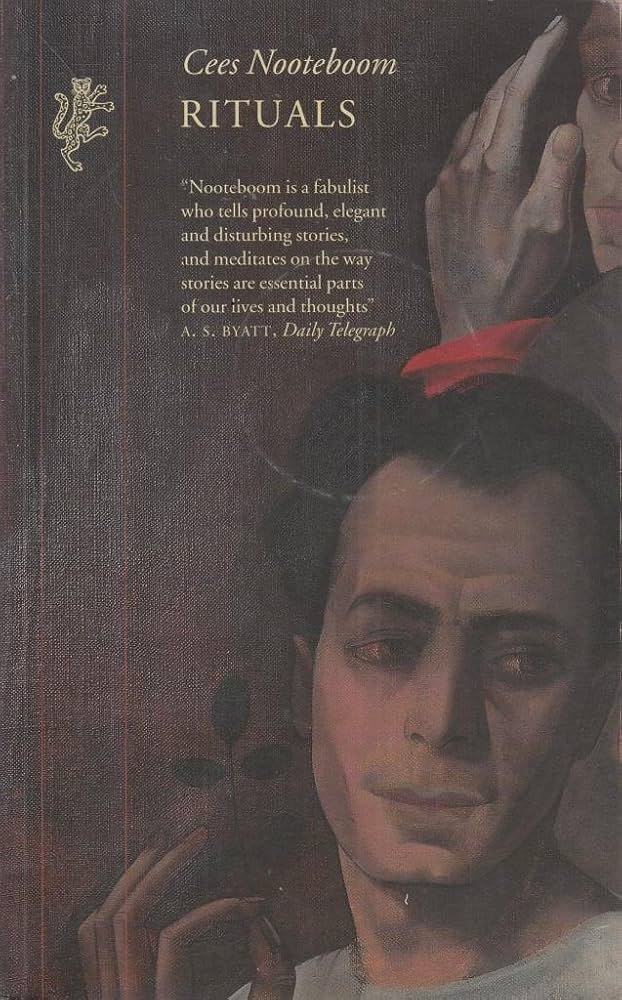
Rituals [1980/92] – ★★★★
“He regarded life as a rather odd club of which he had accidentally become a member and from which one could be expelled without reasons having to be supplied”(Cees Nooteboom, translated from the Dutch by Adrienne Dixon [1980/92]).
This novel centres on a man who drifts through life aimlessly as though in a haze, writing horoscopes and dealing in art for a living, albeit possessing money. Preoccupied with control, or rather the lack of it, Inni Wintrop lets events in his life happen to him, rather than actively trying to change something, while his guiding forces in life inexplicably become two very strange men – apathetic recluse Arnold Taads, and his son, distant and mysterious Philip Taads. Intensely philosophical, witty and sharp, the novel illuminates life as seen through our routines, mirages, actions, inactions and the influence of others.
Nooteboom’s narrative disarms instantly. “On the day that Inni Wintrop committed suicide, Philips shares stood at 149.60. The Amsterdam Bank closing rate was 375, and Shipping Union had slipped to 141.50”. We first find Wintrop in Amsterdam in 1963. He is a man “who doesn’t live, but allows himself to be distracted”. Ambitionless and pleasure-seeking, he shares his life with one frustrated woman Zita. They lead a life of the leisurely boredom of the bourgeoisie, drowning in lethargy, until life knocks on their door. The couple’s infidelities lead to the relationship crumbling, and we are transported to the year 1953, seeing Wintrop’s world-view taking shape under the guidance of his distant aunt and his one-off (“sexual re-awakening”) relationship with girl Petra. Is the meaning of life to be found in some fleeting moments of intimacy, memory scraps of the past, chance encounters or in the interactions with people so unlike oneself that they turn your whole world-view upside down? For a man who writes horoscopes (concerned with predetermination and fate) for magazines, Wintrop left too much to chance in his life. “It was, on the contrary, the very mystery of everything that was so attractive. You should not want to impose too much order on it. If you did, something would be lost irrevocably.”
It is through his aunt that Wintrop meets enigmatic man Arnold Taads. His interest in the man and his philosophy lasts a lifetime. Taads’ hours are numbered and allocated with precision. Each minute is supposed to be taken by a particular activity, and this obsession with order as opposed to chaos is what Wintrop finds fascinating. “The orderliness that reigned in the room was frightening. The only form of accident was the dog, because he moved.” In the last part of the book the year is 1973, and Wintrop is undergoing a midlife crisis as he hits 40. Arnold Taads’ son Philip comes to the picture and he is as eccentric as his late father was, preferring total seclusion as part of his attempt to achieve “deliverance”. Wintrop’s cycle of wonder continues, and he starts to view life as though “he had a first-class seat in the auditorium, and the play was by turns horrific, lyrical, comic, tender, cruel, and obscene.” Existential crisis awakens in every other sentence as the protagonist also grapples with faith.
The first half of the book is more exciting than the second half ultimately delivers, but this is still a lucid, elegant and darkly humorous novel. There is this Nietzschean apathy running through the story giving it a complex finish, an edge and a sense of achieving a lot in just a few pages at a time. This is an unusual novel about navigating life tribulations and confronting the chaos that is life.

