

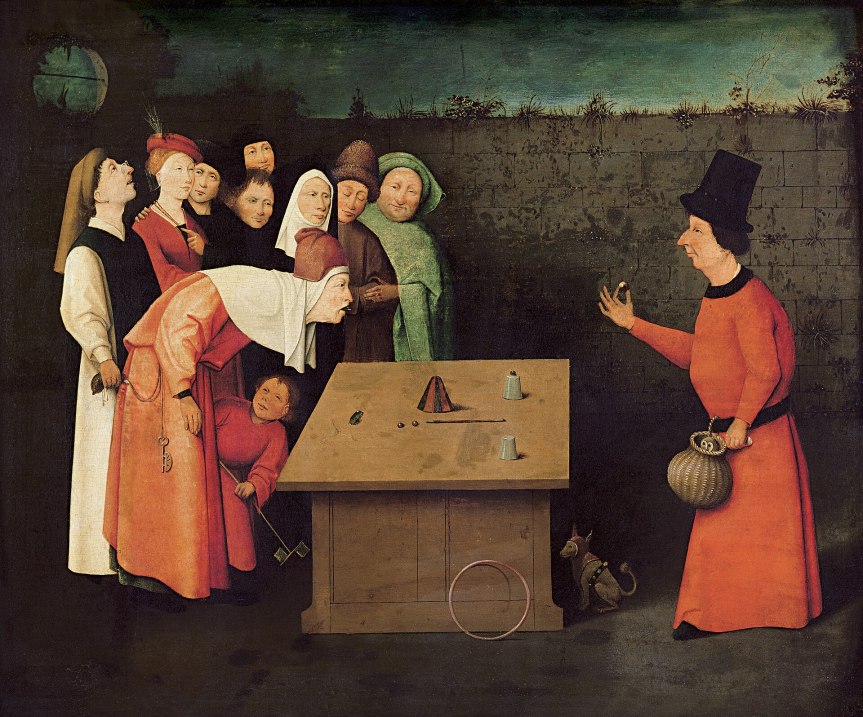
I love delving into mystical, dark-themed artworks come Halloween season, and, this time around, decided to talk about the painting The Conjurer by Hieronymus Bosch (c.1450-1516). In it, he presents an arresting scene: a street magician, dressed in a scarlet robe and reminiscent of the Magician from the Tarot deck, has gathered a crowd of onlookers and performs a trick using cups and balls. The crowd is engrossed in the proceedings, and while almost everyone fixes their eyes on the ball in the magician’s hand, a person dressed in black and white, and looking towards the sky, has his hand around another man’s purse. The distraction seems to be working, and the theft is almost complete. The thief’s dress suggests that he belongs to a religious order, probably the Dominican order, and Bosch’s aim was likely to point out the hypocrisy of authority figures by suggesting that the friar is working in tandem with the magician to steal.
There are other disturbing elements: a magic wand on the table, and a frog, often associated with alchemical processes, that has just been spat out by the person bending forward (there is a second frog poking out of his mouth). The animal in the magician’s basket is either an owl, representing night and darkness, or a monkey, representing cunningness and deceit. The arrangement and position of figures in the artwork are equally fascinating: there is a visual separation of the crowd (the common folk) from the magician (the travelling outsider), who sports unusual headgear, and all seem to be “cut off” from the everyday society by the high wall. In this way, the painting is similar to Bosch‘s Ship of Fools [c. 1490], which also shows people adrift and already “beyond” the usual societal affairs, and where the artist also depicted the moral hypocrisy and corruption. In The Conjurer, one can also spot a pattern: the circular window, the small hoop, the balls, and the magician’s round bag, possibly suggesting infinity, all set an unusual rhythm to the composition. Another pattern is the rectangle: the magician’s black hat, the shape of the table and the small boy’s toy windmill.
There are five versions of this painting, as well as one engraving. The main one is currently housed in the municipal museum in Saint-Germain-en-Laye, France, but is rarely exhibited. At first glance, the artwork appears simple, and yet, its details unveil surprising depth, with the painting overall conveying much about human gullibility and folly.

