

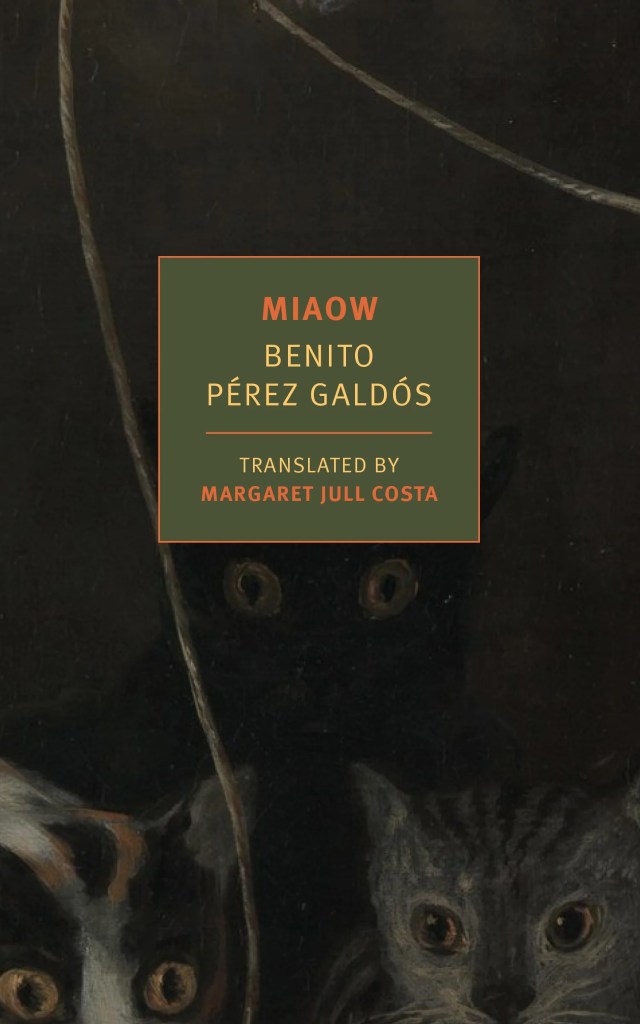
Miaow [1888/2025] – ★★★★
This satirical novel introduces Ramón Villaamil, an honourable man and an ex-employee of the Ministry, who spends all his days petitioning hopelessly his previous employment and begging his friends for favours so he can get a job at the Ministry in any capacity. Living with him are his wife Doña Pura, her sister Milagros, his daughter Abelarda (the three cruelly nicknamed “Miaus” for their cat-like appearance), and his grandson Luis, the child of Luisa, Ramón and Doña Pura’s late daughter. As Ramón Villaamil doesn’t have a stable employment, the family is falling deeper and deeper into poverty and debt, especially since the women of the family are haughty, pretentious and do not manage their finances well. But then, on the scene comes the father of little Luis – the handsome, but wayward Victor Cadalso, and starts play-acting in pursuing Abelarda, while offering money to the family. That is trouble already, but then Villaamil also discovers that Victor is after a governmental post, too, and will exercise more ruthless methods to get what he wants. Benito Pérez Galdós (1843-1920) is considered the greatest Spanish author after Miguel de Cervantes, and seems to have had a real talent for ascertaining where dramatic interest may lie and going there in his narrative. This is a novel of hope and the absence of it, of “keeping up appearances”, of people living in denial, and of daily cruelties and societal indifference.
Pérez Galdós satirises the period in Spanish history following the proclamation of the Restoration, which began in 1874. The aim was to have a political system that minimised the chance of civil wars and unrest by having in place the practice of turno, the rotation of parties in leadership achieved through electoral fraud. Naturally, the whole system, down to governmental appointments, was then open to favoritism and corruption, with the feeling that merit, talent, honesty and any previous record of hard work mean absolutely nothing.
In Pérez Galdós’s novel, Ramón Villaamil is such a man of integrity. He is a lifelong civil servant who contributed much to the government in his time, and is now being left behind by the same government he worshipped. Villaamil sees how his peers and past subordinates take all the posts and promotions because they are brazen, shameless and know how to flatter the right people. Playing by the rules does not serve anymore, and Villaamil slides deeper into depression at the thought that he may need to sacrifice his integrity in his old age “to go places”, achieving a status. Villaamil is told that his honesty is his undoing: “honesty is sometimes taken as just another word for foolishness”, as he finds out that “merit is met with disappointment and demerit with the sweets of office”, and that “Spanish logic can never fail. The rogue before the honest man; the ignorant above those with knowledge, and the upright official comes at the bottom, always at the bottom”. Seeing that Luis applies himself to studying, Villaamil starts to think: “what’s the good of studying? The more of an ass a man is, and the more of a knave, the better his career” [Pérez Galdós/Jull Costa, NYRB Classics, 1888/2025: 32, 119, 250, 35].
Ramón Villaamil is a “man-island”, a man “cut off” because his own household also reflects the new, superficial values of the society he desires to escape. His wife, his sister-in-law and his daughter only concern themselves with appearances and trivialities, paying little attention to their dignity or maintaining a good household budget. They attend opera daily, and desire nothing more than being perceived well-to-do and important, while they disguise their poverty. “There’s no Christian virtue in families nowadays”; “everything’s just pretentiousness”; “there’s no modesty today, no simplicity of living,” complains Villaamil. The only spark of light in these surroundings is little Luis, who has visions of the communion with God, and through his dreams, even speaks to the Heavenly Father. Being just a boy, he already longs for the divine and wants to be a priest. But, in another turn of wilful blindness, Villaamil does not seem to notice the growing spiritual wisdom in his grandchild and largely uses the boy as his personal postman so he can send out his hundreds of employment requests and petitions.
Pérez Galdós injects dramatic contrast at every turn (the young and hopeful Luis vs. the old and despairing Villaamil), but Villaamil’s family is also contrasted with that of Señor Pantoja, a man who works at the government and whose family was trained “to love God and fear all worldly pomp and expense”. It is the circumstances that drive Pérez Galdós’s narrative forward. As in the author’s novel Tristana, the characters are “prisoners” of their own unfortunate circumstances. Tristana could not do much in her situation when Don Lope Garrido held such tight financial reins over her, and, in turn, Ramón Villaamil is in a stagnant, unenviable position that he is unable to escape. He has become too meek, weak and kind for the modern world that rewards boastfulness, self-promotion and social networking (over talent or merit). But, he is not the only one in the story whom the times have left behind. Villaamil’s sister-in-law Milagros once had a beautiful voice and was also an aspiring opera singer who was soon reduced to rather pitiful circumstances: “When she thought of the cruel contrast between her hopes and her fate, she was unable to measure the steps of that slow descent from the heights of poetry to the cellars of vulgarity” [Pérez Galdós/Jull Costa, NYRB Classics, 1888/2025: 46].
One unfortunate aspect of the novel is that, probably, there are two or more stories here, and one of them is more interesting than the others (there is a fight for employment in a Kafkaesque bureaucracy, a love game involving a Casanova-like character, and spiritual reawakening of the old and the young). Pérez Galdós might have hit the mark with his Balzacian characters that jump from the page with much force, but he does not place equal dramatic weight on his narrative strands and fails to tie his plotlines to one unifying theme.
🧾 Miaow, translated from the Spanish by Margaret Jull Costa, is a less focused drama than I expected, but it also has a memorable, thought-provoking ending that has to do with finally finding oneself or the meaning of life (“All that matters is the soul, which goes flying up to what they call the…empyrean”). Pérez Galdós shuffles his characters masterfully throughout the story, and the melodrama is always kept at bay by vivid and elegant characterisations.
<<Buy Miaow (affiliate link)>>


🇪🇸📗🐈⬛
LikeLiked by 1 person
I read Miaow earlier (much earlier) this year. Like you, I had a mixed reaction. There’s a real energy with some of the characters, but the satire at times became a little too repetitive for me — I get it, honest guys don’t get ahead, now can we please move on to another plot strand? I did enjoy the portrayal of life with the “Miaows” however — after all, who wouldn’t go to the opera every night, if they could? On the whole, a flawed but interesting novel; not Galdos’ best but definitely worth a read.
LikeLiked by 2 people
Yes, I agree, and I also had the opposite reaction. I thought that the bureaucracy bit and Ramón’s fight to get re-employed would be the whole plot, so I was prepared for something like Kafka’s The Trial #2 lol – which I would have enjoyed since I love that stuff. Other plot strands like Victor wooing Abelarda and Luis’s visions just caught me by surprise, and I don’t mind and like that too, but then I don’t think Galdos weaved them all together into one theme or vision (as other classic authors would have done, I have to add). I see that Tristana is a later novel, and it did have one powerful central theme, but then again, one can say that the novel began with one story and ended in another. I agree that Miaow is probably not his best. But, then, what is his best? Fortunata y Jacinta? (I have such high expectations!) Or, perhaps, one of those yet to be translated to English?
LikeLike
I couldn’t agree more with you two. That fight for employment drew me in far more as well, and I kept thinking he could have tapped into a much more radical, almost Kafkaesque Spanish streak if he’d explored that side deeper. Still, I’m glad I read it. It really feels as though Galdós absorbed everything from his shorter pieces and let it all simmer until it was ready in Fortunata y Jacinta, which feels completely cohesive and whole. Despite being serialized, the structure is astonishingly balanced—somehow he managed four parts of nearly the same length (around two hundred and fifty pages or so each), creating a sweeping yet brilliant book that repeats a steady pattern for each of the four parts: a short philosophical and political opening to set the scene, followed by lively dialogue and measured, convincing characterization across the board, from minor figures to major ones, with a remarkable sensitivity toward the poor and children.
Keeping all differences in mind—not to say one is better or worse—Galdós offers a classic Dickensian realism, yet his Spanish sensibility brings a vividness of color, scent, and sensory richness you don’t quite find in Dickens. He also has his own unmistakable humor, and above all, his descriptions of food, fabrics, pregnancy—and Jacinta’s poignant dream of pregnancy—are truly remarkable.
LikeLiked by 1 person
Oh, wow. You’re really making me want to pick up Fortunata y Jacinta right now! 🙂 I sense that it may be Galdós’s most glorious achievement, penned when he was at the peak of his powers? since it sits more or less in the middle of his overall bibliography? It is also interesting that you called his characterisations “measured, convincing…across the board”. I quite agree. I am now a fan of his characterisations even though I read only two books (Miaow and Tristana). His characterisations are vivid, but also somewhat delicate. The balance is the word, you are right. And, he really “feels” his characters.
LikeLiked by 1 person
If you loved Anna Karenina or Madame Bovary and aren’t intimidated by long, well-paced novels, Fortunata and Jacinta by Benito Pérez Galdós belongs right alongside them as the third great 19th-century masterpiece on adultery.
Beyond the love triangle, it’s a magnificent portrait of 19th-century Madrid that completely transcends its time. It’s honestly astonishing how Galdós could write so vividly and accurately about what it feels like to be pregnant, despite being a man! It’s one of my absolute favorites—an immersive, self-contained little universe that pulls you in right after the opening pages and never actually feels long. If you’re ready to commit to a sweeping saga, give it a try!
LikeLiked by 1 person
I’m not intimidated by heavy classics and long books at all. They are usually right up my alley, so I’m looking forward to Fortunata and Jacinta. And, yes, thanks, I have exactly that Penguin edition translated by Agnes Moncy Gullón. It’s so great to hear it captures the spirit of the original. Leafing through it, I do notice though that the font is still kind of small (so I guess the novel is even bigger!)
LikeLike
If you pick it up in English, look for the Penguin Classics edition translated by Agnes Moncy Gullón—it captures Galdós’s humor, lively dialogue, and energy wonderfully.
LikeLiked by 1 person
Another thing that blows me away about Galdós is his mastery of characterization. He had a rare gift that you don’t see in many writers: the ability to capture both the physical presence and the entire psychological makeup of a character in just a couple of lines.
Legend has it—and I completely believe it—that he used to spend hours riding trains and streetcars just listening to people talk, and he had a photographic ear for remembering all kinds of different people and the exact way they spoke. He reproduces that so effortlessly that his characters never feel like products of an author’s imagination; it genuinely feels like he is introducing you directly to real, living people.
LikeLiked by 1 person
That’s so interesting. Great insight! I can only judge by Tristana and Miaow ( the only ones I’ve read so far), but I was also very impressed with the characterisations. The handling of plot can be criticised in both (in Tristana, the story kind of shifts in one unexpected direction (from the woman’s attempts to regain independence, and the love triangle, we suddenly awake to a completely new tragedy (another story)), and in Miaow, the plot is possibly too diffused as the author tried to bring different strands together), but the characterisations in both were very elegant. With Dickens, the characterisation veers towards caricatures – often, while with Galdós, we may instantly recognise the types of people he introduces, but they still appear very much human and real, as you put it.
As I also said in my review, I am also interested in the idea that his protagonists are presented as victims of their unfortunate circumstances. Galdos tries to induce empathy. And, I guess he was interested in his characters’ quiet or maybe not so quiet “internal rebellion” as they come to terms with their newly acquired “imprisonment”. With Tristana, it is the disability, and in Miaow, it is this hopeless-to-the-point-of-absurdity quest to regain employment. It will certainly be interesting to explore Galdós’ works in terms of such concepts as “freedom”, “mental imprisonment”, “will”, “lack of will”, “destiny”, and “free will vs. determinism”.
LikeLike
Hello Diana, and thank you for introducing me to this novel.
Villaamil’s situation reminded me of a memoir I recently read, In Search of Rain by Seyed Nourashrafeddin. Despite his academic qualifications, he struggled to secure a position in Iran. Although most of the professors supported his appointment, the opposition of one influential colleague prevented it.
It also made me think of the Japanese educator Takaaki Fujino (藤野高明), who lost his sight and parts of his fingers in a childhood accident. Despite these circumstances, he pursued an academic career. Looking back on his achievements, he considered himself fortunate in the people he had encountered and the times in which he had lived.
Talent and perseverance alone do not guarantee success. Much depends on the people we encounter and the opportunities society affords us.
It seems that, in this respect, the world hasn’t changed all that much since Galdós’s time. Why do you think so little has changed?
LikeLiked by 1 person
Hi! Thank you for this great comment. I haven’t heard of either Seyed Nourashrafeddin or Takaaki Fujino, so thanks for introducing me to them. As for Galdós’s novel, I think little has changed because the core societal structures remained pretty much same (as well as our human nature, of course), even though advances in individual fields have been made.
Your substack looks amazing, too and I see you have this global perspective, too, which I also love (Central Europe, Costa Rica and Japan, too? Wow) As you can see from my site, I am also very interested in Japanese culture and language, and am now preparing for my JLPT N3, aiming to sit this coming summer.
LikeLike
Thank you. I’m glad you took the time to visit my Substack. 🙂
I think you’re right about human nature. We have made a huge progress in many fields, but I sometimes wonder whether our social and moral development has kept pace with our intellectual and technological achievements. 😉
And what a lovely coincidence about Japanese. I recently returned to studying the language myself, and I’m around the N3 level too. I’m actually planning to move from Costa Rica to Fukuoka in the future.
What first sparked your interest in Japan and the Japanese language, by the way? 🙂
LikeLike