

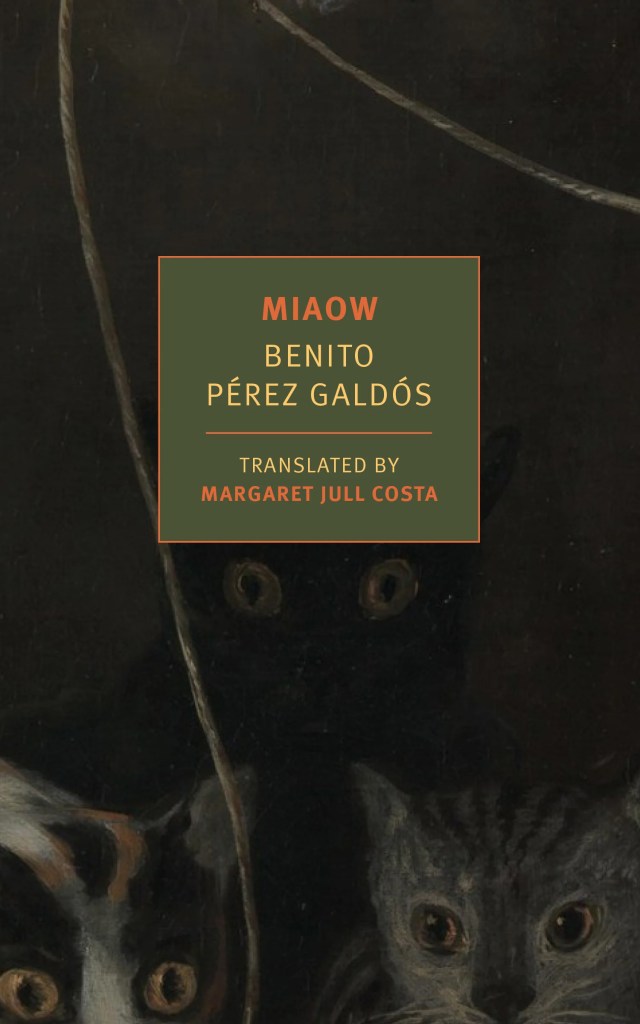
Miaow [1888/2025] – ★★★★
This satirical novel introduces Ramón Villaamil, an honourable man and an ex-employee of the Ministry, who spends all his days petitioning hopelessly his previous employment and begging his friends for favours so he can get a job at the Ministry in any capacity. Living with him are his wife Doña Pura, her sister Milagros, his daughter Abelarda (the three cruelly nicknamed “Miaus” for their cat-like appearance), and his grandson Luis, the child of Luisa, Ramón and Doña Pura’s late daughter. As Ramón Villaamil doesn’t have a stable employment, the family is falling deeper and deeper into poverty and debt, especially since the women of the family are haughty, pretentious and do not manage their finances well. But then, on the scene comes the father of little Luis – the handsome, but wayward Victor Cadalso, and starts play-acting in pursuing Abelarda, while offering money to the family. That is trouble already, but then Villaamil also discovers that Victor is after a governmental post, too, and will exercise more ruthless methods to get what he wants. Benito Pérez Galdós (1843-1920) is considered the greatest Spanish author after Miguel de Cervantes, and seems to have had a real talent for ascertaining where dramatic interest may lie and going there in his narrative. This is a novel of hope and the absence of it, of “keeping up appearances”, of people living in denial, and of daily cruelties and societal indifference.
Pérez Galdós satirises the period in Spanish history following the proclamation of the Restoration, which began in 1874. The aim was to have a political system that minimised the chance of civil wars and unrest by having in place the practice of turno, the rotation of parties in leadership achieved through electoral fraud. Naturally, the whole system, down to governmental appointments, was then open to favoritism and corruption, with the feeling that merit, talent, honesty and any previous record of hard work mean absolutely nothing.
In Pérez Galdós’s novel, Ramón Villaamil is such a man of integrity. He is a lifelong civil servant who contributed much to the government in his time, and is now being left behind by the same government he worshipped. Villaamil sees how his peers and past subordinates take all the posts and promotions because they are brazen, shameless and know how to flatter the right people. Playing by the rules does not serve anymore, and Villaamil slides deeper into depression at the thought that he may need to sacrifice his integrity in his old age “to go places”, achieving a status. Villaamil is told that his honesty is his undoing: “honesty is sometimes taken as just another word for foolishness”, as he finds out that “merit is met with disappointment and demerit with the sweets of office”, and that “Spanish logic can never fail. The rogue before the honest man; the ignorant above those with knowledge, and the upright official comes at the bottom, always at the bottom”. Seeing that Luis applies himself to studying, Villaamil starts to think: “what’s the good of studying? The more of an ass a man is, and the more of a knave, the better his career” [Pérez Galdós/Jull Costa, NYRB Classics, 1888/2025: 32, 119, 250, 35].
Ramón Villaamil is a “man-island”, a man “cut off” because his own household also reflects the new, superficial values of the society he desires to escape. His wife, his sister-in-law and his daughter only concern themselves with appearances and trivialities, paying little attention to their dignity or maintaining a good household budget. They attend opera daily, and desire nothing more than being perceived well-to-do and important, while they disguise their poverty. “There’s no Christian virtue in families nowadays”; “everything’s just pretentiousness”; “there’s no modesty today, no simplicity of living,” complains Villaamil. The only spark of light in these surroundings is little Luis, who has visions of the communion with God, and through his dreams, even speaks to the Heavenly Father. Being just a boy, he already longs for the divine and wants to be a priest. But, in another turn of wilful blindness, Villaamil does not seem to notice the growing spiritual wisdom in his grandchild and largely uses the boy as his personal postman so he can send out his hundreds of employment requests and petitions.
Pérez Galdós injects dramatic contrast at every turn (the young and hopeful Luis vs. the old and despairing Villaamil), but Villaamil’s family is also contrasted with that of Señor Pantoja, a man who works at the government and whose family was trained “to love God and fear all worldly pomp and expense”. It is the circumstances that drive Pérez Galdós’s narrative forward. As in the author’s novel Tristana, the characters are “prisoners” of their own unfortunate circumstances. Tristana could not do much in her situation when Don Lope Garrido held such tight financial reins over her, and, in turn, Ramón Villaamil is in a stagnant, unenviable position that he is unable to escape. He has become too meek, weak and kind for the modern world that rewards boastfulness, self-promotion and social networking (over talent or merit). But, he is not the only one in the story whom the times have left behind. Villaamil’s sister-in-law Milagros once had a beautiful voice and was also an aspiring opera singer who was soon reduced to rather pitiful circumstances: “When she thought of the cruel contrast between her hopes and her fate, she was unable to measure the steps of that slow descent from the heights of poetry to the cellars of vulgarity” [Pérez Galdós/Jull Costa, NYRB Classics, 1888/2025: 46].
One unfortunate aspect of the novel is that, probably, there are two or more stories here, and one of them is more interesting than the others (there is a fight for employment in a Kafkaesque bureaucracy, a love game involving a Casanova-like character, and spiritual reawakening of the old and the young). Pérez Galdós might have hit the mark with his Balzacian characters that jump from the page with much force, but he does not place equal dramatic weight on his narrative strands and fails to tie his plotlines to one unifying theme.
🧾 Miaow, translated from the Spanish by Margaret Jull Costa, is a less focused drama than I expected, but it also has a memorable, thought-provoking ending that has to do with finally finding oneself or the meaning of life (“All that matters is the soul, which goes flying up to what they call the…empyrean”). Pérez Galdós shuffles his characters masterfully throughout the story, and the melodrama is always kept at bay by vivid and elegant characterisations.
<<Buy Miaow (affiliate link)>>


🇪🇸📗🐈⬛
LikeLiked by 1 person
I read Miaow earlier (much earlier) this year. Like you, I had a mixed reaction. There’s a real energy with some of the characters, but the satire at times became a little too repetitive for me — I get it, honest guys don’t get ahead, now can we please move on to another plot strand? I did enjoy the portrayal of life with the “Miaows” however — after all, who wouldn’t go to the opera every night, if they could? On the whole, a flawed but interesting novel; not Galdos’ best but definitely worth a read.
LikeLiked by 1 person
Yes, I agree, and I also had the opposite reaction. I thought that the bureaucracy bit and Ramón’s fight to get re-employed would be the whole plot, so I was prepared for something like Kafka’s The Trial #2 lol – which I would have enjoyed since I love that stuff. Other plot strands like Victor wooing Abelarda and Luis’s visions just caught me by surprise, and I don’t mind and like that too, but then I don’t think Galdos weaved them all together into one theme or vision (as other classic authors would have done, I have to add). I see that Tristana is a later novel, and it did have one powerful central theme, but then again, one can say that the novel began with one story and ended in another. I agree that Miaow is probably not his best. But, then, what is his best? Fortunata y Jacinta? (I have such high expectations!) Or, perhaps, one of those yet to be translated to English?
LikeLike