

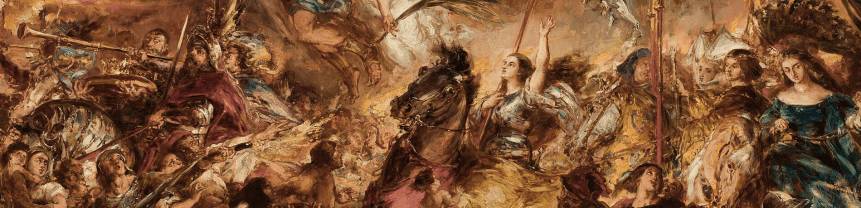
Joan of Arc (1412-1431) was a real historical figure, a young girl who became a Catholic saint and a symbol of France for her role in defending her motherland. She has also been a source of inspiration for artists. Below are five paintings that present Joan of Arc’s life events in chronological order.
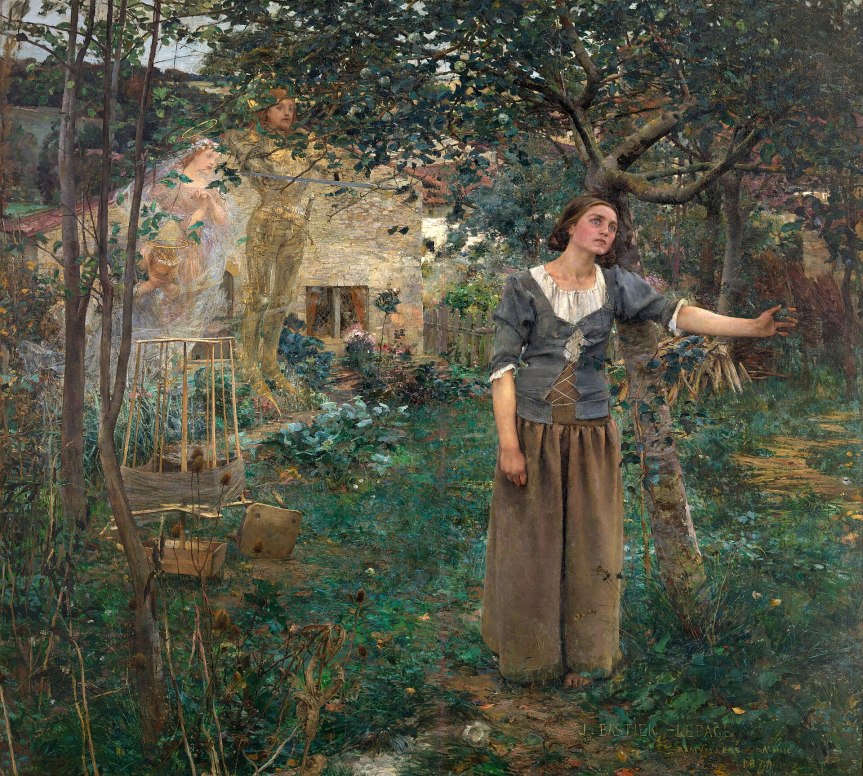
Joan of Arc by Jules Bastien-Lepage
This is one of the most famous depictions of Joan of Arc. Jules Bastien-Lepage (1848–1884) portrays Joan in the moment of her spiritual awakening as she is visited by Archangel Michael, and Saints Margaret and Catherine in her parents’ garden. The saints urged her to the cause for France. Joan’s dazed expression emphasises her awe as she receives their instructions. Bastien-Lepage’s hometown of Damvillers is actually in the same region where Joan was born – part of Lorraine (Grand Est), and he visited her hometown of Domrémy in preparation for creating the painting. The artwork is at the Met, New York.
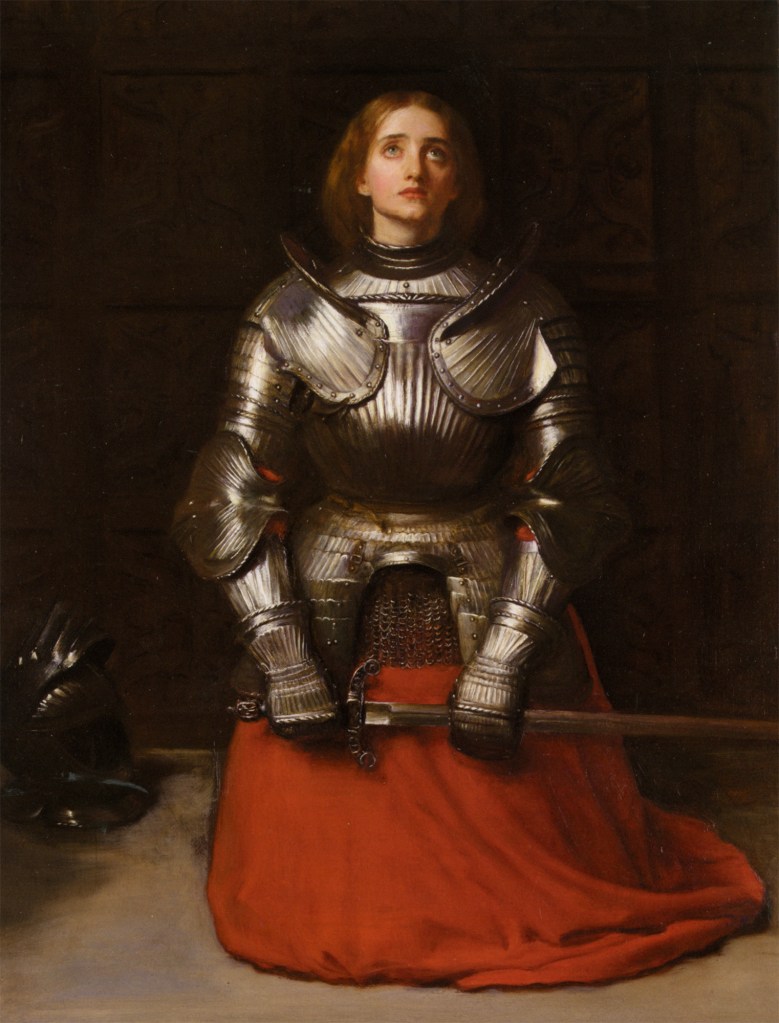
Joan of Arc by John Everett Millais
British painter John Everett Millais (1829-1896) depicted Joan of Arc before her glorious accomplishments. In the painting, she kneels in a quiet place, probably a makeshift camp, looking up devotedly, asking God for strength to lead the army. She is about to embark on the mission that would see the French army break the English siege of Orléans. The contrast here speaks for itself – Joan’s armour and the sword she grips already identify her as a soldier ready for a fight, yet her uncovered head, youthful complexion and eyes full of humility tell us that she is still just an ordinary girl caught up in a series of unbelievable events. The artwork is currently in a private collection.
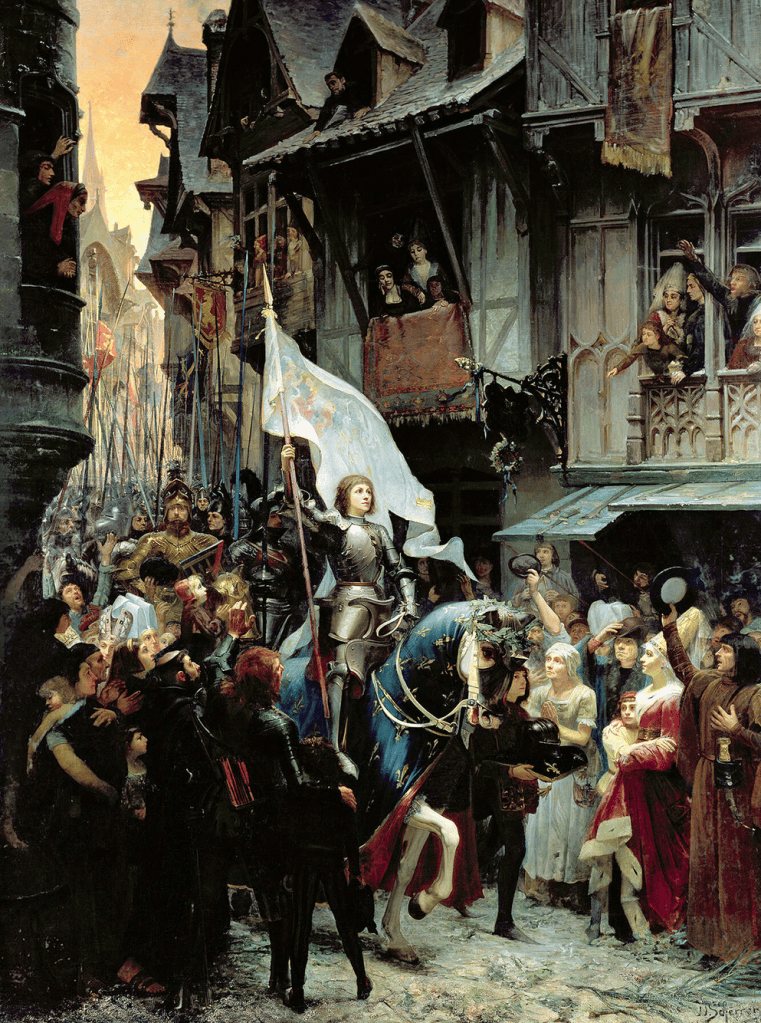
Joan of Arc Enters Orléans by Jean-Jacques Scherrer
This painting by French artist Jean-Jacques Scherrer (1855–1916) captures the moment when Joan of Arc entered the city of Orléans on 8 May 1429 after the siege was lifted. Eyewitnesses described the entry in these words: “at eight o’clock…she entered, armed at all points, riding upon a white horse; and she caused her standard to be borne before her, which was likewise white, on which were two angels, holding each a fleur-de-lys in their hands; and on the pennon was painted an annunciation.” Lords, esquires, captains and soldiers from the garrison came to greet Joan, “bearing great plenty of torches and making such rejoicing as if they had seen God descend in their midst” (Régine Pernoud, Joan of Arc: By Herself and Her Witnesses). Scherrer’s idealised portrayal condensed the campaign’s victory into a single glorious event – Joan’s entry into the city – whereas in reality, she entered the still besieged city on 29 April, and was therefore unlikely to have encountered such an all-around happy welcome. The painting is part of the collection of the Musée des Beaux-Arts d’Orléans, France.
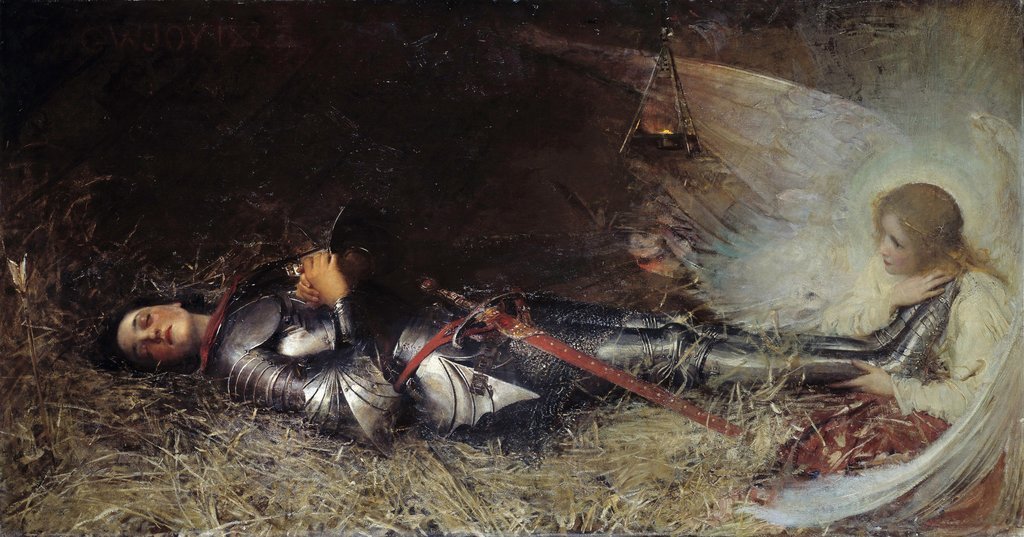
Sleeping Joan of Arc by George W. Joy
George W. Joy’s painting Sleeping Joan of Arc [1895] depicts Joan resting while the angel cradles her feet. Together with her army, she is on her way to Reims to have Charles VII crowned as the King of France. The artwork’s mystical aspects are intriguing. The angel looks devotedly at Joan, watching over her as she sleeps with a serene expression. Joan’s first mission is already behind her and she can look forward to the coronation. There is an interesting framing here as well – Joan is found between the arrow (seen on the left), standing for danger, and the angel, who signifies safety. The sword is placed in between, being the “bridge”. The painting is in the Musée des Beaux-Arts de Rouen.
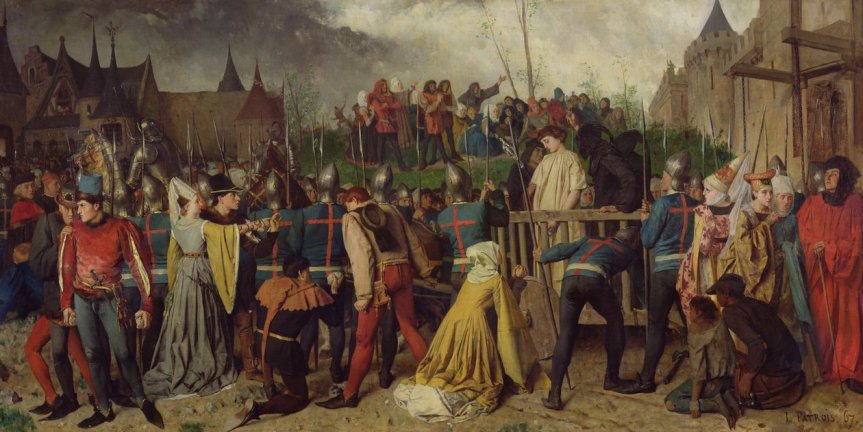
Joan of Arc Being Led to her Death by Isidore Patrois
Isidore Patrois (1815-1884) started as a textile designer before transitioning to painting and focusing on scenes from the lives of François I, Joan of Arc and Jacques Cœur. In this artwork, a great commotion surrounds the final minutes of Joan, who stands in a cart surrounded by English soldiers pushing back the crowd. A woman in yellow kneels in prayer, while others weep and shout in protest. Régine Pernoud presents the following eyewitness account in her book: “The sentence was pronounced whereby Joan was abandoned to secular justice. As soon as possible after this sentence, immediately and without delay, she was delivered into the hands of the sheriff, and [after pronouncing the sentence], the executioner, without further ado, seized Joan and took her to the place where the wood was ready and she was burned”. Another testimony continues: “…in the fire she cried more than six times ‘Jesus’, and above all with her last breath she cried in a loud voice ‘Jesus!’ so that all present could hear her. Almost all wept with pity, and...the ashes, after her burning, were gathered up and cast into the Seine…” The painting is housed at the Musée des Beaux-Arts de Rouen.

