

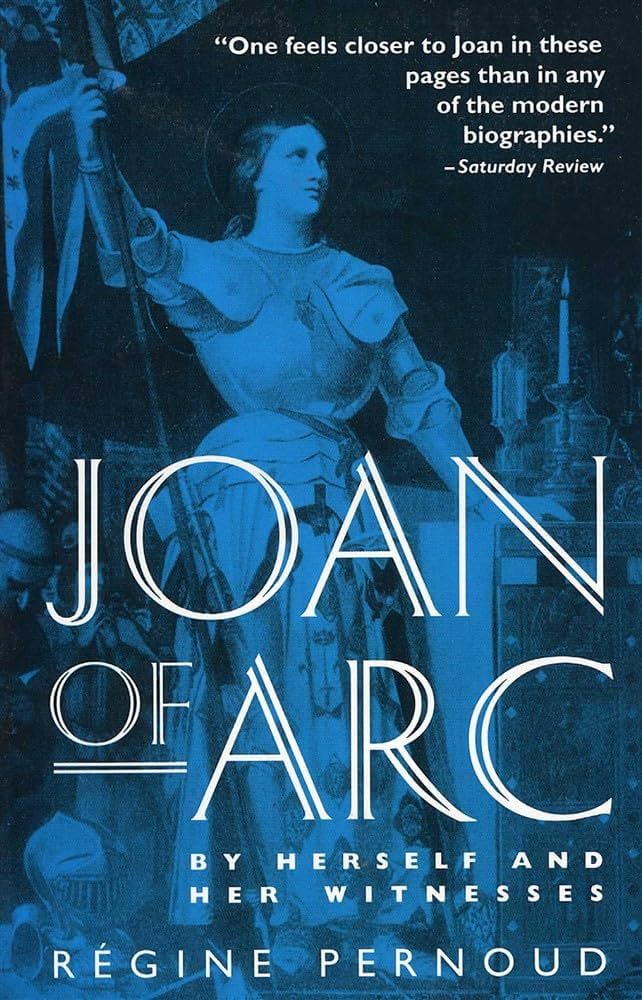
Joan of Arc: By Herself and Her Witnesses [1962/94] – ★★★★
“She raised (all) spirits towards the hope of better times.” Alain Chartier
This is a non-fiction book that makes full use of the primary sources to tell the story of Joan of Arc, a young girl who played a pivotal role in lifting the siege of Orléans during the Hundred Years’ War between France and England, and eventually became the patron saint of France. Historian Régine Pernoud unveils Joan’s trial records, as well as testimonies of people who knew her or came into contact with her, to present this historical figure in a new, more intimate light. From her origins and childhood to her trial and death, this is a well-researched account of the key moments in Joan of Arc’s life, a life so unbelievable that it is often relegated to myth and folklore.
Joan was born in 1412 in Domrémy, now known as Domrémy-la-Pucelle in her honour. She began hearing divine voices from the age of 13: “The voice told me that I should go to France and I could not bear to stay where I was. The voice told me that I should raise the siege laid to the city of Orléans.” The book provides first-person accounts, and we hear about Joan from her neighbours, pages, and fellow soldiers who escorted her to various towns and then to the King himself. Naturally, Joan had much trouble persuading others that her visions were truly from God and that she needed help to fulfil God’s mission. However, she exerted a calming influence on those around her, and finally managed to persuaded Robert de Baudricourt to give her men so she could go to Chinon to meet the King (then the uncrowned Dauphin). She was warned that the road to the Dauphin was dangerous, overrun with men-at-arms who could harm her, but “she answered that she feared not men-at-arms for her way was open, and if there were men-at-arms on her road, she had God, her Lord, who would clear the way for her to go to the lord Dauphin, and that she had been born to do this.”
When Joan arrived to Chinon to meet the King, she recognised him immediately even though there were other, more richly dressed, men present in the room. Even when the King pointed to another man, insisting him to be the King, Joan corrected him and then told the King “things she could not have possibly known”, that no one could possibly have known – “only God”. The King, Charles VII, had Joan examined by his churchmen and clerks, and was then persuaded by Joan, especially since she was making prophecies that the French wanted to believe in – “that the English would be defeated and that the siege which was laid to the town of Orléans would be raised and that the town of Orléans would be liberated of [sic] the English…”
Pernoud then provides a detailed account of the raising of the siege of Orléans, the primary purpose (“the mission”) of Joan, who had been tasked by divine powers to take the noble Dauphin and lead him to Reims to be crowned. Joan’s mere presence boosted the morale of the French who fought against the English, and they successfully lifted the siege. Jean Pasquerel said this of Joan’s victory: “It was said to her: Never have been seen such things as you have been seen to do; in no book are to be read of deeds like them [sic]”.
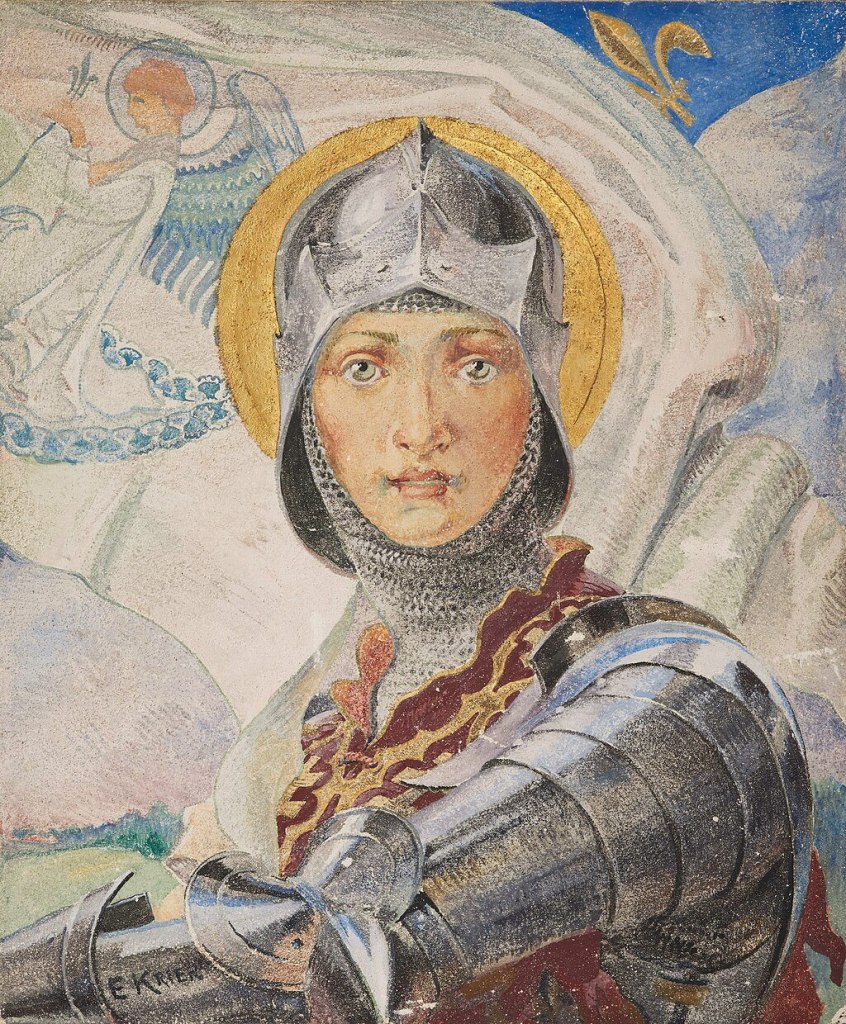
There are also some interesting insights into Joan’s remarkable abilities. She was only a simple girl of sixteen or seventeen, but, apparently, already well-versed in matters of war. Thiband d’Armagnac or de Termes, knight, bailiff of Chartres testified: “...in the matter of warfare, in drawing-up the army in battle (order) and heartening the soldiers, she behaved as if she had been the shrewdest captain in the world and had all her life been learning (the art of) war/…she was very expert, in the management of the lance as in the drawing up of the army in battle order and in preparing the artillery”.
As the Orléans siege was lifted, Charles VII could then travel to Reims to be officially crowned as the King of France, and he did so. After that, Joan pushed for further offensive action, but an attempt to take Paris failed, and she was captured by the Burgundian troops and sold to the English. Her trial for heresy began in early 1431 in Rouen, and on 30 May 1431 she was convicted and burned at the stake in the marketplace. During her trial, questions were put to Joan to exhaust and confuse her, but which she handled well, answering stoically, and with a clear mind and prudence. It was certainly a political trial by the English with the verdict already known beforehand (Joan was held in iron cuffs and was also denied a lawyer). Her rehabilitation trial did not take place until 1456 when her name was finally cleared.
Pernoud provides her own commentary after the trial transcripts and testimonies, and refutes many strange theories about Joan, such as the idea that she might have escaped her execution or been a “political tool” used by, for example, the Queen of Sicily to promote a particular political agenda. It was also interesting to discover little-known facts about Joan, such as the fact that she had a suitor whom she rejected. That suitor then angrily summoned her to appear in front of a judge for breach of promise to marry. The judge ruled in Joan’s favour (promises of marriage carried contractual obligations at that time).
Overall, this is an eye-opening account that emphasises the determination and unshakable belief of Joan of Arc as she faced her adversaries.

