

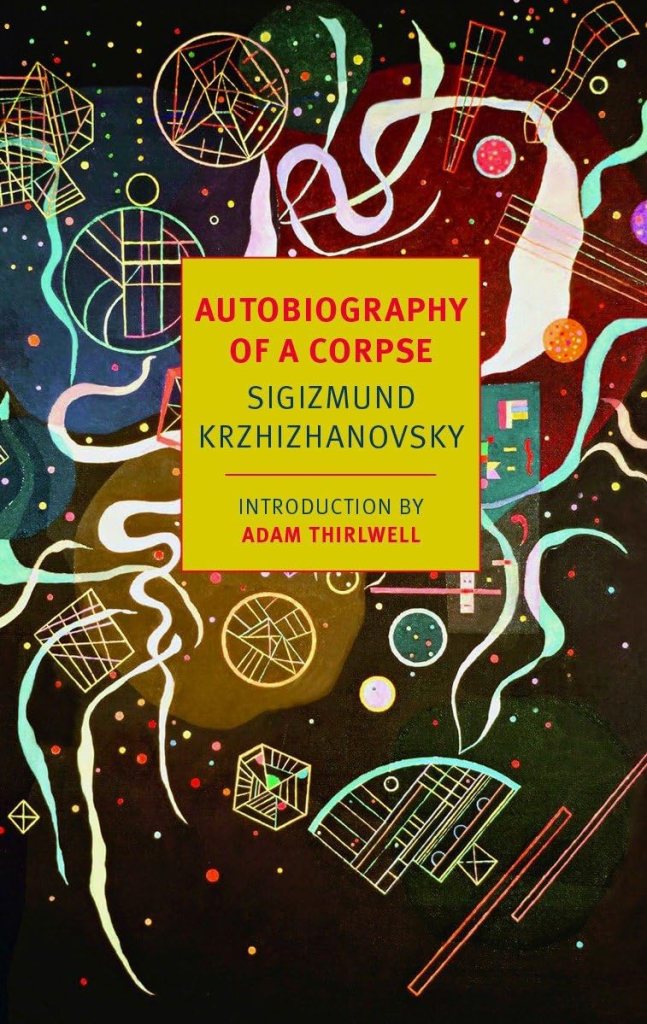
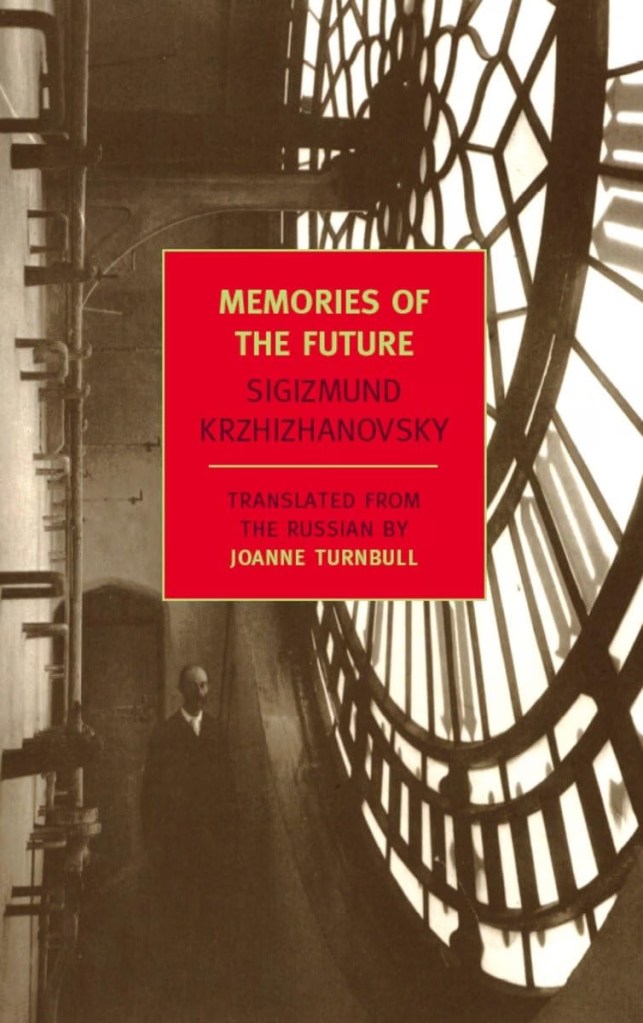
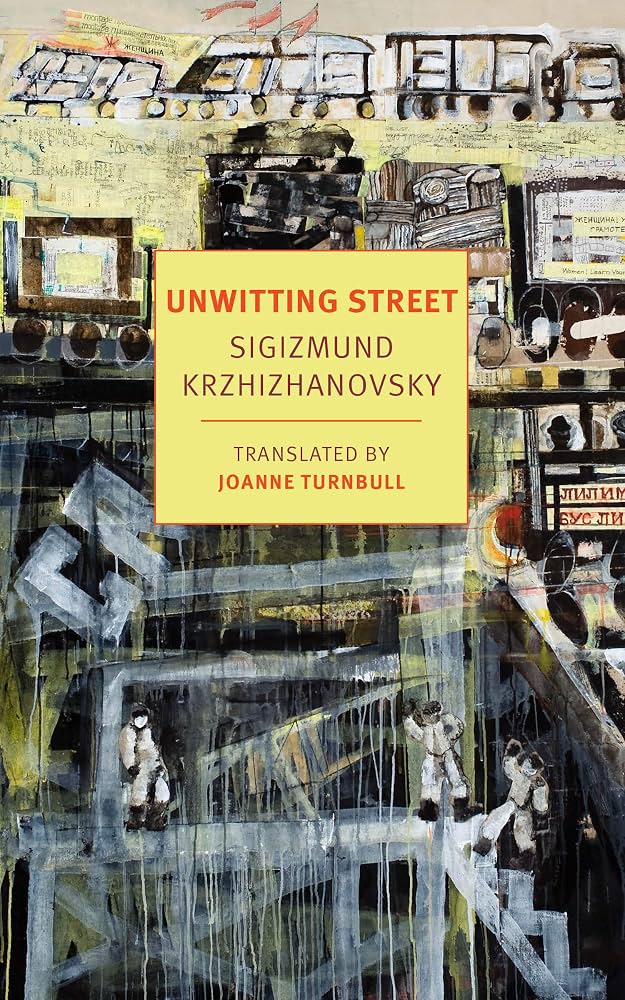
Sigizmund Krzhizhanovsky (1887-1950) was a Russian writer, playwright, philosopher, and historian, and a man who is “known for being unknown”. This is because most of his work was never published during his lifetime, but only posthumously. Often linked to Bulgakov, with whom he shared certain autobiographical details, Krzhizhanovsky eventually became known for his fantastical, absurdist stories and parables that remind of the works of Borges, Gogol, Calvino and Kafka. In his stories, storytellers lose control of their characters (The Bookmark) or thoughts (In Line/The Life & Opinions of a Thought), for example, and body parts or clothes inexplicably run away (The Runaway Fingers/Comrade Punt).
Below, I have selected for review five stories from three short story collections published by the NYRB: Memories of the Future (2009), Autobiography of a Corpse (2013), and Unwitting Street (2020). Some of them reminded me of the short stories of Dino Buzzati – see my reviews of Catastrophe & Other Stories and The Siren, and Kōbō Abe (The Magic Chalk). Both authors were influenced by Gogol and Kafka, as was Krzhizhanovsky.
Memories of the Future [1929] (in the Memories of the Future story collection, NYRB 2009) – ★★★★
This is a story about a gifted boy named Max Shterer, who was always curious about time. When he became a man, he came up with eccentric theories on the nature of time and how to control it, and then built a device that is capable of seeing into the future and the past. However, life also got in the way of his scientific discoveries, and, later, Max fought in the WWI, and contracted typhus, from which he nearly died. Returning to his inventions, Max then makes surprising discoveries about what it means to interfere with the natural flow of time. Krzhizhanovsky had this amazing ability to make short stories feel substantial and philosophically deep. Perhaps this story is not that original, but it is thought-provoking, and the writing is truly wonderful and intelligent.
Quadraturin [1926] (in the Memories of the Future story collection, NYRB 2009) – ★★★★
In this story, Sutulin lives in a ridiculously tiny room resembling a matchbox, and to his luck, one day he receives a mysterious guest – a salesman, who gifts him “Quadraturin”, a liquid in a tube that can miraculously “expand” his habitat. Sutulin starts coating his room’s walls with this substance and a miracle does happen. This is an immersive, Kafkaesque, well-written story, which has at its heart a proverb – “be careful what you wish for”.
The 13th Category of Reason [1927] (in the Memories of the Future story collection, NYRB Classics 2009) – ★★★★
“The 13th category of reason” refers to an absurd, nonsensical category that is beyond the 12 categories of understanding (derived from logical functions of human judgement) from Kant’s treatise Critique of Pure Reason. In this story, a man is walking around a cemetery when he spots a gravedigger. He feels that starting a conversation with him would mean opening a hidden door that leads to this 13th category of reason because it appears as though the gravedigger has lost his mind. The gravedigger tells him that he had some trouble with one corpse who simply refused to *finally* die and be buried, and he had to “deliver” this man back to his home. This is a black comedy about a man stuck with a corpse, and it made me laugh quite a few times as Krzhizhanovsky also pokes fun at the Soviet bureaucracy.
God is Dead [1922] (in the Unwitting Street story collection, NYRB Classics 2020) – ★★★★
This story takes place in the past, present and distant future, hinting at the boundless mystery we carry in our hearts. A star has disappeared from a telescope of Mr Brudge, an astrophysicist at the Royal Observatory, Greenwich; a professor of history of religious prejudices at a British university cannot find a misplaced book; and a poet realises while writing yet another poem that something is amiss – poetry has “evaporated”, vanished. It has ceased to exist. All these strange occurrences are connected. The God has died. The world as we know it will never be the same. And, not only the world has changed, but people too. They have a renewed belief that wasn’t there before. Krzhizhanovsky injects so much depth and thought in each of his paragraphs that it is hard to believe that this is only a short story. This circular tale strikes at the heart of the religious paradox.
Bridge over the Styx [1931] (in the Autobiography of a Corpse story collection, NYRB Classics 2013) – ★★★1/2
This is a fantastical tale, but I found it deeply philosophical. One construction engineer wakes up one day and finds a talking toad sitting on his bedside table. At first, he is amazed, but then the toad starts talking, telling him her life story, and he starts listening. The tale is about the river Styx, which separates the realm of the living from the realm of the dead, and the supreme dominance of Death over Life. The toad dwelled near the river Styx, and can tell many wondrous things about its depth, flow and tides that confuse thoughts, blend memories and entrance souls. Apparently, the commune of the toad population of the Styx has a tricky political system, and there has been a dispute between its liberal and conservative factions. And, then, the toad proposes to the engineer a solution that he can “build” and that could reconcile the living with the dead for good. Krzhizhanovsky satirises the Soviet mentality that aimed to build utopia using one’s will and physical materials alone, while ignoring basic metaphysical concepts, cultural nuances, the notion of death itself or high spiritual matters. He also indirectly mocks the Soviet industrialisation projects of the 1930s.


Thanks, I may have to give this author a second chance.
I read The Letter Killers Club, but it was very confusing to me
LikeLiked by 1 person
Thank you for your contribution to Short Story September! I had never heard of this author. I wonder if Siri Hustvedt had that first story/collection in mind when she chose her novel’s title. I really like the sound of “Quadraturin” (which I have found online and will read in full) and especially “God Is Dead.”
LikeLiked by 1 person
Thank you for hosting. I will surely check out all the other entries. I am not sure if Siri Hustvedt had Krzhizhanovsky‘s story in mind in choosing her title, perhaps even not since it is just an evocative phrase that is kind of paradoxical, but if she did, it wasn’t the first time. I absolutely loved her novel The Blazing World, and she took the title from Margaret Cavendish’s novel.
LikeLiked by 1 person
Short story September— you remind me to read a few before the end of the month📖🍃
LikeLiked by 1 person
I would love to know your choices!
LikeLiked by 1 person
I gotta start with my tried and true for this time of season: Poe. I will report back if I venture beyond the gloom🌝
LikeLiked by 1 person
I love that Rumi quote currently on your sidebar ❤
LikeLiked by 1 person