

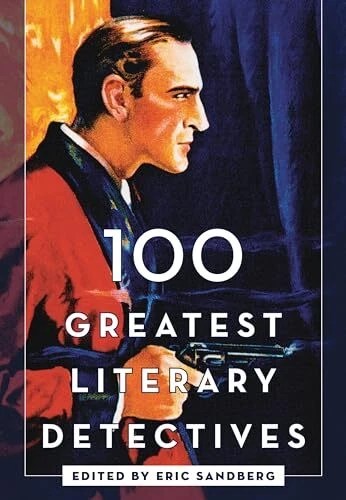
100 Greatest Literary Detectives [2018] – ★★★★
When one thinks about the greatest fictional detectives, certain names pop up – Sherlock Holmes, Hercule Poirot, Miss Jane Marple, Philip Marlowe or Sam Spade. However, there are many others, and this book introduces a great variety of sleuths from around the world, from Swiss Inspector Hans Bärlach (Friedrich Dürrenmatt), Italian Duca Lamberti (Giorgio Scerbanenco) and Swedish Inspector Kurt Wallander (Henning Mankell) to Japanese Kogorō Akechi (Edogawa Ranpo) and Mexican Héctor Belascoarán Shayne (Paco Ignacio Taibo II). With its punchy chapters that focus on each detective in turn, this is primarily a book of discoveries, opening up the world of detective fiction while also pointing out the borrowing, homage and quirky innovations.
There is already a similar book in existence – 100 Great Detectives edited by Maxim Jakubowski, but the strength of this new one edited by Eric Sandberg is that it is an up to date one and goes further afield, introducing detectives from such countries as Poland, Italy, China, India and Peru.
One of those “further afield” detectives is Don Isidro Parodi, created by the Argentinian writers Jorge Luis Borges and Adolfo Bioy Casares. He first appeared in the story collection Six Problems for Don Isidro Parodi (1942/81), and what is immediately striking is that he is such an unusual sleuth – he is just a hairdresser imprisoned for a crime he did not commit, and does his sleuthing from his jail cell. Jorge Luis Borges and Adolfo Bioy Casares use Isidro’s absurd situation to satirise the political and social state of Buenos Aires. Isidro is just a mate-drinking prisoner, but, without leaving his cell, he also manages to solve some of the trickiest crimes as various clients (who are often caricatures of Buenos Aires’ high-flying society) come to him for help. The story shows that detective fiction is often so much more than just a crime investigation. It is also being used to explore and expose political corruption, class inequality, and institutional inadequacies.
The book is insightful even when familiar detectives start appearing, about whom everything under the sun has already been written. For example, Neil McCaw writes with a flair on Miss Jane Marple, who debuted in the 1927 short story The Tuesday Night Club and had her final appearance in Christie’s 1976 novel Sleeping Murder. McCaw says that there are social dimensions to novels where Miss Marple appears, and that “through Miss Marple, Agatha Christie personifies a longstanding value system of decency, etiquette, moral unrightfulness, tact and discretion”.
The chapter on Hercule Poirot, whose mysteries I prefer over those of Miss Marple, gets the same compelling treatment, this time by Merja Makinen. While it is easy to criticise Christie’s stories by pointing out that there are one too many foreign-born baddies in there, it can be overlooked that Hercule Poirot himself is a foreigner – an expat from Belgium, in fact, with the Belgian town of Ellezelles even claiming to hold his birth certificate. In a setting full of English people, who have their own eccentricities and habits, Poirot can stick out like a sore thumb. While Poirot’s foreignness has disadvantages, such as prejudicial treatment, it also has its advantages. Being outside the English class system, Poirot can look objectively at any situation or person, and judge accordingly. It is precisely because he is not “one of them” that he has the freedom to evaluate a situation in a way that few, if any, Englishmen can, just by virtue of them belonging to a certain class with its own constraints. This is true to the times when Christie wrote her novels. Poirot says at one point: “Everyone tells everything to me sooner or later. I’m only a foreigner, you see, so it does not matter. It is easier because I am a foreigner.” What everyone misses is that Poirot can play the English game just as good (if not better) as any Englishman, so people underestimate him to their detriment. Poirot is an expert in human nature, and human nature is the same whether you are in London or in Algiers.
Alison Joseph’s chapter on Georges Simenon’s Chief Inspector Jules Maigret is also surprising honest. Maigret is very human in the stories, and that is his biggest appeal. Joseph writes: “Maigret has no investigative method. He knows he must sit and wait, and reflect on human nature, until such time as the truth is revealed.” Yep. This is pretty much how Maigret novels often go, and suspects often come to him for a partial or even full confession or something drastic happens, and – voilà. The case is miraculously resolved.
The unexpected inclusions were Philip K. Dick’s Bob Arctor and Wilkie Collins’s Valeria Brinton, who turned into a sleuth to clear her husband’s name in the novel The Law and the Lady [1875], while possible omissions are Louise Penny’s Chief Inspector Armand Gamache, and Boileau or Narcejac’s creations. For my part, I also previously enjoyed reading about Gaston Leroux’s Joseph Rouletabille, who appeared in The Mystery of the Yellow Room. I described him in my review as “a breath of fresh air…only eighteen years of age and a journalist, but what he lacks in experience he gains in enthusiasm and mental astuteness.”
I have also added a number of books to my TBR list, including The Silence of the Rain [2003] by Brazilian author Luiz Alfredo Garcia-Roza, and Boris Akunin’s Murder on the Leviathan [2000]. I have known about Akunin’s books for ages, but never read them, and Murder on the Leviathan certainly sounds enticing:“Tipping his hat to Agatha Christie, Boris Akunin’s [book] transports the reader back to the glamorous, dangerous past in a richly atmospheric tale of suspense on the high seas ” (goodreads). The detective here is Erast Petrovich Fandorin, and the corresponding chapter in the book describes Akunin as the one who “revived the tradition of writing entertaining fiction for intellectuals. Like Umberto Eco’s postmodernist The Name of Rose, Akunin’s literary project appeals to different audiences simultaneously: those who follow the plot and enjoy the stylized nineteenth-century narrative, as well as those who read the texts as literary riddles, recognizing their multiple allusions to crime fiction and world literature” (Milla Fedorova).
🕵️♂️ 100 Greatest Literary Detectives is a fun reference book that dives into each detective, their psychology, their connection to their creators, and their position and impact inside the genre as a whole.

