Review: The Crime of Father Amaro by Eça de Queirós

The Crime of Father Amaro Book Cover

The Crime of Father Amaro [1875/1962] – ★★★★★

Portuguese novelist José Maria Eça de Queirós has been compared to Russian Leo Tolstoy and French Honoré Balzac, and for a good reason – his debut (without a collaboration) book The Crime of Father Amaro (translated by Nan Flanagan in 1962) is a multi-faceted novel of great ambition and skill. In it, he tells of events taking place in a small cathedral town of Leiria, north of Lisbon. Father Amaro, a handsome young priest arrives to Leiria to take the position of a parish priest and soon falls under the spell of the most beautiful girl in town – good-natured Amelia, who lives with her strict and apparently religious mother Joanneira in the heart of the city. Amaro is an honourable guest and a lodger in the comfortable house of Amelia and Joanneira, and he soon finds that his duties of a priest clash with his physical desires, and, in particular, with his burning romantic passion for Amelia. Amaro is also caught up in the town’s complex politics, in a clash between the clergy of the town and the governmental powers. The forces within Amaro, as well as from outside of his influence, conspire to lead the young parish priest to making some unprecedented choices.

Continue reading “Review: The Crime of Father Amaro by Eça de Queirós”

Review: The Woman in the Dunes by Kōbō Abe

Kobo Abe The Woman in the Dunes
Continue reading “Review: The Woman in the Dunes by Kōbō Abe”

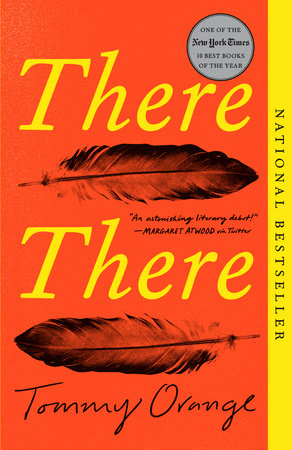
Review: There There by Tommy Orange

There There Book Cover There There [2018] – ★★★★

There There is a debut book by Tommy Orange, a Cheyenne and Arapaho author who has a goal to draw attention to the lives of Native Americans living in an urban setting in the present day US. We follow twelve different characters who all live in Oakland, California and struggle in some form in their lives. From marginalised and criminally-minded Tony Loneman to internet-obsessed and lonely Edwin Black; and from history-inspired Dene Oxendene to poverty-stricken, troubled sisters – Opal Bear Shield and Jacquie Red Feather, Tommy Orange presents a heart-wrenching overview of the struggles of the people who want to re-connect with their families and their Native American heritage. The characters’ lives are intertwined and there is a feeling like they are all moving towards an explosive finale in the story. The result is a powerful tribute to Native Americans living in big US cities today, trying to make their heritage feel relevant and important, even if Orange’s story as a narrative falls short of its mark because of its overly-ambitious multiple perspectives’ focus, as well as its dissatisfying ending. Continue reading “Review: There There by Tommy Orange”

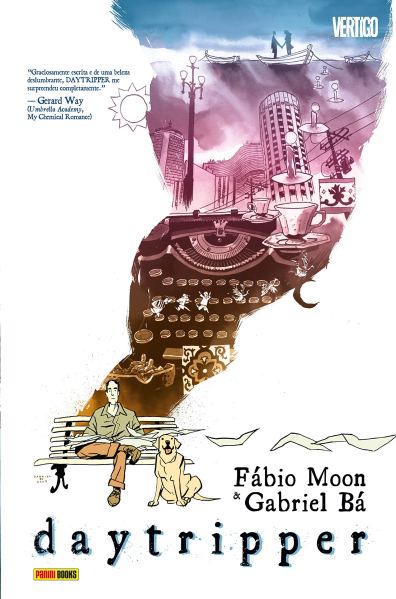
Review: Daytripper by Fábio Moon & Gabriel Bá

Daytripper Book Cover

Daytripper [2010/11] – ★★★★★

An exhilarating journey to uncover the mysteries of life and death. 

Fábio Moon and Gabriel Bá are twin brothers from Brazil who are the creators of Daytripper, an ambitious comic book about Bras de Oliva Domingos, an obituaries’ writer living in São Paulo. We follow and experience his life in a non-chronological order and witness everything from Bras’s “unusual” birth, his first kiss, his major break-up, his career change, to the birth of his child and the death of his parent. Bras learns important life-lessons along the way, and it is his relationships with other people that come to define him and his most memorable life moments. Daytripper may be dealing with very uncomfortable issues of life and death, but this beautiful comic book is also eye-opening, inspirational and moving. Gabriel Bá and Fábio Moon invite you to step into their colourful, slightly transcendental world of one’s memorable life moments, into the world of “what ifs”, ups and downs, hopes and despairs. Their message is clear: we have one shot at this thing called life and should prioritise the most important things in it, including the people we cherish and the relationships we hold dear.

Continue reading “Review: Daytripper by Fábio Moon & Gabriel Bá”

Review: Solaris by Stanisław Lem

Solaris Book Cover

Solaris [1961/70] – ★★★★★

Man has gone out to explore other worlds and other civilisations without having explored his own labyrinth of dark passages and secret chambers, and without finding what lies behind doorways that he himself has sealed” [Stanisław Lem/Kilmartin/Cox, 1961/70: 164].

Solaris is considered to be the most influential and significant work of a Polish writer Stanisław Lem. Also made into a movie [1972] by Andrei Tarkovsky, the book tells of Kelvin, a psychologist, who arrives to a station orbiting the mysterious planet called Solaris. On board of the station are supposed to be three other researchers, and Kelvin joins them to know about their progress in trying to understand the planet, and, in particular, the ocean on Solaris that may or may not have consciousness of its own. Then, Kelvin starts to experience something coming from the mysterious planet no one has warned him about. The so-called “visitors” frequent the station and Kelvin begins to think he is losing his grip on reality when his dead wife makes an appearance, opening his emotional wounds. But, what is this strange force that plays tricks on the inhabitants of the station? What is the meaning of this psychic phenomenon coming from Solaris? Can researchers really understand its workings?

Continue reading “Review: Solaris by Stanisław Lem”

Mini-Review: Trap for Cinderella by Sébastien Japrisot

Trap for Cinderella Book Cover

Trap for Cinderella [1963/65] – ★★★★

Sébastien Japrisot (1931-2003) was an award-winning French author probably best known in the English-speaking world for his book A Very Long Engagement (Un long dimanche de fiançailles) [1991], which was adapted into a well-known film by Jean-Pierre Jeunet. Japrisot’s Trap for Cinderella, translated by Helen Weaver, is an inventive psychological thriller which plays with one very curious scenario: two girls are found in a burnt down beach house – one dead and one alive. The survivor is burnt beyond recognition and remembers nothing about herself or her previous life. Who is she? And what was her relationship with the dead girl? The investigation into the fire uncovers evil intentions, and our main character begins to question everything she is told about herself. Japrisot’s tale of obsession, strange friendship and mistaken identity is a wild literary ride: intense and mentally-stimulating, even if it does rely on an unbelievable and slightly preposterous turn of events. 

Continue reading “Mini-Review: Trap for Cinderella by Sébastien Japrisot”

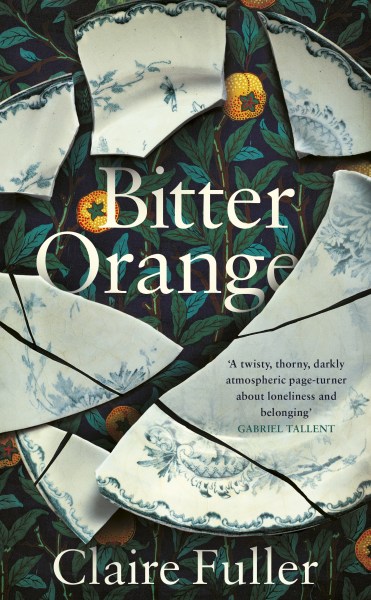
Review: Bitter Orange by Claire Fuller

Bitter Orange Book Cover

Bitter Orange [2018] – ★★★1/2 

Bitter Orange is Claire Fuller’s third novel in which she mixes a crime mystery, antique house drama (a hint on a love triangle) and melancholic nostalgia for the past. Her main character Frances feels like she was given a new lease of life when, at the age of thirty-nine, her previously bedridden mother is dead and she is assigned a task to catalogue garden architecture in a semi-abandoned mansion – Lyntons. At the house, she befriends a couple who rents the first floor of the building, and their present relationships and past come head to head to result in something explosive. Bitter Orange is an oddly evocative book, but also an oddly imperfect one. Sometimes frustratingly uneventful and slow, the book’s main fault is still its underwhelming, under-thought and already unoriginal characters, premise and ending. 

Continue reading “Review: Bitter Orange by Claire Fuller”

Review: Golden Child by Claire Adam

Golden Child Claire Adam
Continue reading “Review: Golden Child by Claire Adam”

Review: Idaho by Emily Ruskovich

Idaho Book Review
Continue reading “Review: Idaho by Emily Ruskovich”

Review: French Exit by Patrick DeWitt

French Exit Book Cover

French Exit [2018] – ★★★

This tragicomedy of manners comes from the author of Man Booker Prize nominee The Sisters Brothers [2011]. In French Exit, Patrick DeWitt centres on mother Frances, a fussy and bossy woman of sixty-five, and her good-for-nothing thirty-two year-old son, Malcolm, who see their fortune fade away after the ill-publicised death of the family provider Franklin Price, once an eminent lawyer in New York City. Once rich and admired, the family of two now face financial ruin and decide to go to Paris, perhaps, for a change of scenery. Frances’s only friend Joan provides an apartment to rent in Paris for them, and the duo of unlikely central characters embark on their French exploit enthusiastically, meeting eccentric characters along the way. This slightly surreal tragicomedy is an amusing enough read, but it is also often somewhat dull, with its emotional punch coming too late in this curious book. 

Continue reading “Review: French Exit by Patrick DeWitt”

Review: Serena by Ron Rash

Serena Book Cover Serena [2008] – ★★★★1/2

Will at Coot’s Reviews suggested that I read Serena by Ron Rash for my Appalachia Reading Challenge, and both H.P from Hillbilly Highways and Emma at Book Around the Corner also recommended that I read Rash’s work, so thank you! Serena pleasantly surprised me. This novel tells the story of a newly-wed couple the Pembertons who arrive to a logging community high up in North Carolina Mountains to take over a timber business there. Every worker at the camp is awed by Mrs Serena Pemberton, a woman so strong-willed and determined she can match any man’s will power or shrewdness. Masterfully-executed and beautifully-written, Serena evokes vividly both the beauty of North Carolina’s landscape and horrors involved in the business of cutting trees to make profit. Ron Rash even packs in the novel “slow-burn” suspense since Mr Pemberton’s past actions give rise to unforeseen consequences, and, as the couple arrive to North Carolina, with them also descends upon the village something disturbing and sinister.

Continue reading “Review: Serena by Ron Rash”

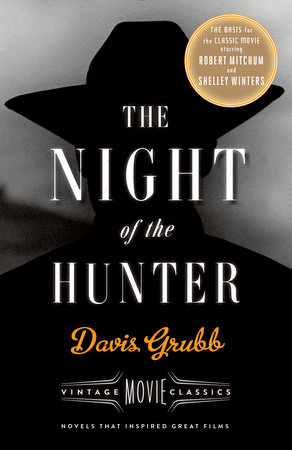
Review: The Night of the Hunter by Davis Grubb

The Night of the Hunter Book Cover

The Night of the Hunter [1953] – ★★★★★

The Night of the Hunter is best known as a film of 1955 by Charles Laughton, but it was first a great book by Davis Grubb, who based his story on a true case of serial killer Harry Powers, a deranged psychopath who preyed on and killed lonely widows in the late 1920s. In the book by Davis Grubb, Willa Harper is a recently widowed mother of two whose husband, Ben Harper, has recently been convicted and executed for killing two men in armed robbery. After the execution, Willa and her two children, John and Pearl, are the centre of sympathy in their community until their “salvation” arrives in the form of Harry Powell or “Preacher”. Preacher knows that Ben Harper disclosed to his children before his execution the location of ten thousand dollars he gained through robbery, and Preacher will use any means – kindness or more disturbing pressure to discover the location of the money. It is safe to say now that The Night of the Hunter was unjustly overshadowed by its cinematic counterpart. American writer Julia Keller called Davis Grubb’s book a “lost masterpiece”, and there is truth in that. The Night of the Hunter is a chilling, unforgettable tale of crime and evil set in the background of a Depression-hit community on a riverbank in West Virginia. The novel is suspenseful and thrilling, with great characterisations and an eerie atmosphere. 

Continue reading “Review: The Night of the Hunter by Davis Grubb”

Review: Fried Green Tomatoes at the Whistle Stop Café by Fannie Flagg

Fried Green Tomatoes Book Cover

Fried Green Tomatoes at the Whistle Stop Café [1987] – ★★★★

I may be sitting here at the Rose Terrace Nursing Home, but in my mind I’m over at the Whistle Stop Café having a plate of fried green tomatoes, Mrs. Cleo Threadgoode, June 1986 (preface quote to Flagg’s Fried Green Tomatoes at the Whistle Stop Café). This book is about two women – Evelyn Couch, a middle-aged housewife, and Ninny Threadgoode, an elderly woman in a nursing home, – meeting in 1985, and Ms Threadgoode starts to tell Evelyn about her youth spent in Whistle Stop, Alabama during the Depression era. Evelyn goes back in her mind to that time when Ms Threadgoode’s wild, free-spirited sister-in-law Idgie and her beautiful, soft-spoken friend Ruth ran a café in Whistle Stop, discovering the hardship they went through and the happiness they found. Mrs Threadgoode also hints at a murder mystery which got everyone talking in the 1930s in Whistle Stop. Fried Green Tomatoes at the Whistle Stop Cafe is a “feel-good” book at the centre of which is a powerful story of two women whose friendship and love enabled them to overcome obstacles in their way. Originally presented, paying special attention to the connecting power of food and cooking, the book also touches on such themes as racism, aging, marital violence, and finding hope in difficult times.

Continue reading “Review: Fried Green Tomatoes at the Whistle Stop Café by Fannie Flagg”

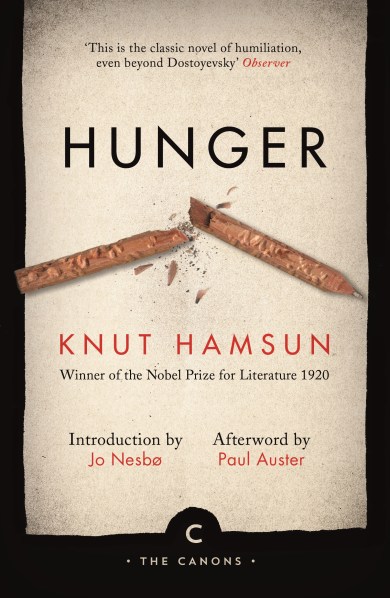
Review: Hunger by Knut Hamsun

Hunger Cover

Hunger [1890/1996] – ★★★★★

Knut Hamsun is a Nobel Prize Winner for Literature whose existentialist literary work Hunger predates Franz Kafka’s The Trial [1925] and Albert Camus’ The Stranger [1942]. Translated from the Norwegian by Sverre Lyngstad, Hunger explores the daily life of one lonely and desperate man on the brink of starvation in a large city. Our unnamed narrator is a freelance writer who has one “ambition” in his life: not to die from hunger. He is hard-working and not demanding, with food and shelter being his main wishes. Hamsun explores mental and physical traumas of the character in a masterful work that inspired some of the greatest philosophical fiction authors of the twentieth century, emphasising in his work that the fight to survive in a big city may take a shape of complete absurdity.

Continue reading “Review: Hunger by Knut Hamsun”

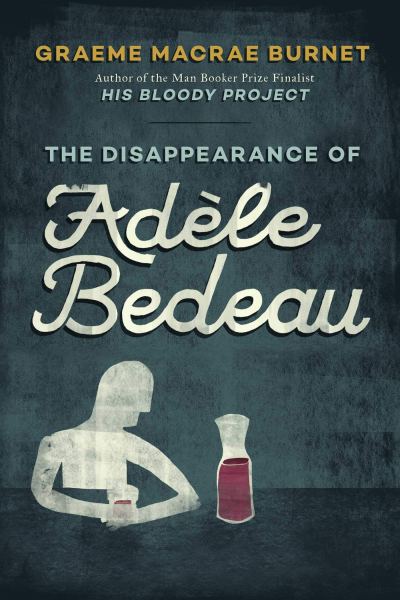
Review: The Disappearance of Adèle Bedeau by Graeme Macrae Burnet

The Disappearance of Adele Bedeau Cover

The Disappearance of Adèle Bedeau [2014] – ★★★★★

Graeme Macrae Burnet is a Scottish author best known for his Man Booker Prize nominated novel His Bloody Project [2015]. The Disappearance of Adèle Bedeau is his debut novel written in the style of a French mystery novel and film noir. Dark and intriguing, the novel tells the story of thirty-six-year old Manfred Baumann, a reclusive, lonely and socially awkward bank worker who spends his evenings in local Restaurant de la Cloche, Saint-Louis, France. When one attractive waitress of the restaurant – Adèle Bedeau disappears after a night-out, Detective Georges Gorski’s suspicions soon fall on Manfred Baumann and one unsolved past criminal case regains its spotlight. The Disappearance of Adèle Bedeau is written in that nostalgic style of old French mystery novels, echoing the works of Georges Simenon (Burnet’s favourite book is Simenon’s The Little Man from Archangel [1957]) or existential literature, such as Ernesto Sabato’s El Tunel [1948]. The Disappearance of Adèle Bedeau is an impressive, understated literary mystery with many subtle elements, convincing psychological character study, and one atmospheric setting.

Continue reading “Review: The Disappearance of Adèle Bedeau by Graeme Macrae Burnet”

Review: The Editor by Steven Rowley

The Editor Book Cover
Continue reading “Review: The Editor by Steven Rowley”

Review: When Rain Clouds Gather by Bessie Head

When Rain Clouds Gather Book Review

When Rain Clouds Gather [1969] – ★★★★★

You may see no rivers on the ground but we keep the rivers inside us. That is why all good things and all good people are called rain. Sometimes we see the rain clouds gather even though not a cloud appears in the sky. It is all in our heart” [Bessie Head, 1969: 191]. 

This is a tale of Makhaya, a refugee from South Africa, who desires to build his life anew in a small village of Golema Mmidi, Botswana. There, he meets eccentric Englishman Gilbert Balfour, who would like to revolutionise farming methods to help people of the village. Both men are running away from the past and are in search of wives. However, before both start to live free lives, trying to help others, they have to face and fight political corruption, unfavourable climatic conditions and village prejudice. When Rain Clouds Gather tells an important story of finding hope in the most hostile and dangerous conditions, and can really be considered a modern classic.

Continue reading “Review: When Rain Clouds Gather by Bessie Head”

Review: The Lost Steps by Alejo Carpentier

Los Pasos Perdidos Cover

The Lost Steps [1953/1989] – ★★★★1/2 

“…we let ourselves succumb to the world of wonder, eager for still greater portents. There arose beside the hearth, conjured up by Montsalvatje, the medicine men who healed the wounds with the magic incantation of Bogotá, the Amazon Queen, Cicanocohora, the amphibious men who slept at night in the bottoms of the lakes, and those whose sole nourishment was the scent of flowers” [Carpentier/de Onis, 1954/89: 144].

Los Pasos Perdidos or The Lost Steps was translated from the Spanish by Harriet de Onis and represents what is believed to be one of the most important Latin American novels to come out in the twentieth century. In this story, our unnamed narrator (believed to be in New York) is sent on a mission to a jungle (believed to be in Venezuela) to discover and collect some ancient musical instruments for a museum. By accepting this request, the narrator has no idea that he is about to embark on one extraordinary journey of self-realisation and self-discovery, which will force him to rethink his previous inculcated beliefs. The Lost Steps is a complex literary work which sometimes slides into being rather metaphysical in nature, but without losing its conviction or power. Carpentier weaves his story in a beautiful, even though enigmatic, language, and the result is a book which puzzles, impresses and astonishes.

Continue reading “Review: The Lost Steps by Alejo Carpentier”

Review: Shipwrecks by Akira Yoshimura

Shipwrecks Book Cover Shipwrecks [1982/96] – ★★★★★

Yoshimura’s observational novel is fascinating and subtly powerful, uncovering a different way of looking at life.

Shipwrecks is a short novel translated from the Japanese by Mark Ealey. It tells the story of one village in rural medieval Japan, following one boy Isaku, as his family struggles to get food essential for their survival. The village has numerous rituals, but one is particularly eerie: the village does everything it can to summon OFune-Sama (the Sea God) or shipwrecks to their coast. This phenomenon is often essential for the survival of the village (since ships carry the necessary food and other commodities), and Isaku and his family are always eagerly awaiting the season when O-Fune-Sama or shipwrecks occur. One day, such a ship does come to the shore where Isaku lives, but will it be a blessing or curse for the village? Those who like books with discernible plot points and fast-paced action should look elsewhere. Shipwrecks by Yoshimura is rather slow and contemplative as it follows day-to-day activities of one village that has one strange, but understandable desire. Continue reading “Review: Shipwrecks by Akira Yoshimura”

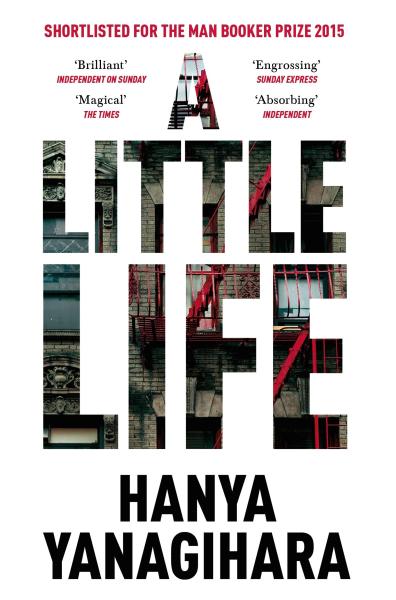
Review: A Little Life by Hanya Yanagihara

A Little Life Book Cover A Little Life [2015] – ★★★★1/2 

Once we are lost unto ourselves, everything else is lost to us” (Johann Wolfgang von Goethe, The Sorrows of Young Werther).

Initially, this Man Booker Prize Nominee is about four friends who try to succeed in New York City after their graduation. Willem is a kind soul and an aspiring actor, JB is a gregarious party-goer and carefree artist, Malcolm is a grounded man, but increasingly disillusioned architect, and, finally, Jude is a brilliant lawyer, but also a man who harbours a secret past which torments him every day and every night. Will friendship and love triumph over the traumas and cruelties of life? This book does depict trauma, distress and violence stemming from the abuse of a child in the past, but, like Yanagihara’s debut, A Little Life is also a beautifully-written and intelligently-constructed novel with significant themes that must have their place in literature. Like the author’s debut, it is sometimes a painfully repetitive read, and Yanagihara drives her main message too torturously in it. However, it is incorrect to view the book as being solely about bad things happening. No person should be defined (or should feel to be defined) by the past trauma that was unfairly inflicted upon them, and the book sends an important message out, becoming a touching and emotional tribute to the power, loyalty and sacrifices of friendship and love, even if that tribute is too thickly wrapped in the pain of our main atypical and mysterious character – Jude St. Francis. 

Continue reading “Review: A Little Life by Hanya Yanagihara”

Review: The Three Stigmata of Palmer Eldritch by Philip K. Dick

The Three Stigmata Philip K Dick Cover

The Three Stigmata of Palmer Eldritch [1964]★★★★1/2 

This is my fourth Philip K. Dick novel (previously, I read Do Androids Dream of Electric Sheep? [1968], A Scanner Darkly [1977] and Ubik [1969]). This story is set in future and follows Barney Mayerson, an employee of P.P (Perky Pat) Layouts, a firm which specialises in providing layouts which can be used for drug experience when customers (those in space colonies) take illegal hallucinatory drug Can-D, which can recreate a perfect life when one takes it. Mayerson finds out that Palmer Eldritch, a man who went to another star system some years previous, has returned to the Solar System and is bringing with him an even more potent drug than Can-D, and it is called Chew-Z. However, soon suspicions mount that the experience with Chew-Z may not be what everybody thinks it is. The Three Stigmata of Palmer Eldritch is messier and more chaotic that some of the author’s later, better known novels, but it is still an entertaining read with all the expected typically Philip K. Dick philosophical considerations and thought-provoking situations. Even if the world he presents this time is tackier and crazier than usual, the author still manages to suspend our disbelief as we plunge deep into this addictive and well-constructed futuristic world where our usual understanding of reality is turned upside down. 

Continue reading “Review: The Three Stigmata of Palmer Eldritch by Philip K. Dick”

Review: The Twin by Gerbrand Bakker

The Twin Book Cover

The Twin [2006/08] – ★★★★

The Twin, translated from the Dutch by David Colmer, is that type of a book which should not work, but somehow it does. It should not work because it is too introspective and has the drama and suspense which are way too subtle. In this book, Helmer van Wonderen is a fifty-seven year old man who is living on an isolated farm in the Netherlands, carrying for his aging father. His identical twin brother Henk, a farmer, died many years before, forcing Helmer to return home to work as a farm hand, helping his father. When his brother’s ex fiancée Riet arrives to the area, bringing her unruly son with her (who is also named Henk), Helmer is forced to confront his painful past, as well as his choices in life. The Twin may be a very “slow” novel, but where it lacks in pace, it makes up for in atmosphere and landscape descriptions. It also has barely perceivable emotional resonance that can be felt in the main character’s words and actions. 

Continue reading “Review: The Twin by Gerbrand Bakker”

Review: Sweet Bean Paste by Durian Sukegawa

Sweet-Bean-Paste-cover

Sweet Bean Paste [2013/2017] – ★★★★★

The aroma seemed to leap up at him, as if it were alive, racing through his nose to the back of his head. Unlike the ready-made paste, this was the smell of fresh, living beans. It had depth. It had life. A mellow, sweet taste unfurled inside Sentaro’s mouth” [Sukegawa/Watts, 2013: 33]. 

This book, translated from the Japanese by Alison Watts (see also the film trailer here), tells a story of Sentaro, a middle-aged man who spends his time unenthusiastically selling dorayaki, a kind of pancake filled with sweet bean paste, to customers at the Doraharu shop, while consuming alcoholic drinks in his spare time. When an elderly woman Tokue approaches his shop and asks to work there, Sentaro first thinks it is a joke. However, Sentaro also tastes the bean paste cooked by Tokue and he is amazed by the flavours she can produce. What follows is a touching human story filled with the passion for food and the importance of appreciating small pleasures in life. Sweet Bean Paste is also so much more than a book about Japanese culinary delights and culture. It is a quietly beautiful book with the message of coming to terms with history, accepting people and recognising their talents no matter how small they may appear. Each person can contribute something to this world if others are willing to listen, learn and accept. 

Continue reading “Review: Sweet Bean Paste by Durian Sukegawa”

Review: The Decagon House Murders by Yukito Ayatsuji

The Decagon House Murders Cover
Continue reading “Review: The Decagon House Murders by Yukito Ayatsuji”

Review: Drive Your Plow Over the Bones of the Dead by Olga Tokarczuk

Drive Your Plow Book Cover Drive Your Plow Over the Bones of the Dead [2009/18] – ★★★★1/2 

This book by Olga Tokarczuk (the winner of the International Booker Prize Award for Flights) was translated from the Polish in 2018 by Antonia Lloyd-Jones. In this story, an eccentric elderly woman Janina Duszejko recounts a series of murders happening in her small village near Kłodzko, Poland. Her neighbour’s death follows that of other hunting men in the vicinity, and suspicions begin to mount. Janina has her own unusual theories about the murders, and these involve animals. But, is she really a new Polish Miss Marple? Tokarczuk did not just write a detective story – her book combines existential philosophy, animal rights and village politics (small people vs. big power) theses, unchangeable horoscope arguments and literary (William Blake) references to produce one of a kind story whose main narrator steals every other page with her insightful and often bizarre observations. Drive Your Plow Over the Bones of the Dead is a strange literary concoction, but also an atmospheric and intelligent one. 

Continue reading “Review: Drive Your Plow Over the Bones of the Dead by Olga Tokarczuk”

Review: The People in the Trees by Hanya Yanagihara

The People in the Trees CoverThe People in the Trees [2013] – ★★★★1/2  

Yanagihara fuses pseudo-factual scientific writings with some fantastical elements to rather impressive results, and it all would have been rather pleasing if the content were not also so devastatingly horrific.

The People in the Trees is a debut novel of Hanya Yanagihara, a writer now best known for her second book A Little Life, a 2015 Man Booker Prize nominee. The People in the Trees is partly an anthropological travelogue, partly a jungle adventure mystery, and party a covert character study, having enough disturbing elements to make its readers feel uncomfortable. However, these do not make the book any less masterful.

Beautifully-written, The People in the Trees reads for the most part like a memoir detailing Dr Norton Perina’s travel to an isolated Micronesian island country in the 1950s to find and study a “lost tribe”. He did so alongside a talented anthropologist Dr Tallent (who is himself a mystery) and Tallent’s colleague Esme Duff. The mysteries Perina uncovers on the island are shockingly significant, revolutionising what is known about science/medicine and having to do with immortality. The only thing that lets this ambitious book down is that Yanagihara cannot quite manage to strike a balance or make a smooth transition between the book passages that detail the implications of Perina’s island discovery and later elements which deal with Perina’s own character insights.

Continue reading “Review: The People in the Trees by Hanya Yanagihara”

Review: The Beautiful Mystery by Louise Penny

The Beautiful Mystery Book Cover The Beautiful Mystery [2012] – ★★★★ 

Louise Penny is an award-winning Canadian author and this is her eight Inspector Gamache detective mystery. The book is about a murder that happened in a mysterious 400 year old monastery somewhere in the northern Quebec. Twenty-three devoted-to-music monks are grieving for their murdered music director who was killed in the most merciless way. Inspector Gamache and his second-in-command Beauvoir are called to investigate and instantly become enchanted by the divine ancient chants of the eccentric and reclusive monks. But, who killed Frère Mathieu and for what purpose? Clues have been left behind, and, as the investigation slowly moves forward, Gamache realises that he has to first solve one ancient mystery of religious music before he gets to the identity of the murderer. It is so hard nowadays to find a quality detective novel and this book ticks almost all the boxes for me. In The Beautiful Mystery, there is one single eerie location setting, a focus on internal thinking/motivations of the characters, including their dynamics, and an unusual element, since the emphasis is also on mysterious ancient music. The Beautiful Mystery may suffer from having two narratives (a murder investigation and a previous case discussion), which run uncomfortably side by side, and the result is not altogether unpredictable. However, the book is still suspenseful (maybe too suspenseful), and the location and music described are just too beautiful and intriguing not to be impressed. In that way, an attempt to fuse beauty and darkness is the forte of this book.  Continue reading “Review: The Beautiful Mystery by Louise Penny”

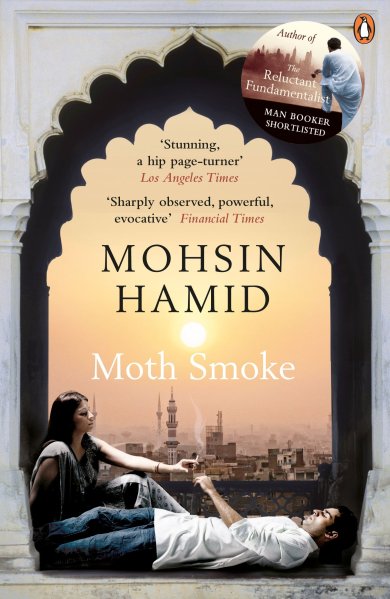
Review: Moth Smoke by Mohsin Hamid

Moth Smoke Cover

Moth Smoke [2000] – ★★★★1/2    

In Moth Smoke, Darashikoh Shezad or Daru is a hash-smoking banker living in Lahore, Pakistan who rekindles his friendship with his childhood friend Ozi, who is now an influential and rich man living under the protection of his equally influential, but corrupt father. Daru also realises that he is attracted to Ozi’s wife Mumtaz, and, among his friends is also a shady character named Murad Badshah, who sometimes acts as his drugs supplier. After Daru is fired from his job, his societal divide from influential and rich Ozi grows even further, and he finds himself on the dark path towards immorality and crime. Moth Smoke is a fascinating, eye-opening journey into Lahore’s criminal underbelly, which makes observations on the societal class divisions and the east vs. west mentality conflict. But, it is also so much more than that: it has an experimental structure and style (with at least four unreliable narrators); employs symbolism and fable-like story-telling; and becomes a book about the limits of morality, friendship and love, while also exploring the nature of guilt and the malleability of truth.

Continue reading “Review: Moth Smoke by Mohsin Hamid”

Review: The Night Circus by Erin Morgenstern

The Night Circus Cover

The Night Circus [2011] – ★★★1/2 

The Harry Potter generation is growing up, becoming a dominant group of consumers, and it seems that those books that contain magic or fairy-tale elements have the biggest chance of success in the market (see also Jonathan Strange & Mr Norrell [2004]). The Night Circus can be considered as yet another book which was written on the back of the success of Harry Potter and its atmosphere of magic. The Night Circus was also originally written as part the NaNoWriMo competition, and contains non-linear, multiple viewpoints narrative. In this story, two “magicians” have arranged for their protégés to compete against each other in a mysterious magic competition. Hector has bound his young daughter Celia to compete against Marco, a protégé of a mysterious man named only as Alexander. Little the “magicians” suspect that Celia and Marco may grow up to be attracted to each other romantically, meaning that the competition may end up to be far from the battle it is meant to be. Meanwhile, Chandresh Lefèvre, a theatrical producer, has plans to set up a different kind of a circus, which functions as a completely “immersive entertainment” for the crowds, providing “a unique experience, a feast for the senses” [Morgenstern, 2011: 74].

Continue reading “Review: The Night Circus by Erin Morgenstern”

Review: Tangerine by Christine Mangan

Tangerine Book Cover

Tangerine [2018] – ★★★★   

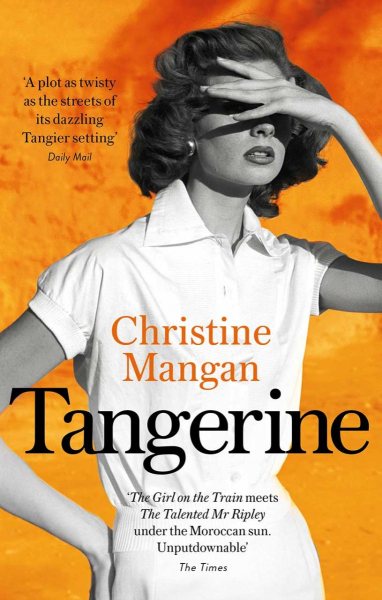
Tangerine is a debut novel which is now both gaining visibility and provoking some strong reactions – there are apparently as many people who love this book as there are those who hate it. The story is about two women – Alice and Lucy, who take turns in the story to share their thoughts on past and present events. Alice, who shared friendship with Lucy in the past, is now married and lives with her husband John in Tangier, Morocco. Unexpectedly, Lucy also arrives to Tangier to rekindle her friendship with Alice after a year of separation. When John disappears, Alice and Lucy have to question both their relationship and their lucidity. The downside is that Mangan’s book gets much too close in its plot and characters to Patricia Highsmith’s novel The Talented Mr Ripley [1955], but it is still an intriguing and enjoyable read. Mangan uses simple language and manages to weave a thriller which is slow-burning and deeply psychological, while also vividly evoking the colours of Morocco. 

Continue reading “Review: Tangerine by Christine Mangan”

Review: Please Look After Mother by Kyung-sook Shin

Please Look After Mother Cover Please Look After Mother [2008] – ★★★★  

“To you, Mother was always Mother. It never occurred to you that she had once taken her first step, or had once been three or twelve or twenty years old. Mother was Mother. She was born as Mother” [Kyung-sook Shin, 2008/11: 27].

It is time for me to press on with the Year of the Asian Reading Challenge (YARC), and I am continuing with this challenge by reviewing a book by another South Korean author. In 2008, Kyungsook Shin wrote a book Please Look After Mother, which has now sold more than two million copies and gained numerous prizes. Incidentally, the novel was translated in 2011 by Chi-young Kim, a female literary translator who also translated Young-Ha Kim’s I Have the Right to Destroy Myself. In this book, grown-up children of a family in South Korea are missing their mother. She disappeared at the Seoul Station while trying to catch an underground train with Father. Mother in this family has always been that unnoticeable centre of love and care to be relied upon at any time, and the book then asks – what if one day this stable and unnoticeable foundation crumbles? Upon the disappearance of Mother in the story, each of the children, as well as Father, are forced to rethink their previous image of Mother, recalling memories of the person they realise they hardly new and should have cherished more. Telling the story from different character perspectives, this book by Kyung-sook Shin is a little gem – insightful, bitter-sweet, moving and, finally, quietly heartbreaking.  Continue reading “Review: Please Look After Mother by Kyung-sook Shin”

Review: Texaco by Patrick Chamoiseau

texaco book cover

Texaco [1992] – ★★★★★ 

Chamoiseau’s colonial-themed magnum opus is a story of and by the generations who fought hard for their right to exist and prosper, and it is this unique perspective which makes the book so exceptional.  

You say “History” but that means nothing. So many lives, so many destinies, so many tracks go into the making of our unique path. You dare say History, but I say histories, stories. The one you take for the master stem of our manioc is but one stem among many others.…” 

Some books shine through times, forever stirring spirits” [Chamoiseau, 1992/7: 325].

Some books have such a distinct, authentic voice, telling of the plight of ordinary people, that they cannot fail to move, defying logical analyses. Martinique-born Patrick Chamoiseau wrote one such emotionally powerful book with one such distinctive voice, and it is titled Texaco, translated from the French by Rose-Myriam Rejouis and Val Vinokurov. The book, which also received the prestigious Prix Goncourt in 1992, reads almost like a fable, evading strict categorisations. 

Continue reading “Review: Texaco by Patrick Chamoiseau”

Review: The Bedlam Stacks by Natasha Pulley

The Bedlam Stacks Cover The Bedlam Stacks [2017] – ★★★

You’re not off to find the Northwest Passage on a thousand-mile plain of ice populated by six Esquimaux and an owl. It’s only Peru” [Pulley, 2017: 46].

When I found out that there is a book set in Peru, takes place in the 19th century, and concerns itself with Incan mythology, I knew immediately I had to read it because all these things appeal to me immensely. In the book by Pulley, we meet an explorer Merrick Tremayne, previously of the East India Company, who now resides in Cornwall with his brother. He has an injured leg and no prospects in England since his family fortunes are in decline. When his friend Clem visits him and suggest that he goes to Peru to fetch cinchona cuttings (which yields quinine), which can then help to cure malaria in India (on the orders of the East India Company), it seems like an impossible task. This is not least because there is a local monopoly regarding the trees in the region, and the journey can prove to be very dangerous. Merrick goes to Peru, with the aim to reach the village of Bethlehem or Bedlam, and soon finds that he needs to rethink his understanding of indigenous traditions, history and beliefs, and do it quickly if he wants to survive. The Bedlam Stacks is steeped in Incan folklore and has an eerie atmosphere, providing for a curious read. However, this book was definitely not a page-turner for me. It has a messy and confusing overall theme, caricature presentations, some unclear and dull descriptions, and – what I believe – a very unsympathetic character in the centre, all making the reading experience less enjoyable.  Continue reading “Review: The Bedlam Stacks by Natasha Pulley”

Review: Faceless Killers by Henning Mankell

Faceless Killers Book Review

Faceless Killers [1991] – ★★★  

This is the first book in the Kurt Wallander detective series penned by Henning Mankell, a Swedish author, who in 1992 won for this book the first ever Glass Key Award, given to authors from the Nordic countries. The translation of 1997 is by Steven T. Murray. In this story, Inspector Wallander is called upon to investigate the savage double murder in Lunnarp, Skåne. A husband and wife (Johannes and Maria Lövgren) are found brutally killed with mysterious clues left behind, such as the fact that the killers allegedly fed the farm horse before they left. The investigation team soon notice that the area where the murders happened is very isolated, relatively peaceful, and they have no immediate suspects. As the investigation continues, Inspector Wallander confronts clues that point to the possibility of foreign nationals being responsible for the murders, and then have to deal with the hate crime and racially-motivated attacks. If the first part of this book is this exciting mystery-thriller where we also delve into the character of Wallander and uncover the extent of his personal problems, the second part of the book is a less compelling narrative of an investigation of another crime which leads to a predictable conclusion. 

Continue reading “Review: Faceless Killers by Henning Mankell”

Review: I Have the Right to Destroy Myself by Young-Ha Kim

book cover 2

I Have the Right to Destroy Myself [1996] – ★★★★ 

This will be my first book review as part of The Year of the Asian Reading Challenge 2019. Kim Young-Ha is a South Korean author and this is his debut novel, which was first translated into English by Chi-Young Kim in 2007. The book is set in Seoul and deals with rather dark and uncomfortable issues. Death is a prominent theme of this little book, and, even though it delivers a curious read, it is also rather shocking and racy at times, so giving a warning is justified. In the story, our unnamed narrator helps his clients to commit a suicide, and we also follow the lives of C and K, two brothers, who compete with each other for the attention of one enigmatic woman – Se-yeon. The author packs many thought-provoking messages into this novel, reflecting on art and popular culture, but also on the nature of truth, loneliness and dying. The enigmatic structure of the book, as well as the ambiguousness related to the identities of the characters in the story, guarantee that the read is interesting, even if morbidly appealing.

Continue reading “Review: I Have the Right to Destroy Myself by Young-Ha Kim”

Review: Hotel du Lac by Anita Brookner

hotel du lac book cover

Hotel du Lac [1984] – ★★★★1/2 

From the window all that could be seen was a receding area of grey. It was to be supposed that beyond the grey garden, which seemed to sprout nothing but the stiffish leaves of some unfamiliar plant, lay the vast grey lake, spreading like an anaesthetic towards the invisible further shore, and beyond that, in imagination only, yet verified by the brochure, the peak of the Dent d’Oche, on which snow might already be slightly and silently falling [Brookner, 1984: 7], so begins the short novel by Anita Brookner, who was the recipient of the Man Booker Prize in 1984.

Clearly, after such an opening, one would expect a rich, highly-descriptive, beautifully-written observational novel of some insight, and this is exactly what the reader gets. Those who are after some fast-paced action in their books should look elsewhere because Hotel du Lac is a quietly powerful, almost reflective, character-driven novel at the heart of which is one embarrassingly unmarried female heroine Edith Hope, an idealistic writer, who abandons her London home for a holiday getaway to be spent in a respectable hotel-establishment in Switzerland. At the Hotel du Lac, Edith encounters a puzzling-to-her company until she finally meets Mr Neville, a gentleman who may finally help our hopeless heroine to gain esteem and respectability in the eyes of society. 

Continue reading “Review: Hotel du Lac by Anita Brookner”

Review: Washington Black by Esi Edugyan

washington black cover

Washington Black [2018] – ★★★ 

Shortlisted for the Man Booker Prize 2018, Washington Black has certainly been on many readers’ radar. This is the tale of Washington Black, a young boy who is initially a slave on a plantation in Barbados. This is where we begin the journey: the year is 1830 and the setting is Faith Plantation, Barbados. Young Washington (or Wash) is raised by Big Kit, a female slave, who looks after him. Like the rest, Wash witnesses the death of his old master, and sees how his new master – cruel Erasmus Wilde – takes control of the farm. Wash then becomes an assistant to the eccentric brother of Erasmus – Christopher Wilde or just Titch. What follows is the adventure which Wash never imagined (but we, probably, all did). In fact, as an adventure, the story is predictable, rather boring, at times too unbelievable, and, strangely, unexciting. Edugyan introduced several exciting and even original plot lines (such as scientific endeavours), but all of them are dropped before they are allowed to continue. The characters are rather shallow, and even though the beginning and writing are strong, the issue is still that there is nothing fresh in this story – it follows a very familiar journey. The author has virtually nothing original or fascinating to add to an already long and established (“done-to-death”) literary theme of slave liberation, and hardship and discrimination experienced by a community outcast living in the early nineteenth century.

Continue reading “Review: Washington Black by Esi Edugyan”

Review: Jonathan Strange & Mr Norrell by Susanna Clarke

jonathan strange & mr norrell book cover

Jonathan Strange & Mr Norrell [2004] – ★★★★★

Neil Gaiman called Jonathan Strange & Mr Norrellthe finest English novel of the fantastic written in the last seventy years”. This hits the mark. It is a very long book, but it is totally absorbing from the very first page. The novel begins in autumn 1806 with Mr Segundus, a theoretical magician, wanting to know why there was no more magic done in England. He is a new addition to the society of magicians in York, England. Practical magic has declined in England and there are apparently no practising magicians left in the country. The profession of a practising magician has fallen in reputation, and Mr Segundus comes to inquire of another magician who lives in Yorkshire why this is the case. He finds, however, that not only the reclusive Mr Norrell has an established library filled with rare books on the practice of magic, he also claims to be a practising magician himself! Mr Norrell soon desires to establish himself as the only practising magician in the country.

The episodic-in-nature plot is delightful to read, and, in style, reminds of Dickens’s Bleak House [1853]. Delving into the British folklore, Clarke opens up a fascinating magical world, which you will not want to leave. Inside the book, one will find a gripping adventure-mystery, great characterisation, unforgettable atmosphere, humorous sequences, and the masterful use of the language. The book’s story, format, style and language all give the impression as though the book was written back when it was set – in the 19th century. In sum, Jonathan Strange & Mr Norrell is quite brilliant in every respect, and, as I would like to discuss the book here in some depth, the following review will contain spoilers.

Continue reading “Review: Jonathan Strange & Mr Norrell by Susanna Clarke”

Review: The Hour of the Star by Clarice Lispector

the hour of the star cover

The Hour of the Star [1977] – ★★★★★ 

Clarice Lispector’s finest achievement, one unusual story which is also emotional, philosophical, brave and inventive.

This thought-provoking novella by Clarice Lispector was translated from Portuguese by Benjamin Moser. It is narrated by one man Rodrigo S.M. who tells the tale of Macabéa, an ordinary girl from the northeast, who tries to make ends meet living in the slums of Rio de Janeiro, Brazil. The novella is very unusual because, before the narrator gets to the crux of the story, he spends quite some time musing on the task at hand – how to write this story (for example, should the writer undergo some “transformation” before writing?), and whether there is any point in doing so since fiction may never capture the real truth. Despite its short length, the book tells an immersive and emotional story, while the author, through her narrator, also meditates on human existence and the meaning of life.

Continue reading “Review: The Hour of the Star by Clarice Lispector”

Review: The Dry by Jane Harper

the dry cover1

The Dry [2016] – ★★★1/2

This bestseller is a debut novel of Jane Harper. It is a murder mystery with two tragedies at the heart of it. The setting is a small town of Kiewarra, Australia that was shaken by the gruesome murders of the Hadler family: Luke, Karen and their son Billy. The official version is that Luke, the father, killed his family before committing suicide. But is this open-and-shut case as straightforward as it seems? Aaron Falk, a police officer in Melbourne, arrives to his native town of Kiewarra for the funeral of his estranged pal Luke, and finds out that there is more to the deaths than first meets the eye. The Dry turns out to be a good, atmospheric book, but not necessarily because of the story. The story is actually quite typical in the genre of “small community” mysteries and not something extraordinary or special at all. What elevates this book above many others is the assured execution of the plot, the particular atmosphere conveyed, as well as some insightful character study. All this provides for an emotional and engaging read.

Continue reading “Review: The Dry by Jane Harper”

Review: The Last Children of Tokyo by Yoko Tawada

The Last Children of Tokyo CoverThe Last Children of Tokyo [2014] – ★★★★

The short novella is a beautiful and unsettling evocation of the future.

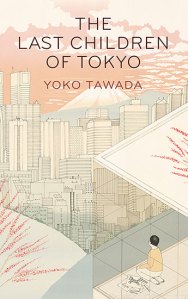
Yoko Tawada sets her book in near-future Japan where the elderly regain their powers and live beyond one hundred years old, while the young become weak and sickly. Everyone is worried in the story because, due to some catastrophe, “the human race may be evolving in a direction no one ever imagined” [Tawada, 2014: 14]. The central characters are an old man called Yoshiro and an orphaned boy named Mumei. While Yoshiro is the very definition of health and vigour at his age of one hundred plus, his great-grandson Mumei is feverish, vitamin-deficient, and in the course to face a slow death. Translated by Margaret Mitsutani, Tawada’s dystopian novel is a fascinating read, even though most of the time it reads like an essay on some highly imaginative dystopian future, rather than like a story with a linear plot. Continue reading “Review: The Last Children of Tokyo by Yoko Tawada”

Review: The Time of the Hero by Mario Vargas Llosa

The Time of the Hero

The Time of the Hero [1963] – ★★★★

The Time of the Hero (La Cuidad y Los Perros) is a controversial novel written by Nobel Prize winner Mario Vargas Llosa. The fictional story takes place in Lima, Peru at the Leoncio Prado Military Academy, a military educational establishment once attended by the author. In the story, a group of cadets is trying to steal the questions to the forthcoming chemistry exam, while being involved in a number of other similar “illicit” activities, such as fighting among themselves, bullying younger year groups and drinking. Little everyone knows that one careless action while trying to copy the exam leads to one irreparable tragedy and the shocking cover-up. It is without any doubt that The Time of the Hero is a literary work of great importance. The novel may not be easy or enjoyable to read, but its message is powerful, its themes – timeless, and its simple story is all the more significant for portraying what it means to be human and good in a society where cunningness, forcefulness and competitiveness are encouraged and lauded.  

Continue reading “Review: The Time of the Hero by Mario Vargas Llosa”

Review: The Miniaturist by Jessie Burton

the miniaturist coverThe Miniaturist [2014] – ★★

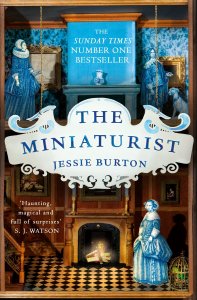
The Miniaturist, “The Sunday Times Number One Bestseller”, has received much praise, but is all the hype justified? The original idea for the book came to the author in Amsterdam, where Burton first saw Petronella Oortman’s cabinet house at the the Rijksmuseum. In her fictional story set in the 1680s, eighteen-year old Nella comes to Amsterdam after her advantageous marriage to an older rich merchant Johannes Brandt. Nella finds out that Johannes lives in a house with his domineering sister Marin, and soon begins to question the security of her husband’s finances. When Johannes gifts Nella a miniature doll house, which is the exact replica of their own home, Nella does not hesitate to ask for services from an elusive miniaturist, leading to unpredictable turns of events. This atmospheric novel is perfectly readable, but it is also too simplistic and melodramatic. Even worse, despite some obvious hints, The Miniaturist does not put its main mystery about the miniaturist or the doll house (the cabinet) at the centre for the readers to uncover; the novel’s male characters are superficial; and its surprises – preposterous. The plot does not go anywhere or reveal anything of substance, and the actions of the characters are as nonsensical as the ending is unsatisfying.  Continue reading “Review: The Miniaturist by Jessie Burton”

Review: A Scanner Darkly by Philip K. Dick

A Scanner Darkly Book Review

A Scanner Darkly [1977] – ★★★★1/2

In this novel by the brilliant science-fiction writer Philip K. Dick the setting is dystopia some time in future and the location is Anaheim, California. Bob Arctor (also known as Fred) is an undercover narcotics agent working for authorities while pretending to be a drug addict. His task is to trace dealers, including his on-off girlfriend Donna, to a source of drug supply. Other major drugs aside, the one drug which really causes havoc in the dystopian future is Substance D, a highly addictive matter, which, in a long-run, causes a strange and irreversible brain damage. Arctor knows all the dangers, but the problem is that no one is immune, and, soon, the undercover agent senses that he has gone too far in his goal to make himself indistinguishable from his drug addict pals. Due to the subject matter, this atmospheric story is far from being a comfortable read, but it is also fair to say that A Scanner Darkly is a philosophically and psychologically insightful work of science fiction with the strong character study at its core, as well as witty dialogues and a powerful message. 

Continue reading “Review: A Scanner Darkly by Philip K. Dick”

Review: News of the World by Paulette Jiles

news of the world cover

News of the World [2016] – ★★★★★

He broke down the .38, cleaned it, reassembled it. He made a list: feed, flour, ammunition, soap, beef, candles, faith, hope, charity” [Jiles, 2016: 177].

The story begins at Wichita Falls, Texas during the winter of 1870 and centres on Captain Kidd, aged seventy-one, who “travel[s] from town to town in North Texas with his newspapers and read[s] aloud the news of the day to assemblies” [Jiles, 2016: 3]. When Captain Kidd comes across a little girl who has recently been an Indian native and is now abandoned to the newness and vulgarities of the civilised world, Captain promises to deliver the girl back to her German-American family in South Texas. The issue for Captain Kidd is that Johanna was taken captive at the age of six and now, at the age of ten, considers herself a Kiowa. What follows is the journey of two vulnerable people on the treacherous road to the area of San Antonio, where Johanna’s aunt and uncle allegedly await her return. This is not only a tale of an exciting journey through the American South, which delves into the culture of native tribes, but also an emotional journey of two people whose resilience to hardship and kindness to strangers are the only guarantors of their survival. 

Continue reading “Review: News of the World by Paulette Jiles”

Review: Burial Rites by Hannah Kent

Burial Rites Book Cover
Continue reading “Review: Burial Rites by Hannah Kent”

Review: The God of Small Things by Arundhati Roy

The God of Small Things Cover

The God of Small Things [1997] – ★★★★★

Once in awhile a book comes your way which is so powerful in its message, so inexplicably poetic in its presentation and so wondrous in its understated emotion that you may wonder how come you have not read it yet. The God of Small Things by Arundhati Roy is that book to me. The notable feature of the book is that it is a debut novel which won the Booker Prize for Fiction in 1997. It takes a cross-generational approach to tell the story, but at the heart of the plot is a pair of twins – brother and sister – seven-year old Estha and Rahel respectively – who grow up in Ayemenem, part of Kerala, India, in the late 1960s. This is a turbulent time to grow up because there is political unrest and uncertainty in the country, and financial and other hardships, as well as all kinds of injustice, are seen as just part and parcel of life. However, the twins are not concerned with the Big Things, and are eagerly anticipating the arrival of their nine year-old English cousin Sophie Mol. Her father and the twins’ uncle Chacko are welcoming his ex-wife Margaret and his daughter to India. At the height of all the excitement, however, everyone is quite oblivious to the dangers lurking just on the periphery of their lives, and these dangers seem to just wait for all the circumstances to conspire in their favour to strike the final blow into the very heart of the small lives of Ayemenem.

Continue reading “Review: The God of Small Things by Arundhati Roy”

Review: The Mystery of the Yellow Room by Gaston Leroux

The Mystery of the Yellow Room Cover

The Mystery of the Yellow Room [1907] – ★★★★

Obvious signs have never been anything to me but servants; they never were my masters. They never made me that monstrous thing, a thousand times worse than a blind man – a man who cannot see straight” [Leroux, 1907/Ed. 2010: 126]. 

This French author influenced Agatha Christie and wrote The Phantom of the Opera [1910]. His name is Gaston Leroux, and some claim that his The Mystery of the Yellow Room is the greatest detective story in the world. This is a serious claim, but his story is also an ambitious one. Influenced by the stories of Conan Doyle and Edgar Allan Poe, Leroux conjured up his own, deciding to focus on the most fascinating of cases – the seemingly impossible crime.

Miss Stangerson gets attacked in the Yellow Room of the Château du Glandier in a manner which says that her attempted assassin could not have easily come to the room, and nor could he have escaped from it at all after the attack. Miss Stangerson locked the room behind her when she went to her room and got attacked, and the adjoining room was occupied by her father Mr Stangerson and Old Jacques, their employee. The crime could not have been committed, or could it have? The case falls into the hands of a young crime journalist Joseph Rouletabille, and the young man is determined to prove that he is a match for famous criminal investigator Frédéric Larsan.

Continue reading “Review: The Mystery of the Yellow Room by Gaston Leroux”

Review: The Seven Deaths of Evelyn Hardcastle by Stuart Turton

The Seven Deaths of Evelyn Hardcastle Cover
Continue reading “Review: The Seven Deaths of Evelyn Hardcastle by Stuart Turton”

The Turn of the Screw: A Ghost Story or A Tale of Mental Breakdown?

the turn of the screw book cover

<<This review will contain spoilers 👻>>  

Wasn’t it just a story-book over which I had fallen a-doze and a-dream?” [James, Ed. 2004: 33].  

This is a horror novella penned by James in 1898 at the invitation of Robert J. Collier for his magazine. First published as a series, it tells of a hired governess who comes to Bly, a country estate in Essex, to supervise two children, Miles and Flora. The children are orphans under the responsibility of their uncle who, in turn, does not have much time to spend with them and resides in London. The young governess willingly assumes her responsibilities, being totally delighted to be in charge of two beautiful, lovely and well-behaved children in such a grand estate. However, Bly soon opens its horrors to the governess, and she becomes aware that there are at least two ghosts in the house that haunt the children. The Turn of the Screw is now infamous for its multiple story interpretations and all kinds of meanings that can be read into the text. Nevertheless, whether one reads the story as a straightforward ghost tale or as a more complex psychological study of one nanny losing her mind, it is still a scary and intriguing read, which leaves much to think about and discuss upon finishing. 

Continue reading “The Turn of the Screw: A Ghost Story or A Tale of Mental Breakdown?”

Review: The Luminaries by Eleanor Catton

The Luminaries Book Cover

The Luminaries [2013] – ★★★★1/2

We shall not cease from exploration, and the end of all our exploring will be to arrive where we started and know the place for the first time” (T. S. Eliot).

What is the most intelligent, complicated and intricately-designed novel of this century? Eleanor Catton wrote it in 2013 and titled it The Luminaries. The winner of the Man Booker Prize for Fiction in 2013, The Luminaries is a multi-layered tour-de-force, running about 820 pages, that tells the story of mysterious events, including a disappearance and a possible murder, taking place in a gold-mining town of Hokitika, New Zealand, in 1865 and 1866. To tell her story, Catton employs astrological charts, and planetary positions and relations vis-à-vis zodiac constellations, thereby twelve leading male characters in her novel correspond to twelve zodiac signs, such as Scorpio or Sagittarius, and other characters relate to planets, such as Venus or Mercury. These characters’ interactions with each other take a complicated turn and, as we find out more about some eerie coincidences, undoubtedly influenced by astral positions, the mystery deepens and we uncover hidden relations, start to doubt our prior perceptions and come full circle to glimpse at the real truth. As Te Rau Tauwhare explains the origin of the word “Hokitika” to Balfour, “Understand it like this.Around. And then back again, beginning” [Catton, 2013: 106]. Beautifully-written and cleverly-construed, this rich in descriptions novel may appear challenging at first, but the book proves to be hugely rewarding and could be confidently called a modern classic. 

Continue reading “Review: The Luminaries by Eleanor Catton”

Review: Pachinko by Min Jin Lee

Pachinko Book Cover

Pachinko [2017] – ★★★★

“The Japanese could think what they wanted about them, but none of it would matter if they survived and succeeded” [Min Jin Lee, 2017: 117]. 

Min Jin Lee’s Pachinko had a long road to publication, almost thirty years, being first conceived as an idea by the author in 1989. The story spans four generations, and tells of Korean immigrants who come to Japan to seek a better life in 1933. This family then faces all manner of hardship, including poverty and discrimination, in the new country. For example, we follow Sunja, a daughter of a cleft-lipped, club-footed man, who takes her chance to marry a missionary, Isak, and goes to Japan to give birth there to her son, whose father, Hansu, remains a powerful man in Korea. In Japan, she meets her brother-in-law and his wife, and their life to survive begins. This emotional novel is a real page-turner and this is so not only because of its fascinating story set in a particularly turbulent time period. Pachinko is sustained by its vivid characters whose resilience in times of hardship is somehow both admirable and chilling. The characters’ determination to survive and succeed in conditions which are designed to make them fail will not leave the reader uninvolved. 

Continue reading “Review: Pachinko by Min Jin Lee”

Review: A Pale View of Hills by Kazuo Ishiguro

A Pale View of Hills Book Cover

A Pale View of Hills [1982] – ★★1/2 

<<This review may contain spoilers>>

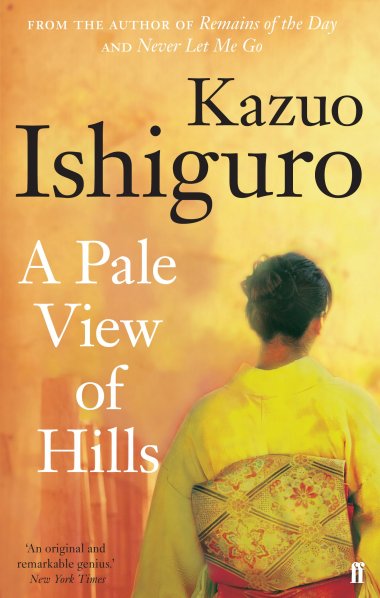
Kazuo Ishiguro’s debut novel is quite a puzzle. In the story, we first meet Etsuko, a middle-aged woman from Japan who is now residing in the English countryside, while her younger daughter Niki lives in London. As Niki comes from London to visit her mother, Etsuko starts to reminisce about her previous life in Nagasaki, Japan. We eventually start to guess that Etsuko’s memory of the suicide of her older daughter Keiko in England is somehow linked to Etsuko’s recollections of her friendship with strange woman Sachiko and her daughter Mariko at the time that she lived in Nagasaki.

This short novel is an easy and, at times, intriguing read, with Ishiguro sometimes making insightful points about Japanese culture and the effect of the passage of time on his characters. However, it seems that this subtle novel also asks too much from its reader. If there was a mystery somewhere in the novel’s midst, then it was not sufficiently elaborated upon or given sufficient space to breathe for the reader to really care; and, if there was no real mystery, then the point of the novel is partly lost. Ishiguro seems to have wrapped his story in too many layers of subtlety, thereby forcing his readers to make a giant leap forward in terms of imagination so that they finally decide to start unwrapping the unwrappable. It is unlikely that there will be a satisfactory meaning or explanation found by the novel’s end. Besides, while the reader may want to delve into possible interpretations of what he or she has just read, there is also the possibility that the interest will be lost half-way through. 

Continue reading “Review: A Pale View of Hills by Kazuo Ishiguro”