

Gustave-Adolphe Mossa (1883-1971) was a French artist and museum curator from Nice who worked in a Symbolist style from roughly 1900 to 1911, before discovering Flemish masterpieces and Gothic art, and switching directions. In the production of his art, he was heavily influenced by novels (Joris-Karl Huysmans), poetry (Charles Baudelaire), and the styles of Art Nouveau and the Pre-Raphaelites. His paintings are characterized by vivid transformations of well-known characters and scenes from mythology and folklore, and are truly an idiosyncratic bouquet of the macabre, beauty, dark satire, eroticism and psychological intensity.

In this artwork, two women, perhaps sisters, are depicted with their skulls visible since their faces were eaten by the vermin. They appear to be unconcerned, though, strolling in their fashionable blue dresses and elegant hats. They have their make-up on, too. I appreciate Mossa’s attention to detail and hidden symbolism. Cypress trees have always been associated with mourning and the afterlife, and we see them in the background of these two women who enjoy their “deadly” stroll.
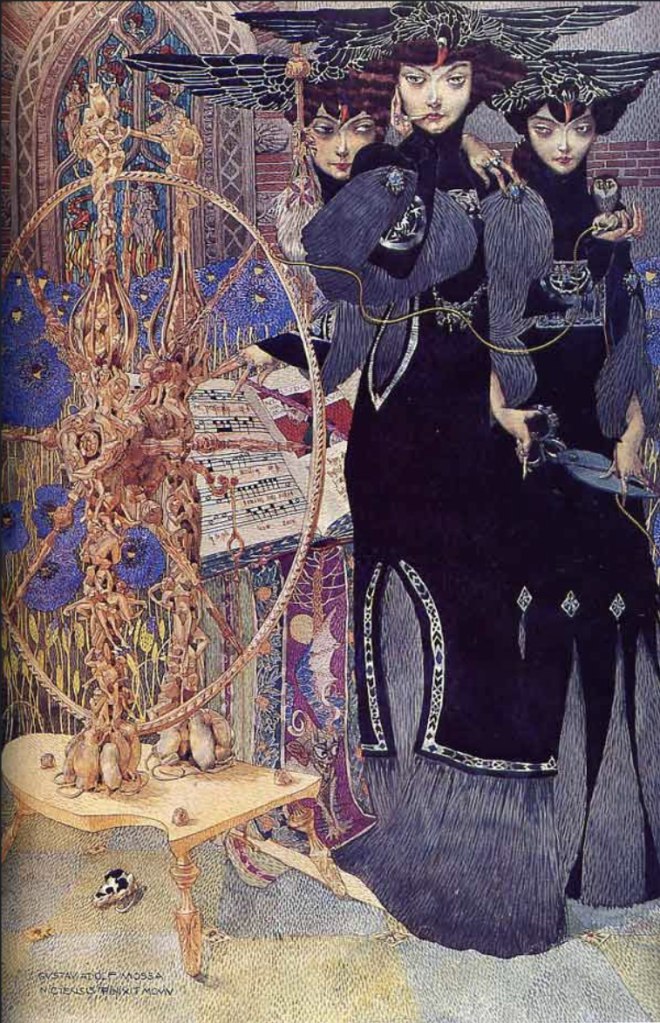
I like this rather unusual, macabre representation of the Three Fates from the Greek mythology. Clotho, Lachesis, and Atropos were said to be the Rulers of Destiny, whose parents were Erebus (Darkness and Shadow) and Nyx (Night). Clotho (the Present) was tasked with starting a thread, or a man’s life, Lachesis (The Future) allocated the years to live, and Atropos decided when and how to end a man’s life by cutting the thread. In Mossa’s artwork, the divinities are the epitome of elegance, dressed in luxurious black gowns. They appear to be displaying their parents’ symbols, such as the owl (one of Nyx’s signs) held by Lachesis, and their elaborate bird-like headgear also resembles a vulture (Egyptian Nekhbet), which may also stand for Erebus, their father and the personification of darkness.
Their spinning wheel is as sophisticated – golden with elaborate human figurines. It is interesting how by portraying the Fates’ spinning wheel in this way, Mossa merges it with the Wheel of Fortune, a device used to decide the fate of people and notably associated with Fortuna, a Roman Goddess. Other interesting elements here are a large pair of scissors held by Atropos, who is already at the point of cutting the thread, and the presence of a book of musical scores, being also symbolically linked to human fate (perhaps a veiled reference to danse macabre?) Literature provided the main inspiration for Mossa, and, clearly, much thought went into the composition’s content and stylistic choices.
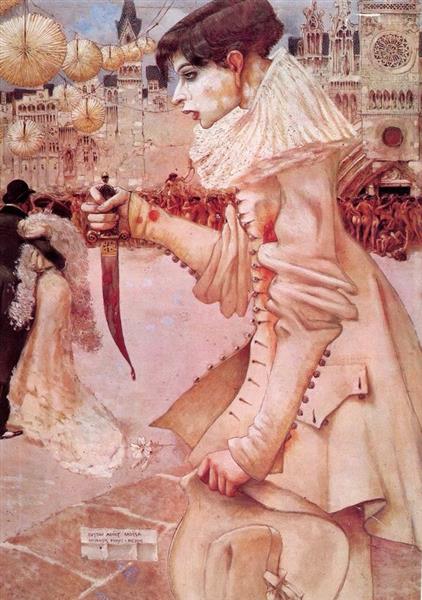
In March I talked about the portrayal in art of clowns in more difficult situations, where their usual smiles and laughter are replaced with sadness, exhaustion and tears – see my post here, and it seems that Mossa took this a step further in his artwork, showing Pierrot wandering around the canals of Bruges with a dagger in his hand and a passive-aggressive look on his face. There is blood dripping from his dagger, and it is also seen on his clothes, making us wonder whether Pierrot had already stabbed others, or, perhaps himself. This is actually a very modern interpretation of Pierrot, a character from the Comédie-Italienne, who was traditionally portrayed as a naïve, inoffensive dreamer. Perhaps Mossa should be credited with setting the path for this more complex portrayal of the character who is now fighting back against (what he sees to be) the injustices around, giving vent to his own inner torment. Symbolists often saw Pierrot as depressed, isolated and suffering, but, clearly, Mossa took this sentiment further in his work and made Pierrot disturbed and, perhaps, revengeful. The pastel colours of white, red and pink contrast with the dark subject matter.
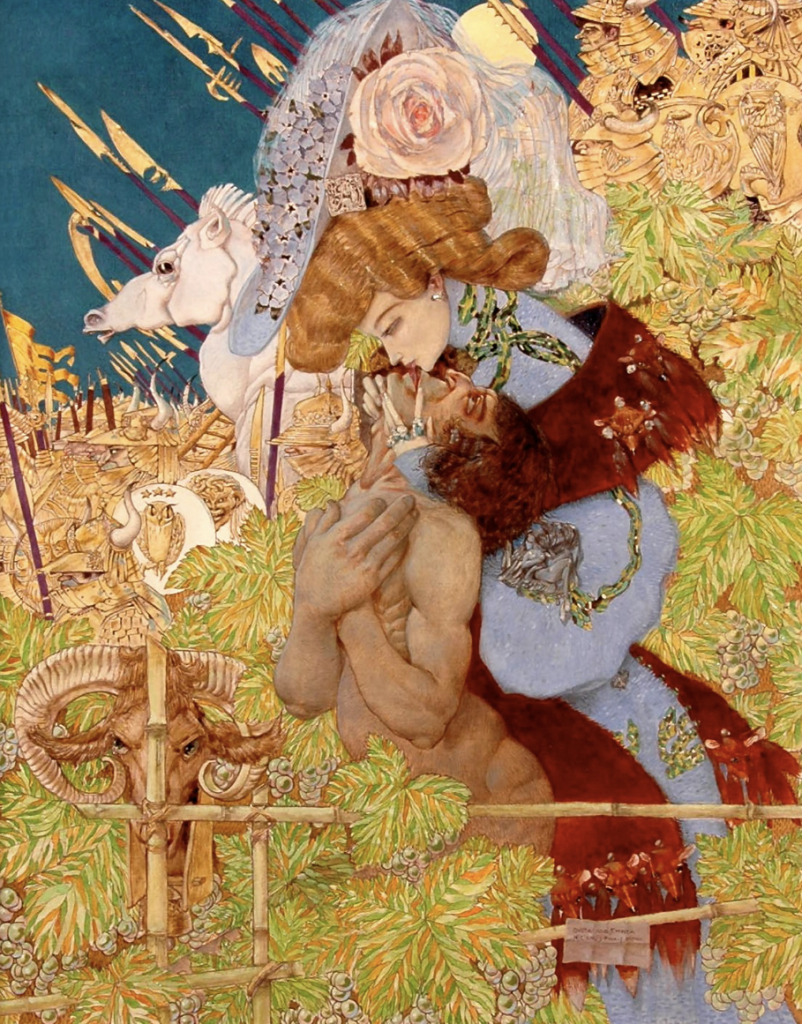
In this painting, which has some positional similarities with Klimt’s The Kiss [1908], Helen of Troy from Greek mythology is locked in a passionate embrace with her first husband Menelaus, the King of Sparta (though some suggest this is Paris of Troy). This is a very dreamy, symbolist artwork that paints its own vivid images of the passion and the Trojan War that stemmed from it. Helen is presented as a protective, seductive force, and by rendering the Trojan Horse in white, Mossa tried to emphasise the supernatural elements at play. One curious thing about this artwork is a pearl sewn onto the canvas.
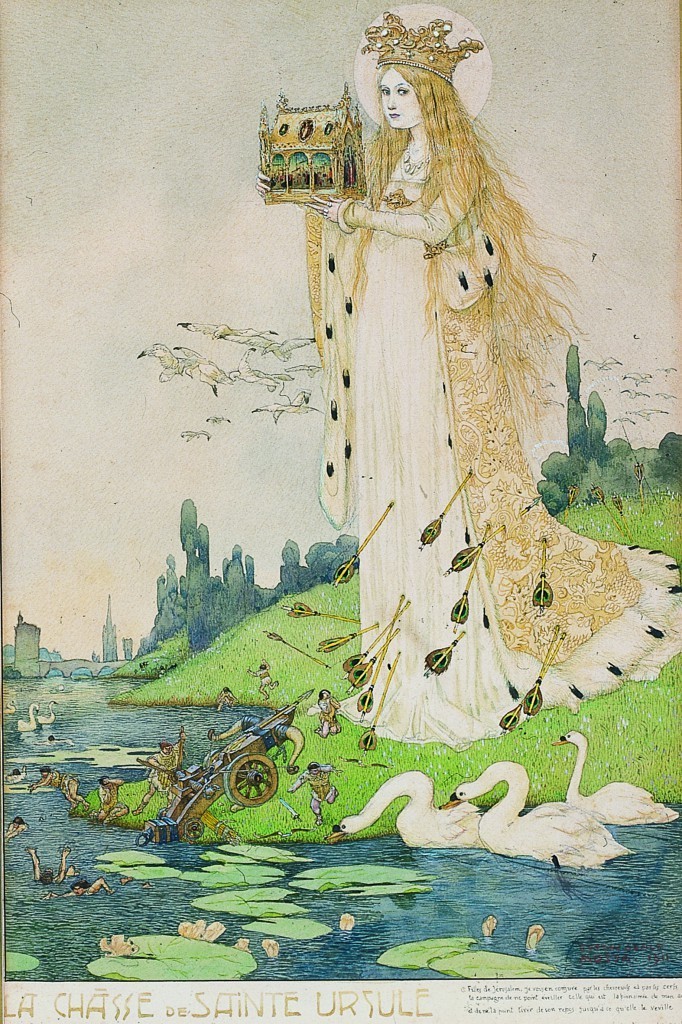
Mossa was also a talented illustrator, and though he is now vilified for his excessive femme fatale presentation of women, his depiction of religious women appears to be restrained. In the painting above, Saint Ursula, looking confident and serene, stands on the shores of a river holding a golden casket, which may represent the Church and her inviolate Faith. She is surrounded by swans, which represent purity and loyalty, and is besieged by arrows, which, nevertheless, only damage her white garment and do not harm to her. In the legend, Ursula, who is said to be Romano-British princess, was betrothed to the son of a pagan king, and not wanting to lose her virginity, asked for a delay in her marriage. She then escaped with her ten handmaidens, who each brought one thousand companions, making up eleven thousand girls. They were on a ship, but fell into the hands of pagan Huns after a storm at sea. They endured stoically the onslaught of Huns, refusing to give up their faith or marry the Huns. Death was their punishment.

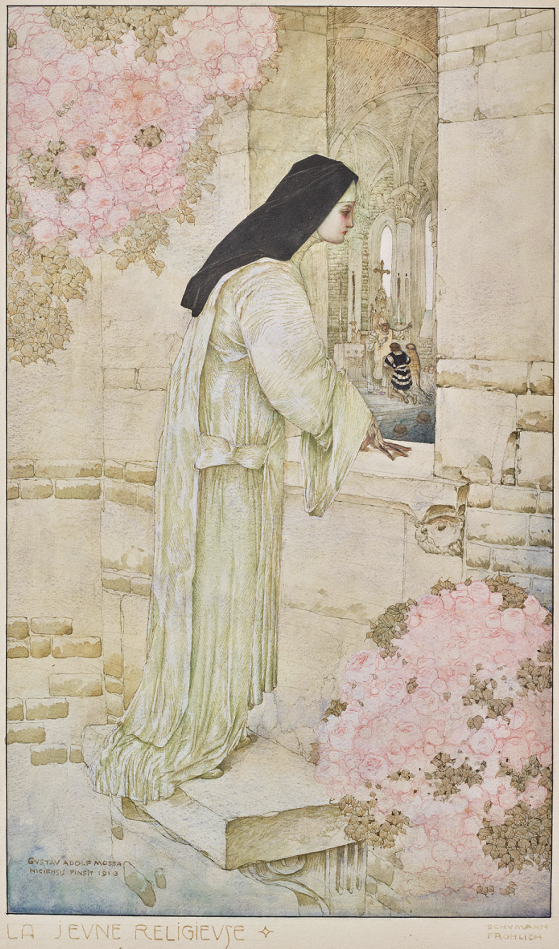
The illustration to the right is that of a young nun, looking inside a church building. A wedding is taking place and a priest is seen blessing a couple, while the nun with her sad, red-from-crying eyes, is looking on. Is she mourning her own youth and inability to have a husband, or perhaps she knows the man who is being wed and experiences a heartbreak? As the Pierrot painting above, Mossa cleverly juxtaposes the colour black (the nun’s veil/Pierrot’s hair) with the white scene, making the depiction thought-provoking. The nun’s fingers also seem to be coated in something black (self-inflicted injury?), drawing our attention to them, emphasising her resignation and psychological defeat.
🇫🇷 This post was written as part of the Paris in July 2026 event, hosted by Emma at Words and Peace. This is a blogging event to celebrate all things French, from reading books and watching films to cooking and discovering history.


Wow this is amazing, I like it as much as Moreau, another great symbolist (check out his museum in Paris). I don’t know if you’ve read the French decadents much, but it makes me think of them as well (Huysmans, Villiers, Mirbeau)
LikeLiked by 2 people
Yes, Mossa was apparently very much influenced by Huysmans, whom I read, but not the other two authors you mentioned. And, yes, thanks, I will definitely try to visit the Moreau museum next time I am in Paris, which will be in August.
LikeLike
Stunning artwork! I’m going to go look up more symbolist artwork.
LikeLiked by 2 people
I’m totally unfamiliar with this artist — how exciting, to discover a new Symbolist painter! (The Dead Women reminds me a bit of James Ensor’s skeletons) As I’ve probably stated in past comments, my very favorite Symbolist painter is the Belgian artist Fernand Khnopff (I particularly love I Lock My Door Upon Myself). I’m not quite sure if he can be classified as a Symbolist, but I’m also very fond of Vilhelm Hammershøi, with his spare & mysterious interiors.
LikeLiked by 1 person
I love I Lock My Door Upon Myself, and the artworks of Vilhelm Hammershøi really appeal to me, thanks! They remind me of the interiors of Georg Friedrich Kersting. I talked about them earlier this year: Kersting: Introverted Pastimes – Thoughts on Papyrus.
LikeLiked by 1 person
Gustave Mossa now? I’d never heard of him before though he would be called a “contemporary”. Maybe obscured by Picasso et al. He’s a very interesting painter. Thanks for the introduction.
And “bon voyage” to Paris in August…
LikeLiked by 1 person
Oh hi, haven’t heard from you for a while. How are you doing? Are you going to post anything for #parisinjuly2026?
LikeLiked by 1 person
Ça va plus ou moins. L’état du monde m’attriste considérablement. Je crains un peu pour ma famille. One of my daughters has been badly affected by the demise of USAID. They were 90-95% of her clients. And I find the lunatic on Penn avenue extremely dangerous not just for Americans but for the whole world…
Normally I would in Paris in July, but we’re spending most of our time in Cuernavaca. I’ll pass for parisinjuly this time.
All well with you I hope?
Au revoir.
LikeLike
Sorry to hear about your daughter. Most Americans have no idea of all the consequences after USAID disappeared
LikeLiked by 1 person
I know, the indirect consequences on health, security, journalism (in Central America in particular) are considerable…
Merci et bon weekend.
LikeLiked by 1 person
Merci!
LikeLiked by 1 person
I see his work is mostly in Nice… Hmmm. Been ages since I was in Nice… Again thanks for the tip.
LikeLiked by 1 person
oh wow, I actually didn’t know Mossa! Gorgeous, thanks so much for sharing
LikeLike
And welcome to #parisinjuly2026!
LikeLiked by 1 person
Thanks for hosting! I like reading other entries.
LikeLiked by 1 person