

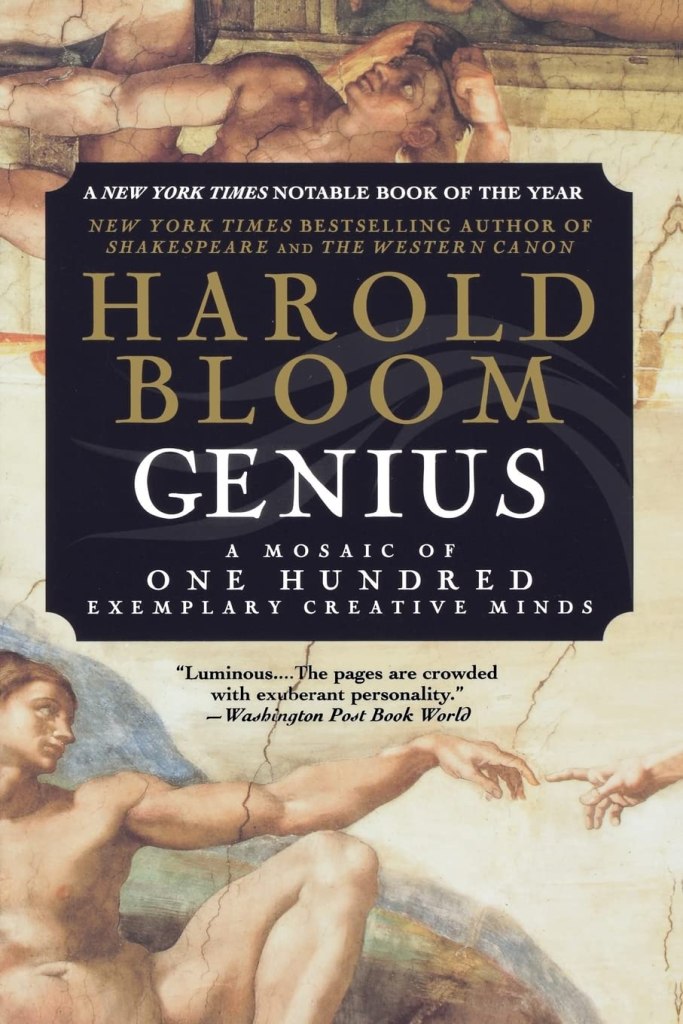
Genius: A Mosaic of One Hundred Exemplary Creative Minds [2002] – ★★★★
Using the structure of Lurianic Kabbalah, American literary critic Harold Bloom (1930-2019) talks about one hundred literary geniuses in this book that presents each of the authors’ major works, biographical trivia and Bloom’s own insightful commentary. Virgil, William Shakespeare, Thomas Mann, Fyodor Dostoevsky, Charles Dickens, William Faulkner, Henry James, Lewis Carroll, Virginia Woolf, Edith Wharton, George Eliot, Miguel de Cervantes, Jorge Luis Borges, and Fernando Pessoa are just some of the authors included. Since there are so many, I chose to briefly comment on only seven of them in this review.
Honoré de Balzac (1799–1850)
In this section, Harold Bloom largely focuses on the character of Vautrin from Balzac’s La Comédie humaine. This is curious because when I read and reviewed Lost Illusions, The Black Sheep and Le Père Goriot, I certainly did not concentrate on him. Bloom calls Vautrin “a Byronic hero-villain”. He goes on to say that Balzac was “always apocalyptically in debt, […] wrote in a frenzy, sometimes sleeping just two hours a night while drowning himself in coffee”, as well as quotes Graham Robb who said that “Balzac is both the embodiment of his age and its most revealing exception” [Bloom, Warner, 2002: 736]. I found that very interesting. Bloom then hints that he is at a loss as to why Balzac achieved big success with his female readers, but I personally think that one novel was enough for him to win all the female hearts – Eugénie Grandet, which portrays a stoic female spirit, quite a change from seductive courtesans or often rather unflattering female portrayals penned by Zola.
Finally, Bloom quotes Henry James who had this to say about Balzacian characters: “they are interesting, in fact, as subjects of fate, the figures round whom a situation closes, in proportion as, sharing their existence, we feel where fate comes in and just how it gets at them. In the void they are not interesting, and Balzac, like Nature herself, abhorred a vacuum. Their situation takes hold of us because it is theirs, not because it is somebody’s, any one’s, that of creatures unidentified…” [Bloom, Warner, 2002: 739].
Willa Cather (1873–1947)
“She is the novelist of a retrospective glory, of the beauty of loss” [Bloom, Warner, 2002: 629], says Bloom, and it is certainly true, particularly regarding one of Cather’s underrated novels – A Lost Lady. “Geniuses of nostalgia are rare”, continues Bloom, “and she was one of them.” In this section, Bloom brings attention to things in Cather’s novels that I haven’t previously considered, such as erotic longing in My Ántonia. I also agree with him when he says that A Lost Lady is Cather’s most exquisite book. Bloom then goes on to mention Nick Carraway of The Great Gatsby as being similar to the My Ántonia and A Lost Lady protagonists (both first being distant admirers of the titled characters), but I wish he had also mentioned how A Lost Lady may have provided an inspiration for The Great Gatsby. I said in my review: “Similarly to Fitzgerald’s The Great Gatsby [1925], which was published two years after A Lost Lady and was probably inspired by it, there is a tone of pure nostalgia in the telling of this story, a sense of a quiet tragedy unfolding in the background, and, clearly, as in The Great Gatsby – a fascination by the narrator with one mysterious and enchanting “outsider” to a community.”
José Maria de Eça de Queiroz (1845–1900)
Bloom rightly points out that Portuguese classic author Jose Maria Eça de Queiroz is largely unknown and unread in the English speaking world (perhaps like Italian Alessandro Manzoni or Japanese Ichiyō Higuchi). So, it is important to promote his books – see my reviews The Crime of Father Amaro and The City and the Mountains. Regarding the author, Bloom largely talks about a novel I am still to read, but which I have now moved higher on my TBR list – de Queiroz’s The Relic, which he describes to be “a masterpiece, a work as fresh in 2001 as it was in 1887.” For my part, I have always found de Queiroz a surprisingly modern author, especially in the way he structured his novels. They contain certain psychologically-intriguing endings, which may even be considered “twists” by today’s standards. He liked to confound our expectations. We start from one place in his novels, but end up in a different one by the end of the book. This is absent from The City and the Mountains, but is certainly present in both The Crime of Father Amaro and The Maias.
Alejo Carpentier (1904-1980)
I like that Bloom highlights the genius of Carpentier’s work. He says that The Kingdom of This World (1949), The Lost Steps (1953), and Explosion in a Cathedral (1962) “have literary strengths at least equal to those of Borges’s Ficciones and Marquez’s One Hundred Years of Solitude.” He does talk at length about The Kingdom of This World, one of my best reads of last year, saying that Carpentier “never moralizes” and that “the greatness…found by…Ti Noel (main character) is not at all a moral greatness” [Bloom, Warner, 2002: 531]. I find that Carpentier emphasised in his work the cyclical nature of history, pointing out how quickly the so-called “heroes” can turn into new tyrants, which, of course, also reflects the consequences of the revolution in France.
In this section, Bloom criticises “politicised literary criticism”, implying that he is always being neutral, but throughout the book there are hints that he is somewhat biased. His treatment of Russian authors shows it since his views tend to reflect English-language sources on this subject (understandable), but, then, on a number of occasions, he also stresses authors’ nationalities or their sexual orientations (as with Willa Cather) as pivotal in shaping their books, which is eyebrow-raising. And then, in the section on Carpentier, Bloom states: “I remember being surprised when Gonzalez Echevarria first told me that Carpentier was French and Russian, with no black ancestors” (Carpentier wrote passionately about the plight of black people in the Caribbean). Really? Bloom’s thinking appears to be an example of what I consider today’s biased thinking that presupposes that people always do things through some kind of self-interest based on their “fixed innate characteristics”. There is this expectation that because someone is of certain nationality or have certain ancestors, they should promote or write about “their own”, so to speak. But, in fact, all people are free agents born on this planet Earth and many are constantly embracing cultures, countries and movements that are not “their own”, and they can certainly extend their respects to any country if they feel particular affinity to it or have a deep interest in it. Carpentier’s family moved to Havana shortly after his birth in Switzerland and he was linked to the Afro-Cuban movements.
Johann Wolfgang von Goethe (1749–1832)
Bloom characterises Goethe’s work as “an enormous poetic gift, more truly lyric than dramatic”, and says that “Faust, even in translation, remains an essential work…Faustian women and men are all around us…there is a Faustian element in all our technological new-fangledness. Perhaps our Age of Information is essentially Faustian, and is the consequence of a Faustian bargain that an Americanized world goes on making” [Bloom, Warner, 2002: 175].
He then makes rather curious observations: “Goethe associated happiness with astonishment” – interesting, but then proceeds to say: “to read Goethe is, for me, endlessly fascinating, but the Wilhelm Meister novels…and The Sorrows of Young Werther are now museums, transports into past realities…The problem is not that something is wrong with Goethe…but that something is very wrong with us. We have lost not just knowledge, but qualities of spirit that are minimal requirements if Goethe is to be read with pleasure” [Bloom, Warner, 2002: 176]. I understand what he means, but, overall, I am far less pessimistic than he is about Goethe’s novels, which stood the test of time. The Sorrows of Young Werther is a very human drama of longing, unrequited love and despair, and, surely, any teenager of today who experiences the pangs of first love can find something in the story that reflects their own state. Goethe’s Elective Affinities also feels surprisingly contemporary as it explores impulsive passion and emotional manipulation.
Bloom hardly ever makes any comparison with international authors, but, possibly, Goethe may be linked to Alexander Pushkin (1799-1837). Both were writers of idealism and romanticism who believed in an ultimate, transcendent truth, but Pushkin’s hold on the minds and hearts of the readers never abated, though he was inclined to German idealism. No one can ever say that Pushkin or his works are now “museums” and we lost some “qualities of spirit” to enjoy them, the way Bloom characterises Goethe.
Thomas Mann (1875-1955)
One of the best novels I have read this year is Thomas Mann’s The Buddenbrooks, so I was interested in Bloom’s take on the author, but just like Goethe above, Bloom says (writing in 2001) that Mann’s books are in decline: “Mann, like his heroic Goethe, was a great ironist, and irony is difficult to preserve in our present moment” [Bloom, Warner, 2002: 185]. The sentiment rings true, but probably not to the extent Bloom believes it to be the case, or maybe I just have too much faith in the modern reader.
Bloom also emphasises the influence of Goethe on Mann: “The shadow of Goethe rarely left him, though Mann had the strength not to evade the shadow, but rather to render it even more luminous. Bildung, the Goethean vision of self-development, remained Mann’s ideal, even when it is parodied savagely, as throughout Doctor Faustus” [Bloom, Warner, 2002: 186]. This vision of perfecting oneself, reaching emotional depths, and being on the journey of (intellectual) self-discovery is surely prevalent in Mann’s The Magic Mountain, where the protagonist probes deep into the recesses of human knowledge and selfless love while being confined in the same place.
Edith Wharton (1862–1937)
This is probably Bloom’s most “shocking” chapter. He starts it well, saying that Wharton’s “ghosts are rather like her living characters in that they are as much absences as presences, except for Undine Spragg, the present-all-too-present protagonist of The Custom of the Country” [Bloom, Warner, 2002: 636]. This is astute and also makes me think of du Maurier’s novels. Bloom considers The Custom of the Country as Wharton’s best book, and the disturbing Undine Spragg – her strongest character. That is a curious choice. Bloom seemed to have a penchant for antagonists (as evidenced by his obsession with Balzac’s Vautrin), but I also believe that The Custom of the Country is underrated. Bloom then says that “though Mrs. Wharton and Henry James were good (if uneasy) friends, she found the novels of his major phase unreadable” [Bloom, Warner, 2002: 636]. That made me laugh out loud because, yes, one needs some patience to plough through The Ambassadors and The Golden Bowl.
Then, Bloom proceeds to say that he admires Wharton (The House of Mirth), but does not like her. That is fair enough, but then he calls Wharton “a racist, antisemite and a snob”. Well, Bloom’s Henry James section does not have such strong wording, though, Henry James was also a snob. Henry James’s private letters and his travelogue also express plenty of very worrying chauvinism and xenophobia (and Charles Dickens have antisemitic book tropes), but neither James nor Dickens received any negative comments of this nature by Bloom. Only Wharton did. And if Bloom then says that “perhaps Wharton was only a near-genius, except in the best of her short stories,” (something I don’t agree with), why did he include her in his book at all?
There are no chapters in this book on Thomas Hardy!, Albert Camus, Nikolai Gogol, Gabriel García Márquez or Vladimir Nabokov. In the Charles Dickens section, Bloom largely discusses the novel The Pickwick Papers, which was his favourite, the Victor Hugo section is about Hugo’s poetry, and in the Tennessee Williams chapter, the talk is almost exclusively about the influence of Hart Crane on Williams, rather than perhaps delving into that playwright’s themes, such as the erosion of “dignity and elegance” by modernisation/postbellum deprivation. I was also not a fan of Bloom mixing poets, novelists and philosophers in one book since their “creativity” is different (how do you compare Carroll’s Alice’s Adventures in Wonderland and Nietzsche’s philosophical treatise?), and, of course, Harold Bloom being Harold Bloom, nearly every author/their creative potential is traced back to Shakespeare. On the other hand, I found it interesting that Bloom’s favourite Tolstoy novel was Hadji Murat, and now want to read the stories of Flannery O’Connor and The Rainbow by D.H. Lawrence.
📔 I sound rather critical about some points Bloom makes, but his book is still insightful and packed with invaluable information on many classic books and authors. It is Bloom’s personal take on the classic literature, and his own list, and I especially appreciate his inclusion of some non-English language authors, including Carpentier, Machado de Assis, and Lady Murasaki. In sum, this is a book with a wealth of information and insight.
Are you interested in this book? Who are the authors that would make your “one hundred great authors” list?


I like books like this, and I have more than a few, so I’ve got enough of them now.
LikeLiked by 1 person
Fascinating, and I like your choice of authors to highlight.
I keep wanting to reread The Sorrows of Young Werther
LikeLiked by 1 person
I suppose if you asked 100 readers, we would all choose different authors who we wanted to see included in this book.
I’m glad you included your thoughts on Edith Wharton as she is a favourite of mine.
LikeLiked by 1 person
This does sound interesting, and yes we would all include different authors so it has to be taken as a personal choice – his statements about Wharton probably say more about him, thank you for pointing that out!
LikeLiked by 1 person
I’m loath to catalogue names that I’d describe as genius authors, especially as it’s both limiting and liable to change according to my changing tastes, but I do like discussions of authors new to me whom I’m exhorted to try because I do like the occasional challenge!
LikeLiked by 1 person
Yes, I understand. A list of this kind is bound to be limiting. The book was actually useful to me as I am in the process of compiling a list of one hundred books (not authors) which I consider “great”. To publish it, though, I still need to read about twenty (at least) authors, and I am not at all sure if I manage it this year – probably the next.
LikeLiked by 2 people
Thank you for the review, I enjoyed every part of it!
LikeLiked by 1 person
I’m glad you liked it. Thanks for stopping by.
LikeLiked by 1 person
I particularly liked the idea that you can choose any nation (and its art) to become a part of you. You certainly can. At times you see it through the lenses of your own but there are marvelous moments when you almost feel like a foreign author, the certain notion important to them becomes important to you as well. I believe that’s what literature is all about.
LikeLiked by 1 person
Oh, for certain! That’s why I actually feel uneasy when authors are reduced to their race, gender or nationality or actually their sexual orientation (identity politics gone haywire?) It may be a useful analysis in certain contexts and in respect of only certain authors, but people in general are so so so much more than that and each is unique and had varied experiences and world influences, but especially in literature, the whole point is to try to think and feel like others, to experience and understand something that is “beyond us”. We also write to discover other realms within ourselves and different points of views, etc., and not make public statements according to our biological characteristics as the media of today seems to believe books do or supposed to do.
LikeLiked by 1 person
I agree completely with everything said. Nationality can be important if the author explicitly invokes the nation’s traditions, but in case of most others, like Kafka for instance, it is irrelevant. But also if it was important for them, you cannot reduce them to the nationality of course (Thomas Mann changed three of them!). As for everything else, I could not agree more. Sexual orientation can be important in cases when author refers to it strongly himself, otherwise it is irrelevant.
LikeLiked by 1 person