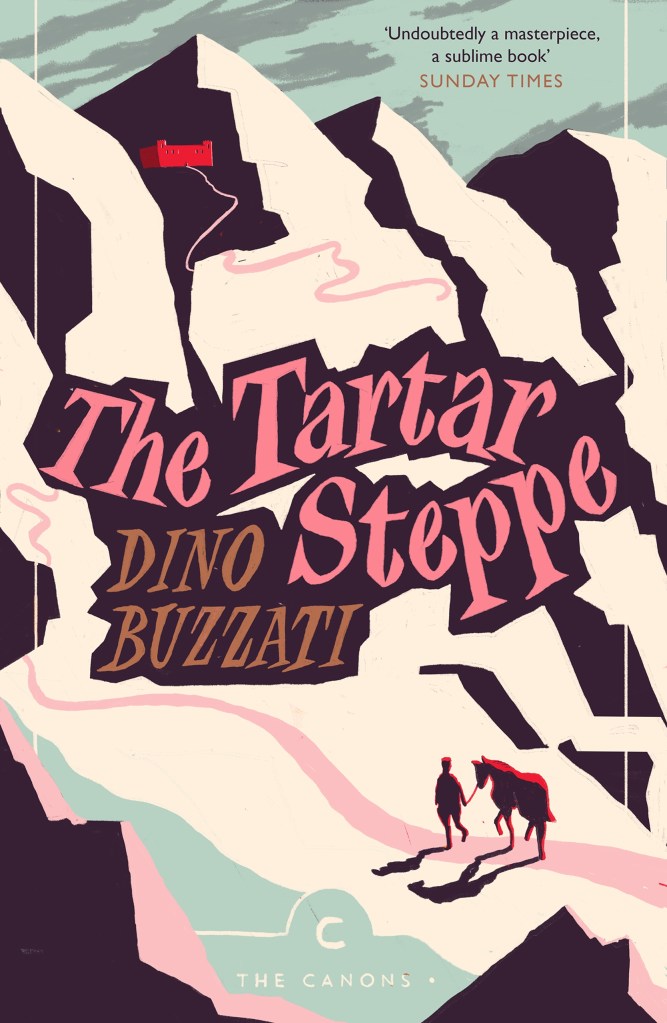
Mini-Review: The Tartar Steppe by Dino Buzzati

The Tartar Steppe [1940/2018] – ★★★★1/2

First published in 1940 and translated from the Italian by Stuart Hood, this novel is about young and idealistic Giovanni Drogo, a newly appointed Officer to Fort Bastiani, an obscure mountainous place near the country’s frontier. Drogo is excited about his first posting and hurries to his destination eagerly wanting to put to the test his soldiery skills, valour and discipline, as well as begin his new life. However, what awaits him is the unexpected: “the desolate steppe…which had mystery, but no meaning”, where “people [have] no knowledge of time” and where “everything [speaks] of renunciation” [Buzzati/Hood, 1945/1973: 22, 72, 82]. Fort Bastiani is a place in the middle of nowhere where no enemy has been seen since the time immemorial. Drogo soon feels rebellious, then depressed and lonely, and is finally completely enchanted by nothingness.

The Tartar Steppe is a masterful and subtle work which echoes the best work of Franz Kafka. It is a story about the traps that time lays to a man, about dashed hopes and missed life opportunities, and is a profound meditation on prisons that reside in the recesses of our own minds, in our beloved habits and dear ideals which we can never seem to cast aside no matter how nonsensical they may start to appear.

Continue reading “Mini-Review: The Tartar Steppe by Dino Buzzati”

September 2020 Wrap-Up: From A is For Arsenic to 1Q84

A is For Arsenic: The Poisons of Agatha Christie [2015] by Kathryn Harkup ★★★★★

When it comes to morbidly-curious books, it does not get better that this book. The author takes a deep look into all the poisons that Agatha Christie used in her books to “kill off” her “victims”, and the result is a read that both fascinates and informs – Full Review.

Doctor Glas [1905/1963] by Hjalmar Söderberg★★★★1/2

Truth is like the sun, its value depends wholly upon our being at a correct distance away from it” [Söderberg/Austen, 1905/1963: 138].

This little novel is a Swedish classic written in a diary form from the perspective of one dutiful doctor Tyko Gabriel Glas. He is a rather lonely and introverted individual who is used to handle expertly the delicate matters of city inhabitants. That is, until he meets the charming wife of one “repulsive” priest Rev. Gregorius. As he gets entangled in the affairs of this couple, the doctor also starts rethinking his stance on life and his thoughts turn darker. Soon, torn between his medical ethics and objective morality on the one hand, and his rising sense of injustice and romantic emotions on the other, Doctor Glas is quite ready to commit the unthinkable. Deemed highly controversial upon its release in 1905, this tale of obsession, suppressed emotions, sexual frustration and jealousy is now rightly considered to be a national classic. Existential angst and hidden psychological torments mingle ominously within the pages, with the author making a sober, but surprisingly potent statement on the power of the unconscious in human actions and condition.

Continue reading “September 2020 Wrap-Up: From A is For Arsenic to 1Q84”

Review: The Silent Cry by Kenzaburō Ōe

the silent cry The Silent Cry [1967/88] – ★★★★★

Full of uneasiness and foreboding, The Silent Cry is a subtly powerful work that masterfully evokes the unsaid, the forbidden and the terrifying, getting us close to the real Truth and to the final Hope.

In The Silent Cry, we are presented with the early 1960s and Mitsu, a disillusioned husband to an alcoholic wife and a father to a child who is now in an institution. Mitsu sees his life changing when his estranged brother Takashi arrives from America and together they travel to their native village in Shikoku, one of the main islands in Japan. There, they find that there is a shift in local power and one rich Korean magnate is proposing to buy what remains of Mitsu and Takashi’s land inheritance – their storehouse. Reluctantly, Mitsu finds himself drawn into a complicated political situation of the village, while also realising that Takashi starts to wield the unprecedented power over the village inhabitants. The Silent Cry is a slow-paced descent into one kind of a nightmare where the violent history of the village is about to be re-enacted and other grim discoveries made as the relationship between the two brothers takes an unexpected turn. Continue reading “Review: The Silent Cry by Kenzaburō Ōe”

Review: The Face of Another by Kōbō Abe

The Face of Another Book Cover
Continue reading “Review: The Face of Another by Kōbō Abe”

Review: The Woman in the Dunes by Kōbō Abe

Kobo Abe The Woman in the Dunes
Continue reading “Review: The Woman in the Dunes by Kōbō Abe”

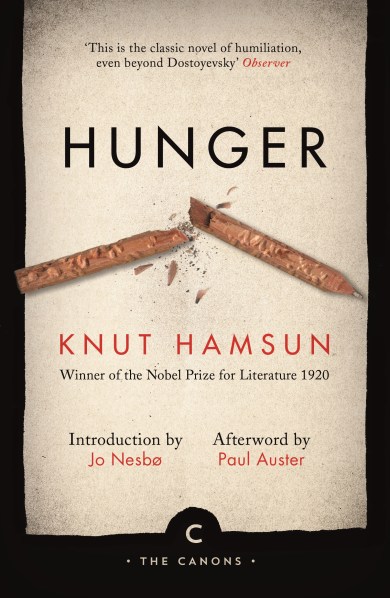
Review: Hunger by Knut Hamsun

Hunger Cover

Hunger [1890/1996] – ★★★★★

Knut Hamsun is a Nobel Prize Winner for Literature whose existentialist literary work Hunger predates Franz Kafka’s The Trial [1925] and Albert Camus’ The Stranger [1942]. Translated from the Norwegian by Sverre Lyngstad, Hunger explores the daily life of one lonely and desperate man on the brink of starvation in a large city. Our unnamed narrator is a freelance writer who has one “ambition” in his life: not to die from hunger. He is hard-working and not demanding, with food and shelter being his main wishes. Hamsun explores mental and physical traumas of the character in a masterful work that inspired some of the greatest philosophical fiction authors of the twentieth century, emphasising in his work that the fight to survive in a big city may take a shape of complete absurdity.

Continue reading “Review: Hunger by Knut Hamsun”

10 “Must-Read” Existentialist Novels with Memorable Lines

I. Albert Camus – The Stranger [1942]

Mother died today. Or maybe yesterday, I don’t know.” [1984: 9, Camus/translation]. “You could never change your life…[and] that in any case one life was as good as another and…I wasn’t at all dissatisfied with mine here” [1984: 44, Camus/translation]. 

II. José Saramago – The Cave [2000] 

Human vocabulary is still not capable, and probably never will be, of knowing, recognising and communicating everything that can be humanly experienced and felt” [2002: 254, Saramago/translation]. “What a strange scene you describe and what strange prisoners, They are just like us” [Plato, The Republic, Book VII]. 

Continue reading “10 “Must-Read” Existentialist Novels with Memorable Lines”