
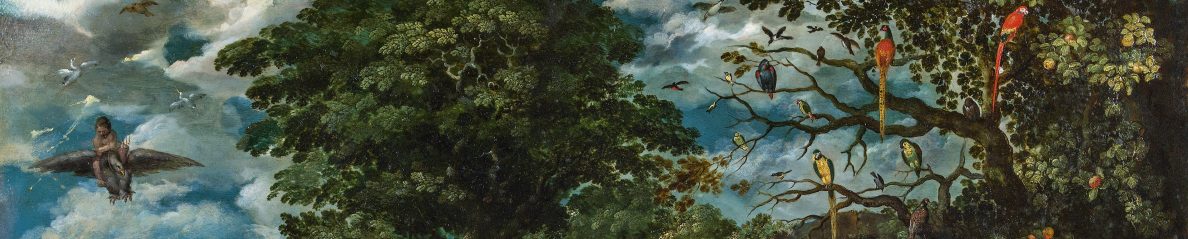
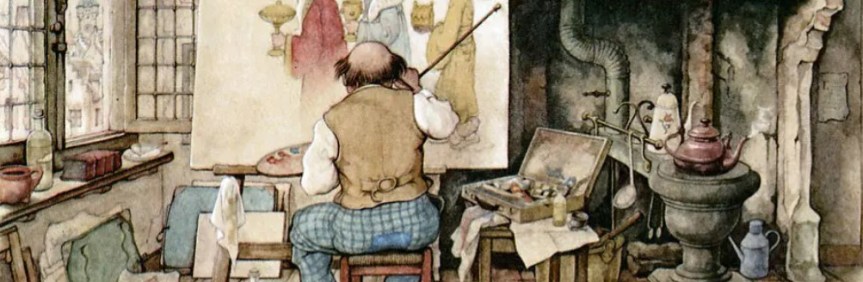
Artists’ studios are curious places. Part domestic and part commercial, they can be viewed as an extension of the artistic process itself and function as a kind of self-portraits where we can observe the reflection of an artist’s mind. But, how have artists depicted these spaces in art? Have they portrayed them as sacred abodes where geniuses dwell and labour, or presented them as tattered lodgings of talented, but increasingly hopeless, desperate and poor individuals? Below are five paintings of artists’ studios (in no particular order). Some are idealised versions, while others poke fun at the messiness and misunderstanding of artistic creativity. *The header image is a fragment of an illustration by Anton Pieck.
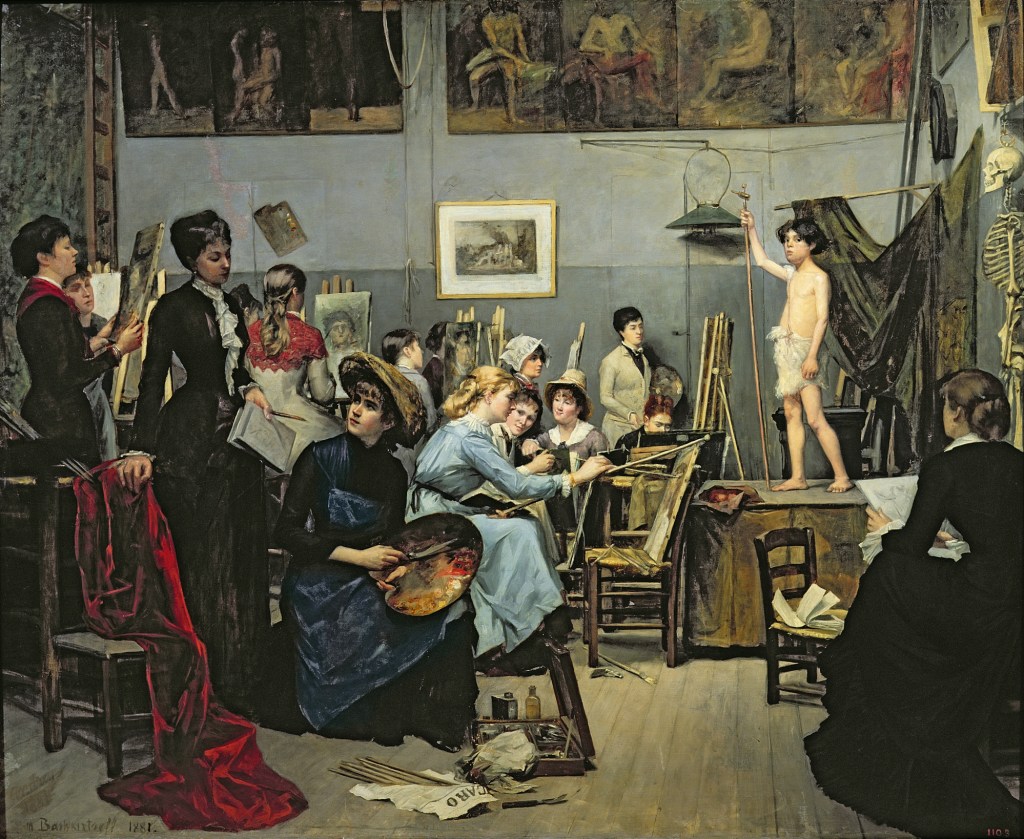
In the Studio by Marie Bashkirtseff
Marie Bashkirtseff (1860-84), born Maria Bashkirtseva into a Russian noble family, was an émigré artist who lived and worked in Paris. In her art, she was inspired by naturalism and realism, but she also wrote and her coming-of-age diary gained success after its publication, with its admirers being such people as William Gladstone and George Bernard Shaw. Bashkirtseff died of tuberculosis at the age of just 24. Though many of her works were destroyed by the Nazi regime during the World War II, some remained, becoming part of museums around the world, and In the Studio is one of them. Here, she painted herself (wearing a hat and dressed in a dark dress) surrounded by her fellow women painters on the second floor of the Académie Julian in Paris, one of only a few reputable schools which accepted female students at that time. In fact, women painters faced many struggles in those times, including the inability to paint from nude male models when male pupils were present, and Bashkirtseff was an active voice for greater liberty. In her artwork, she depicted a rather messy studio, but there seems to be much camaraderie among the students. This artwork also became a sort of a manifesto emphasising the right of women to receive the same standard of art education as men do.
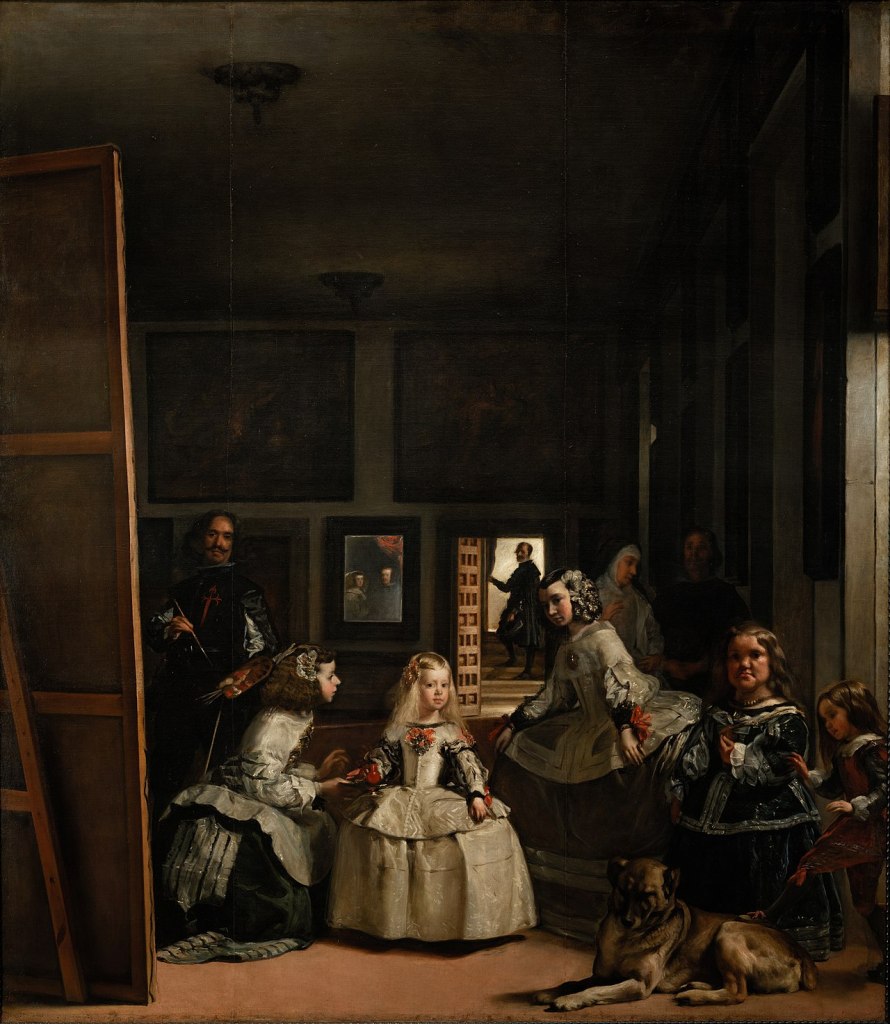
Las Meninas by Diego Velázquez
One of the most famous paintings in the world, Las Meninas presents a fairly accurate depiction of the artist’s studio (Velázquez’s) in the Alcázar palace in Madrid. In the centre of the painting is the five-year-old Infanta Margarita María, whose parents, Philip IV of Spain and Mariana of Austria, are reflected in the mirror behind (the viewer’s position). Margarita is attended to by two ladies-in-waiting, las meninas, Isabel de Velasco and María Agustina Sarmiento, as well as surrounded by court jesters. In the doorway at the back is the silhouette of José de Nieto, Chamberlain of the Queen’s Quarters, while in the foreground, in front of a large canvas, stands the artist himself – Diego Velázquez, the court painter. The artwork’s unusual lighting and the presence of a mirror create a mysterious atmosphere, and the painting itself is the study of shifting perspectives because the artist created tension between the structural vanishing point (to be found inside the open doorway) and the mirror reflecting the royal couple, complicated by the light that falls on Margarita and partly on the meninas.
Las Meninas was probably inspired by Jan van Eyck’s The Arnolfini Portrait, which also contains a mirror, and some have also speculated that the royal couple depicted in the mirror are not actually present, and it is simply their portrait that is reflected in the mirror, while others proposed that it is the royal couple’s portrait which was the main objective of the gathering, and the child in the painting is in the process of being persuaded to join her parents for a portrait. The Velázquez expert José López-Rey also noticed parallels and dualities. There are two maids of honour, being “mirror images” of each other, the King and Queen possess their own doubles within the mirror, and Velázquez may have his own “double” in either the bodyguard (the man behind the dwarf) or in José de Nieto. His “double” is probably de Nieto because the Chamberlain seems to mirror any artist’s movement, with his right hand being in the position of holding a brush, while his left seems to be in the position of holding a palette. Then, López-Rey also observed a curious pattern within the painting: one man, a couple, one man, a couple…
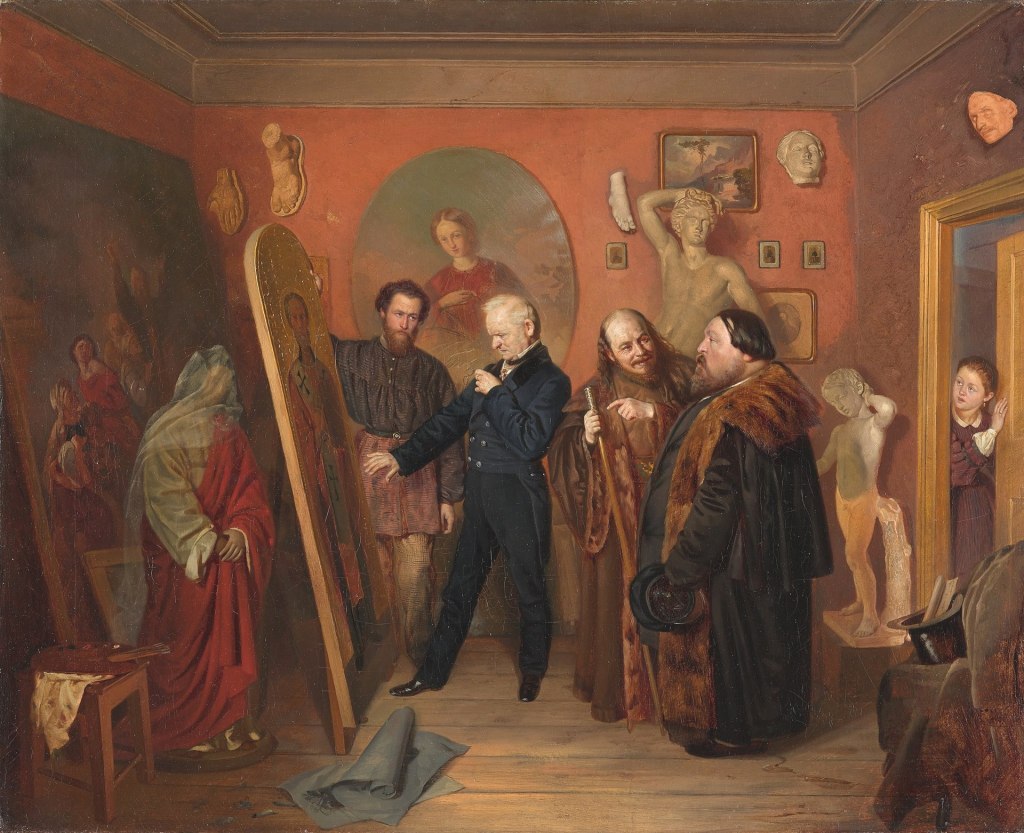
In the Artist’s Studio by Vasili Pukirev
Vasili Pukirev (1832-1890) was a Russian painter, working in the Realist style, and is largely known as “an artist of one painting” – The Unequal Marriage (1863), currently in the Tretyakov Gallery. However, he also produced a number of other vivid genre artworks. One of them is In the Artist’s Studio that shows a rather busy studio of an artist, where, supposedly, Pukirev depicted himself showing off his latest work to potential buyers. The artist is standing and holding a religious icon, his latest work, while a man dressed in black with a serious expression on his face is focused on the artwork. This is likely a satirical depiction, and Pukirev tries to convey the idea that it is unlikely that the man understands the work (as evidenced by the rather tired and exasperated glance that the artist throws at the man). Behind the man, a priest and, probably, an art connoisseur or collector are engaged in a conversation. The priest can probably judge the painting on its merits, but he is not looking at it at all, being busy conversing, while the supposed art connoisseur just looks lost and confused. A servant is also seen peeking through the door, curious to see how the scene will unfold.
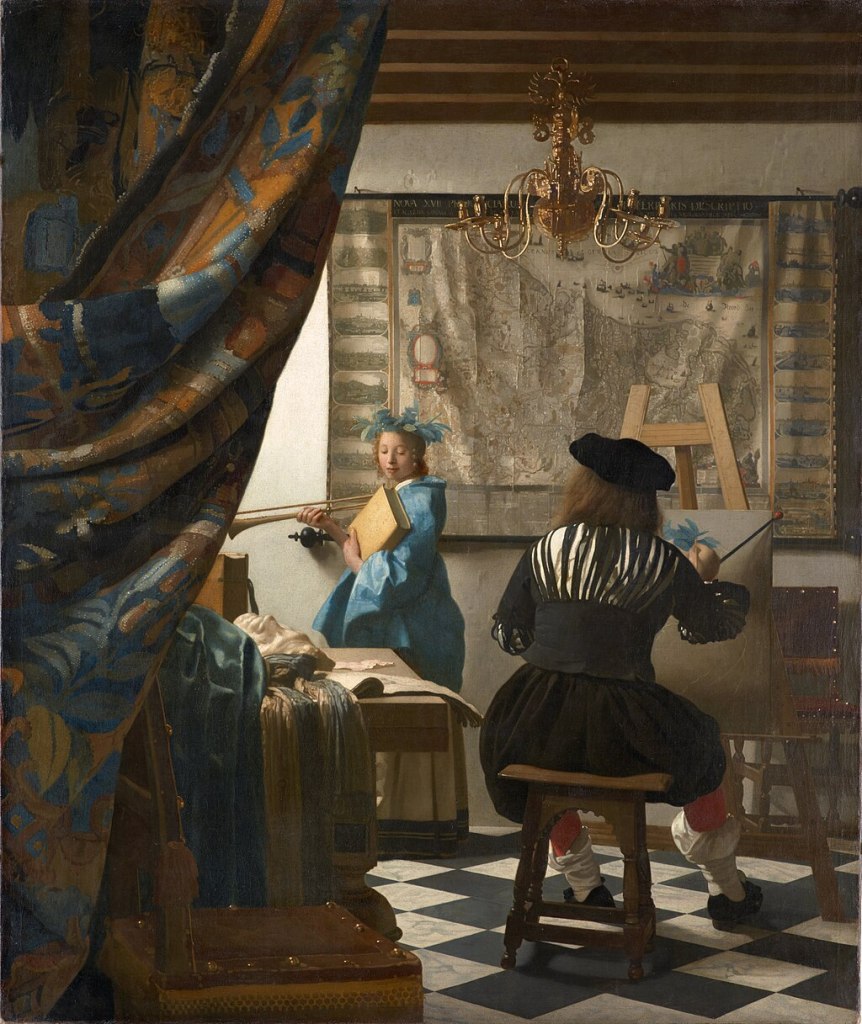
The Art of Painting by Johannes Vermeer
This painting with a rich history is an idealised portrayal of an artist at work. He is dressed elegantly and somewhat flamboyantly (not exactly one’s usual artist-at-work clothing), capturing attention with his black and white attire. He is also in a studio which looks too chic and grand for any artist’s real life – there is a golden chandelier on the ceiling (though without its candles), a huge Netherlands map on the wall (signifying the artist’s worldliness?) and the marble floor beneath the artist’s feet -, and all this does not represent Vermeer’s real artistic quarters, which were humbler (though they had the same chequered floor). The large curtain drawn back, as though by some invisible hand, gives the impression that we are peeking in to see a genius at work in some tableau vivant. It is also a misleading painting because the artist uses such a scale that he could only manage to convey a “zoomed-in” version of the woman, which would not even include the whole of her trumpet, and it is unlikely that any real portrait of that time would require the holding of such an odd combination of objects – a trumpet and a heavy book. Thus, the prevailing view is that the artwork presents an allegory of painting, with the model being, in fact, Clio (the muse of history) or Fama (the personification of fame).
Some, like art historian Christiane Hertel, noticed the fascinating dualities in the artwork (similar to Las Meninas above) – the painter and the model, two halves of the wall map, the model’s face and the mask on the table, two books, etc., which underscore the relationship between the observer and the depiction. The fact that the artist is dressed in the colours of the floor tiles and his body contours follow the pattern of these tiles may subtly suggest that he wants to be presented as both the figure in the (background) art and the mind of the creator, who invites us to look at different kinds of works presented here: his model, his painting (in the painting), himself painting the model, and finally, the painting itself – The Art of Painting.
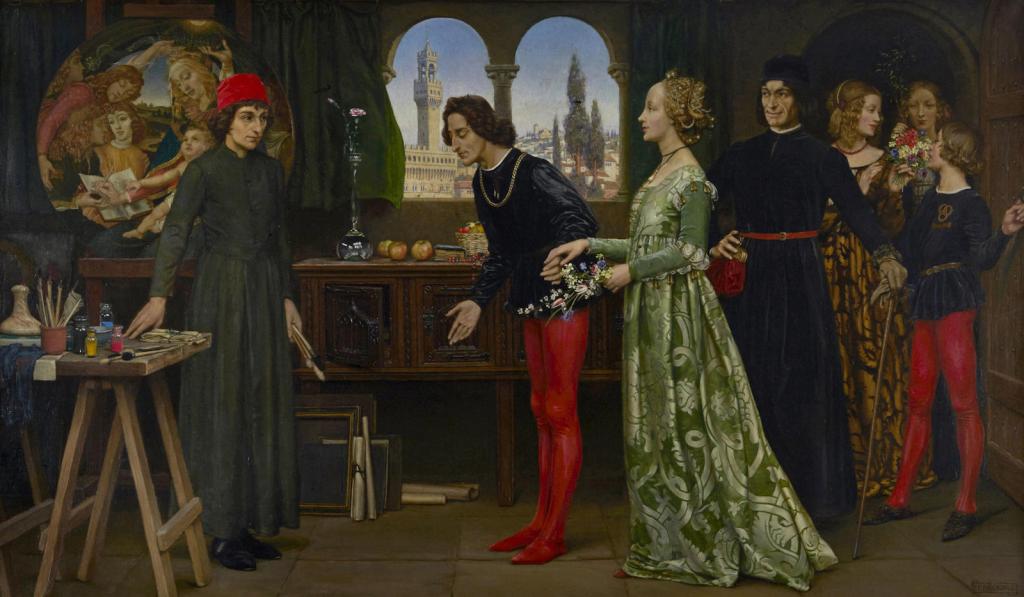
Botticelli’s Studio by Eleanor Fortescue-Brickdale
Eleanor Fortescue-Brickdale (1872-1945) was a very interesting British artist who is said to be the last Pre-Raphaelite. She was born in an upper-class family and started her artistic journey with illustrations before moving on to major works of art, among which is The Pale Complexion of True Love, and then to watercolours. In her painting Botticelli’s Studio, she depicted artist Sandro Botticelli (on the left) receiving his distinguished visitors – Giuliano de’ Medici (the man bowing), Simonetta Vespucci (the lady in the green dress), Lorenzo de’ Medici (all in black), and Giovanna Tornabuoni (further back). It is a detailed, highly romanticised portrayal of the patrons (rendered realistically) paying a visit to the great artist in his orderly studio. The Palazzo Vecchio can be seen outside the window, which is next to Botticelli’s masterpiece-in-progress Madonna of the Magnificat, perhaps with the artist linking the two. What is interesting is that the final version of the painting Madonna of the Magnificat shows six people (excluding the infant), which is the exact number of the visitors to the studio, and the painting was also interpreted as portraying the Medici family: the Virgin being Lucrezia Tornabuoni, the wife of Piero di Cosimo de’ Medici and the mother of Lorenzo de’ Medici and Giuliano de’ Medici, who are depicted as the angels in the work.
 Thoughts on Papyrus

Las Meninas is an intriguing work. The more you look, and the more you know, the more you see.
LikeLiked by 1 person
Very true. And, for me, the more questions also arise.
LikeLike
I always thought Rembrandt’s “The Artist in His Studio” was the purest expression of the topic, and the most symbolicly expressive, with the monumental frame dominating the painting.
https://en.wikipedia.org/wiki/The_Artist_in_his_Studio
LikeLiked by 1 person
Yes, I love that one. And its idea that “the art is bigger than the artist”.
There are many other examples, of course, including Gustave Courbet’s The Painter’s Studio, and just the other day I also stumbled across a curious one – Dagnan-Bouveret’s Gustave Courtois in his Studio (or Sulking).
LikeLike