


The nine muses are the daughters of Zeus and Titan goddess Mnemosyne (of “memory”) who lived on Mount Helicon where they cultivated their creative gifts near the streams and geysers made by the hoof of winged horse Pegasus. Those streams and lakes, created by the hoof, were said to endow anyone who drunk from them with unlimited creative potential, intellectual curiosity and prophetic insight. In this environment, Mnemosyne taught her daughters various arts and trained their voices, and they later danced and sang at parties held by gods and heroes. The daughters are Calliope (Epic Poetry), Melpomene (Tragic Drama), Thalia (Comedy), Terpsichore (Dance), Clio (History), Erato (Lyric Poetry), Euterpe (Music), Polyhymnia (Mime & Sacred Lyrics), and Urania (Astronomy). All of them brought artistic inspiration to mortals, igniting the human spirit to explore and express the arts, and the word “museum” is from Greek “mouseion”, meaning a sacred shrine built to honour the muses, that now refers to a building that houses all things art.
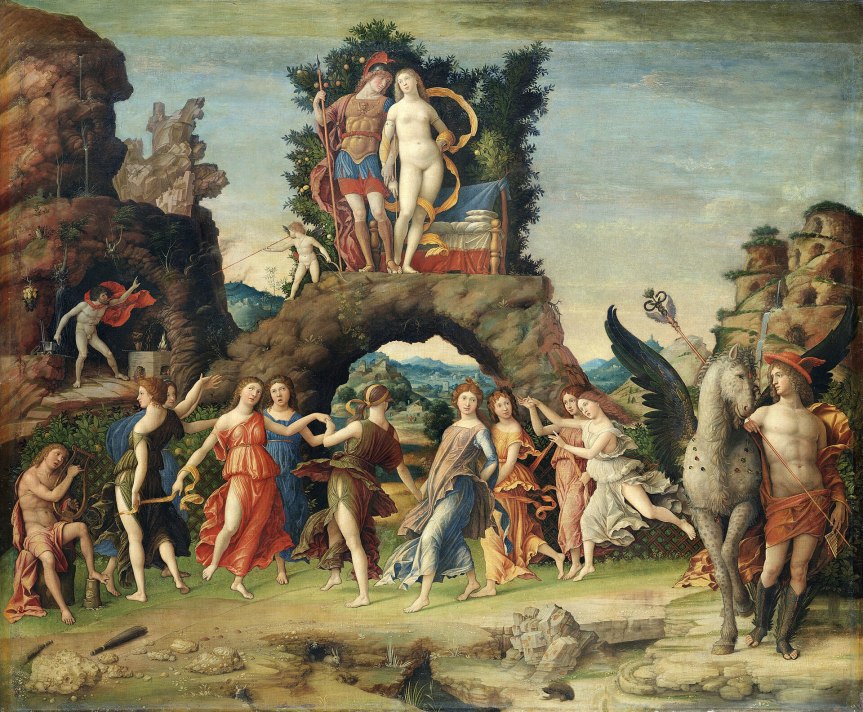
Andrea Mantegna was an Italian Renaissance painter who experimented with perspectives and worked with techniques that imitated the look of classical sculptures. In the foreground of this painting is Apollo playing a lyre, while the nine muses are dancing, overseen by Venus and Mars (Isabella d’Este and Francesco II allegorised) who stand at the top of the arch. Near the winged horse Pegasus is Mercury, the god of communication and commerce. It is difficult to identify specific muses in this artwork, but the muse in white appears to be the most energetic dancer and is probably the muse of Dance – Terpsichore, while the muse in blue with her hands stretched towards the sky is Urania, the goddess of Astronomy.
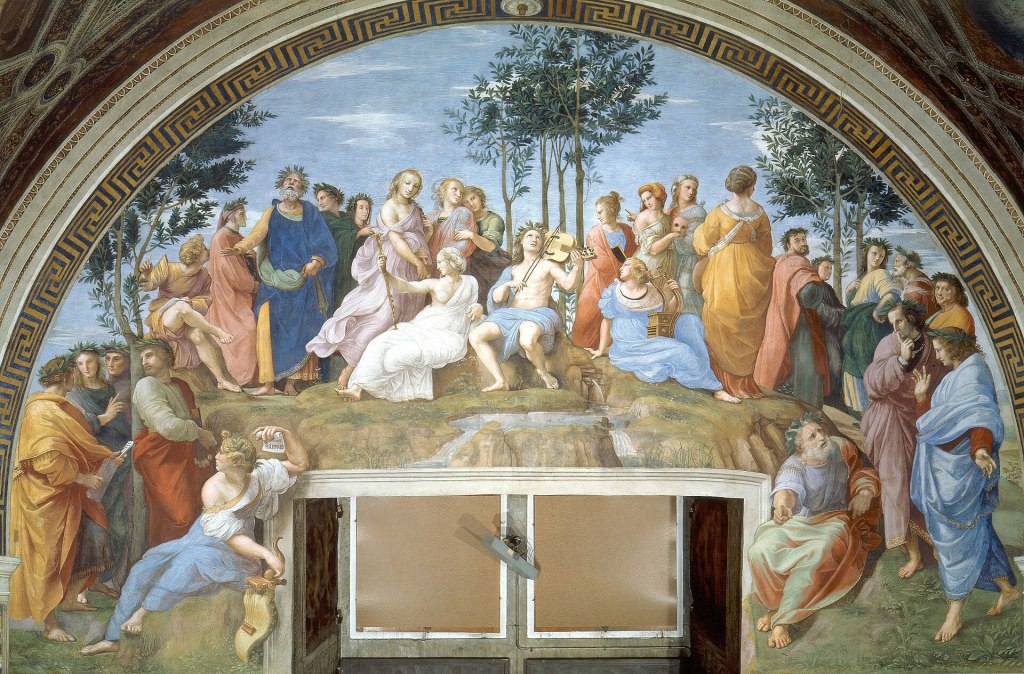
This fresco by Raphael portrays the Mount Parnassus where Apollo is playing an instrument surrounded by the nine muses, nine poets of antiquity (for example, Dante in red and Virgil in green) and nine contemporary poets. To the right of Apollo, dressed in white and holding a trumpet is likely Calliope, the muse of Epic Poetry, who is the eldest of the muses, and, according to some accounts, was also the mother of Orpheus. Calliope was considered one of the most accomplished, if not, the most accomplished of the muses, and wanted to preserve the great stories through the generations, making sure there is excellence in storytelling. To the left of Apollo, dressed in blue, is probably Terpsichore with a lyre, the muse of Dance, who ensures that dance is a way for the people to share meaning and beauty.

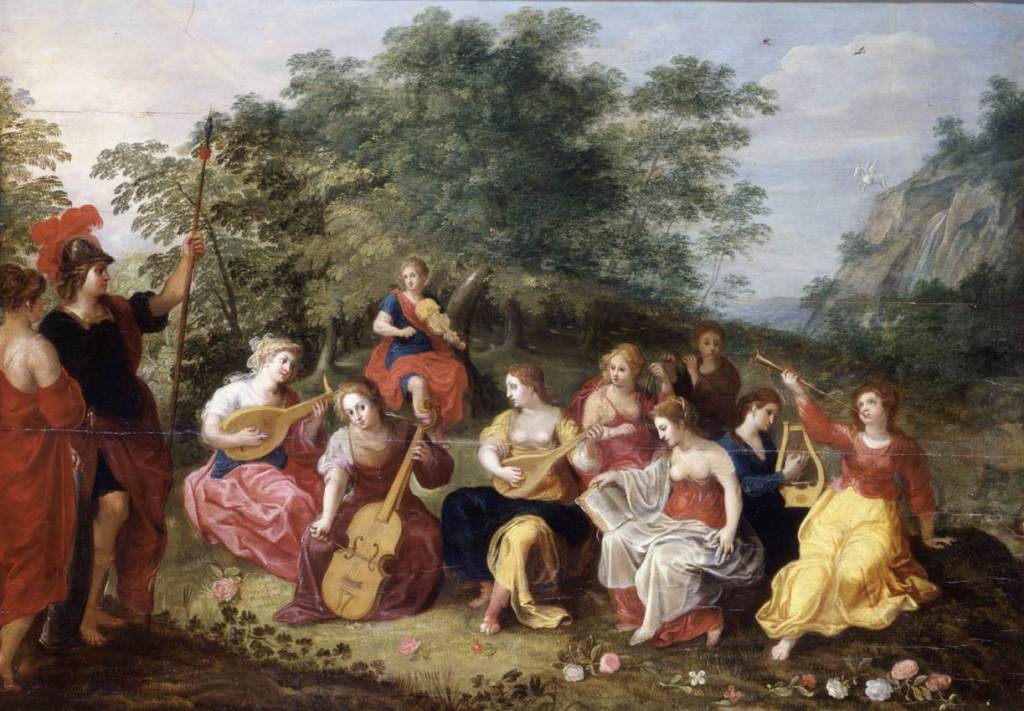
This painting by Flemish artist Joos de Momper depicts a scene from Ovid’s Metamorphoses. In it, Minerva, the goddess of Warfare and Wisdom (Greek Athena) came to Mount Helicon to view and listen to the muses’ dance and song, as well as to see Hippocrene, the sacred spring created by Pegasus. In the artwork, Minerva, wearing a helmet and holding a “Medusa” shield in her hand, walks up confidently to the muses, and engages Euterpe, the muse of Music (or Calliope), in conversation. It is harder to identify other muses, but, perhaps, it is Melpomene, the muse of Tragic Drama and Clio, the muse of History, who have a book open in front of them.
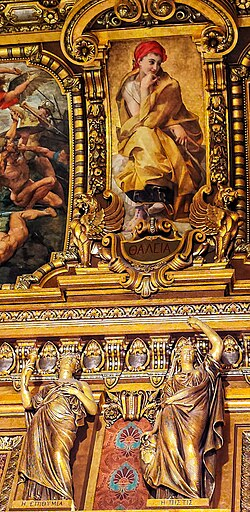
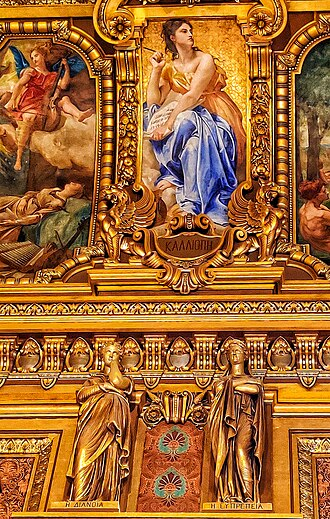
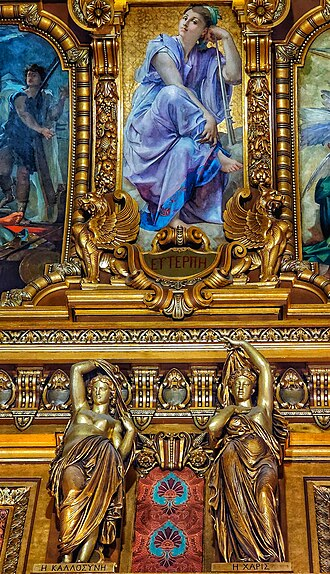
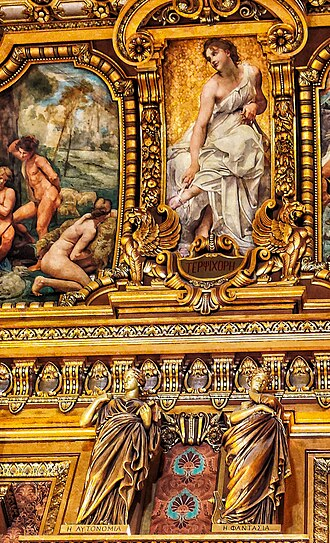
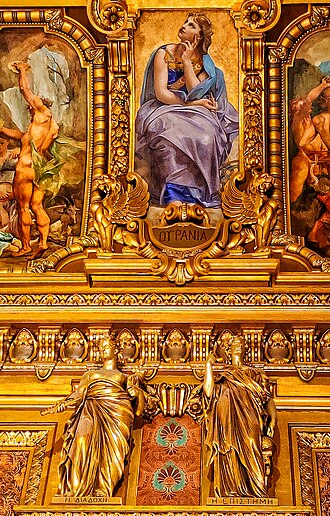
When I visited Opéra Garnier in Paris last November, I enjoyed viewing the artworks of Paul-Jacques-Aimé Baudry (1828-1886), who painted the eight muses on the ceiling of the Grand Foyer. To make the ceiling paintings symmetrical, one muse had to be “sacrificed”, meaning omitted, and that was Polyhymnia, the muse of Sacred Lyrics. Hence, their number on the ceiling is eight. Below, are Thalia, the muse of Comedy, in bright and cheery yellow, and sporting a smirk, Melpomene, the muse of Tragedy, in red, holding a dagger to symbolise the violent demise of heroes, Erato, the muse of Lyric Poetry, in pale pink to emphasise sensuality, and Clio, the muse of History, holding her parchment scroll where historic events are recorded.
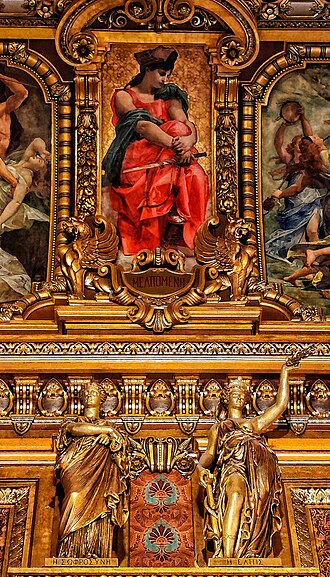
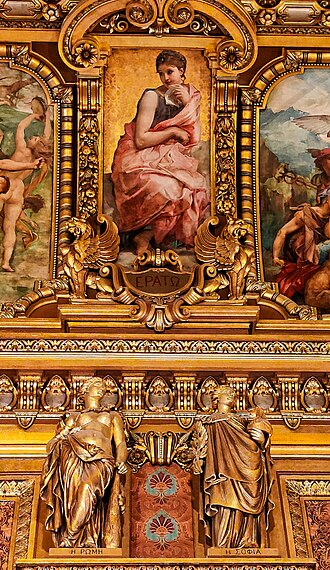
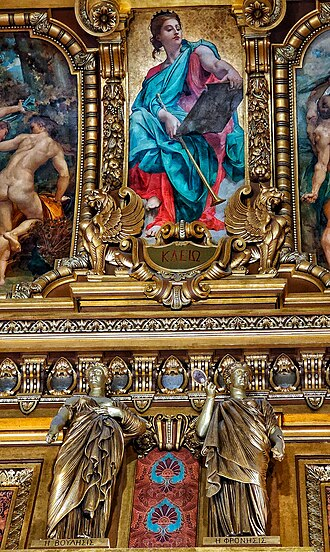
Next comes Calliope, the muse of Epic Poetry, and Euterpe, the muse of Music, whose name is translated as a “giver of much delight” and who is often seen with an aulos (double-flute), an ancient wind instrument. Terpsichore, the muse of Dance, comes next. She was often depicted with a laurel wreath and holding a harp, but below she is in simple white, posing to emphasise feet and movement. The final muse is Urania, the muse of Astronomy, looking pensively at the sky above.*The panel painting in the header is Apollo and the Muses Dancing by Baldassare Peruzzi.


Thank you for sharing the art with the stories!
LikeLiked by 1 person
Some of the most beautiful art in the world derives from ancient myth.
LikeLiked by 1 person
I’ve long contemplated composing a post on the Muses but have never got round to it; I do however like your art-based approach to considering their attributes and associations!
LikeLiked by 1 person
Yes, thanks, it was a fun post to compose.
LikeLiked by 1 person