

Matthias Grünewald is one of those Renaissance painters who were forgotten for a long time before being rediscovered in the nineteenth century. Grünewald was born c.1470, and gained some recognition during his lifetime for his work in the late medieval style, even as the world turned to classicism. Much of his work was lost at sea, and his art was often also mistaken for that of Albrecht Dürer, with the result being that what remained were just ten paintings and thirty-five drawings. Grünewald’s most famous work is the Isenheim Altarpiece, completed in 1515. Since the nineteenth century, he has been championed by several notable authors, including Joris-Karl Huysmans, Elias Canetti and W. G. Sebald. I love Grünewald‘s dramatic use of colour, and the fact that, like Bosch, he emphasised spiritual struggle and the grotesque in mystical contexts.
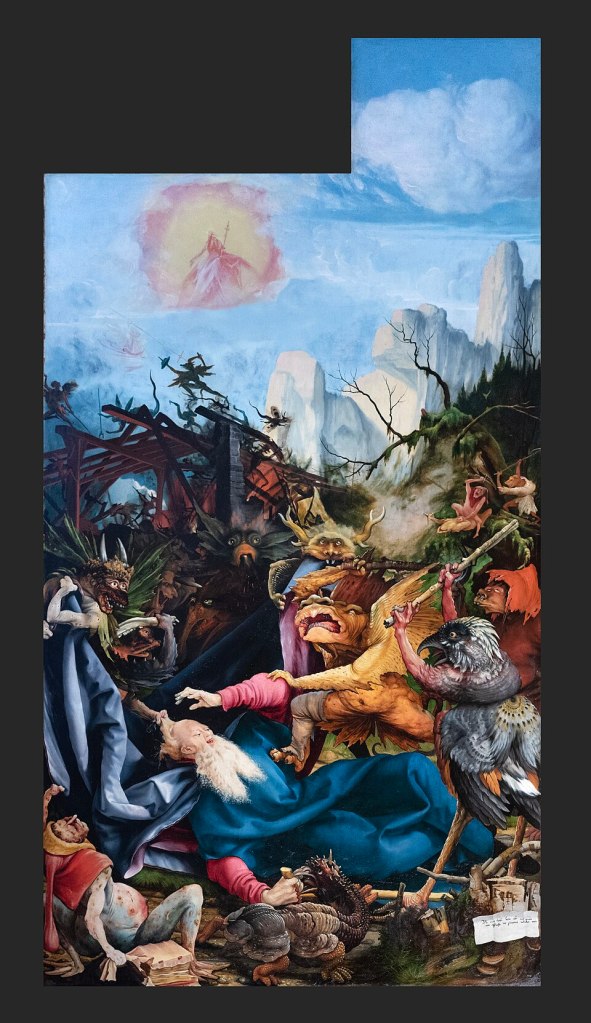
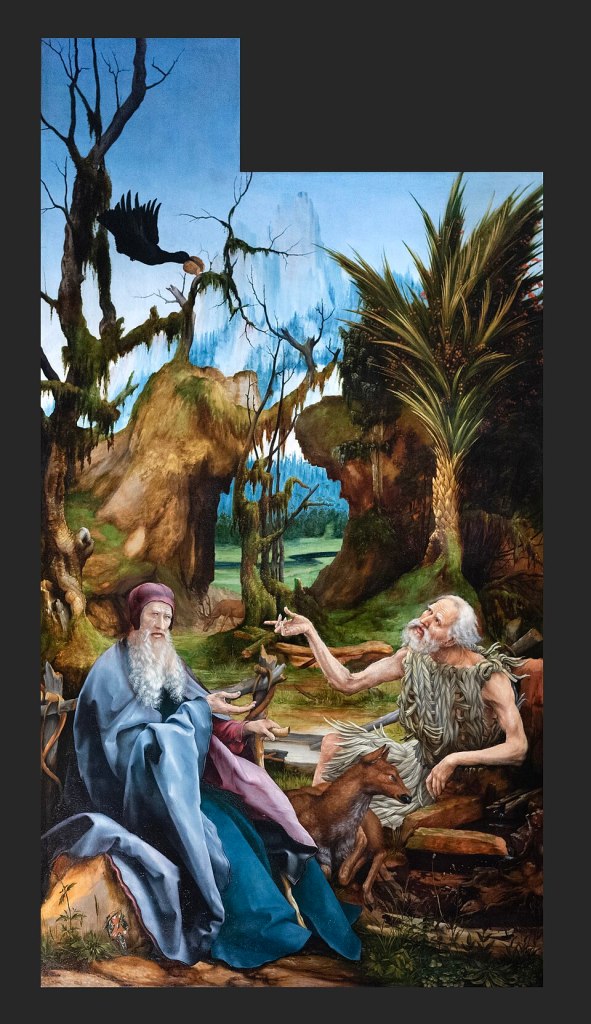
This painting is part of the Isenheim Altarpiece, that can be viewed in Unterlinden Museum in Colmar, France. To the left is Saint Anthony being tempted or tormented in the desert by demons sent by Satan. Saint Anthony is on the ground being beaten, and appeals to God to send angels to combat the monsters. In the lower left corner, a being is seen suffering from the effects of ergot poisoning that causes swelling and ulcers. Again, the colour palette and the imaginative depictions of the monsters are standing out. To the right, Saint Anthony meets Paul the Hermit. This is a much calmer setting representing the Theban Desert with its palm tree and animals that live peacefully alongside humans. The crow is seen bringing bread to Paul and Saint Anthony.
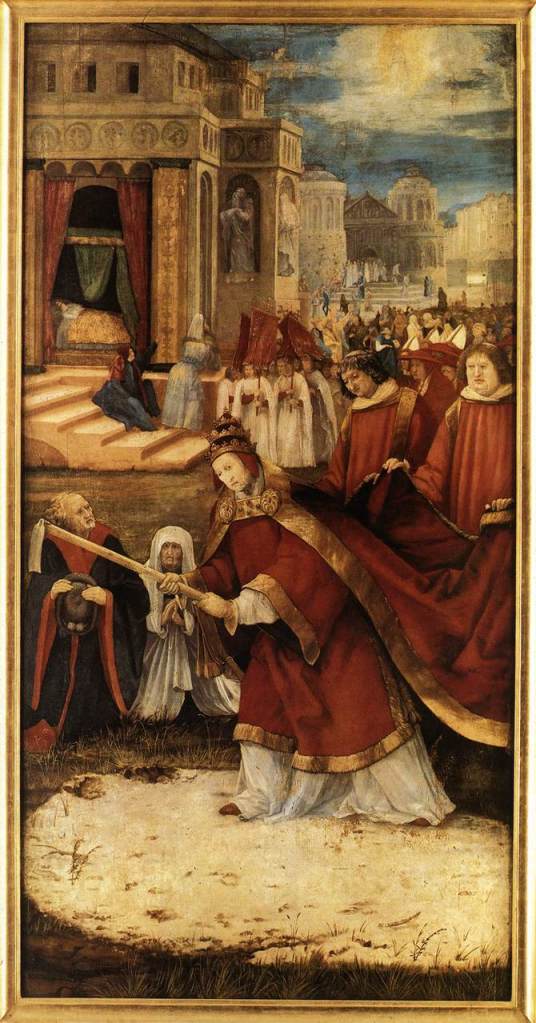
The Miracle of Our Lady of the Snows portrays the legend of the origin of the Roman Basilica of Santa Maria Maggiore. On the night of 5 August, Pope Liberius (352-366) had a dream in which the Virgin asked him that a Basilica be erected in her name and in the location where snow would fall. According to the legend, the miraculous snowfall did occur on that summer day on the Esquiline Hill, and the work on the Basilica began. Grünewald’s painting shows the papal palace where the Pope is fast asleep, and the Virgin Mary who appears in the sky. On the right, the clergy and their followers are gathering to witness the miracle, while in the foreground, the Pope is marking the location of the cornerstone with a hoe. The Miracle of Our Lady of the Snows is on display in Augustiner Museum in Freiburg, Germany.
 Thoughts on Papyrus
oh neat! I so loved the Isenheim Altarpiece, that I discovered as a teen. I think I read a fabulous book on it, but alas that’s about 45 years ago, and in French
LikeLiked by 2 people
I made a pilgrimage to Strasbourg to see the Isenheim Alterpiece and I have to say, the intense power and beauty of the work was so overwhelming, I actually cried, something that didn’t happen again until I went to the room with the Botticellis in the Uffizi galleries in Florence. The work is surprisingly large, like Rembrandt’s “The Night Watch.” The center panel is eight feet high! There’s nothing like it, and photos do not capture it.
LikeLiked by 1 person
I feel so fortunate that I have had the chance to visit the altarpiece several times, most recently at Whitsun this year. And I want to go again – reproductions can give an inkling, but there’s nothing like being the presence of the work itself. Like entering a cathedral of canvas.
LikeLiked by 1 person