


Fires on the Plain [1951] – ★★★★1/2
One of the most important anti-war novels ever written.
Winner of the prestigious Yomiuri Prize, Fires on the Plain details the experience of a Japanese soldier in the Philippines during the last months of the World War II (the Leyte island landing). This sometimes gruesome and traumatic, but vividly introspective and unputdowanable novel full of conviction is filled with psychological and philosophical insights. Drawing from his own experience of the WWII, Shōhei Ōoka wrote about the degradation, futility and meaninglessness of war through the experience of one injured and stranded soldier who gets suspended between complete despair, increasing apathy and little choice, but to commit war crimes, on the one hand, and glimpses of hope and religious visions, on the other. Plagued by contradictions and irrational thoughts, Private Tamura finds himself psychologically distancing from war horrors around him, as Ōoka makes a powerful statement on one situation where such concepts as morality or rationality no longer seem to have any meaning.
Translated from the Japanese by Ivan Morris, the novel is a first-hand account of injured Private Tamura of the Japanese Imperial Army fighting in the Philippines. As a result of Tamura’s injury he is sent to a local army hospital, but he soon finds out that the hospital cannot accommodate him because he does not have sufficient food. In fact, this is a “hospital”“where the only concern of the doctors was how to get rid of their patients and save food” [Ōoka, 1951: 31]. A number of soldiers find themselves in a similar situation to Tamura through their injury and are caught in a seemingly absurd situation: they are no longer useful to the army, but they are not yet dead either. They are left to survive on their own, and their horrific injuries and the lack of food both presuppose they they will not be alive much longer. The whole regiment of Tamura is also pitiful: “our company had in fact become no more than a broken group of stragglers skulking in a small mountain village; for some time the Americans had no longer even bothered to bomb us” [Ōoka, 1951: 8], tells Tamura. When he joins a group of “rejects, the debris of a defeated army”, those that at “this stage of the campaign…could be of no possible military use” [1951: 34], he finds his hopelessness increases.
At no point Shōhei Ōoka tries to actively elicit our sympathy for the narrator, who, in fact, remains an ordinary, “brutish” soldier and, essentially, a killer. The account is merely factual and soon becomes rather eye-opening in terms of dissecting the psychology of a soldier on the battlefield. Private Tamura, equipped with despair, growing apathy and nonsensical orders from the commanders to (maybe) “kill himself”, finds himself isolated, aimlessly drifting around the island. In fact, he grows more and more distant from his role on the battlefield, and, like so many soldiers before him, starts to put a psychological distance (barrier) between his intrinsic inner self and what he sees around him (his representation of himself and his actions) to protect his psyche. Thus, later in the novel, he seems to act as an automaton or as “an actor on stage”, dis-identifying himself from his actions and the trauma which surrounds him.
Taken by all the natural beauty around him, facing his own imminent death, and torn between fears about food shortage and “it’s only the end of the world” apathy, Private Tamura starts to philosophise: “does not our entire life-feeling depend upon this inherent assumption that we can “repeat indefinitely” what we are doing at the moment?” [Ōoka, 1951: 18], asks Tamura, and “it was not because I was still alive that I clung to the notion of life, but because I was already dead” [1951: 67], he states. He starts to see symbols everywhere, and, burdened with his “Raskolnikov-type” guilt, his journey through Philippine forests sometimes takes a hallucinatory, metaphoric shape.
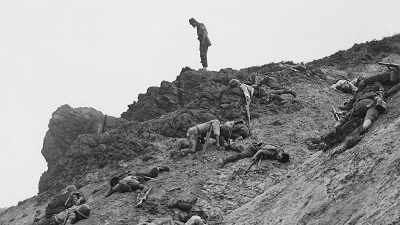
In Fires on the Plain, Shōhei Ōoka tried to demonstrate the absurdities of war, and what it may feel like to start seeking meaning in a completely meaningless and illogical set of situations. In the narrative of Tamura, self-interest is pitted against patriotism, especially that kind of patriotism that finds itself on another man’s territory and not the one that defends its own motherland: “It was my country that had forced this lethal weapon on me, and until recently my usefulness to my country had been in exact proportion to the amount of damage I could inflict with it on the enemy” [Ōoka, 1951: 119], says Tamura, and continues :“I felt not the slightest hatred for them (people of the Philippines); yet I knew only too well that since the country to which I belonged happened to be fighting the country to which they belonged, there could never be any human relationship between us” [1951: 79]. The final part of the book or the Epilogue is all about coming to terms with the horrors of the war, and is a bit over-explained and even needless, detracting from the insights already given in the novel.
🕊️ This book about a “solitary alien in enemy land” [Ōoka, 1951: 104] showcases convincingly the devastating impact of war on human psychology and physiology, and, in a way, the novel paved the way for such authors as Nobel Laureate Kenzaburo Oe (The Silent Cry [1967], Nip the Buds, Shoot the Kids [1958]) and Akira Yoshimura (Typhoon of Steel [1967], Shipwrecks [1982]). The portrayal of the sheer demoralisation, dehumanisation and purposelessness of war, where individual needs and instincts of self-preservation collide brutally with collective action and vague war aims, is coming from the author who undoubtedly experienced it all first hand.


Fantastic book review. Thanks for sharing. I really need to get a new Kindle e-reader since mine broke hmm.
LikeLiked by 2 people
Thanks for reading and commenting!
LikeLiked by 2 people
Wonderful review, Diana! This is a new-to-me book and writer. This book looks very fascinating! I loved this quote you’ve shared – “does not our entire life-feeling depend upon this inherent assumption that we can “repeat indefinitely” what we are doing at the moment?” Very thought-provoking. It is sad that the author over-explains things in the last part of the book. But glad to know that this book is wonderful overall. I’ll add it to my reading list. Of the other books you’ve mentioned, I have ‘Shipwrecks’. Yay 🙂 Hoping to read that one soon. Thanks for sharing your thoughts 😊
LikeLiked by 1 person
Thank you! I hope you enjoy Shipwrecks! I loved how understated that short novel was and the way the author showed the ways of a quiet Japanese village and what the villagers there were prepared to do so survive.
LikeLike
This sounds like an excellent novel, albeit not for the faint of heart. I have a particular interest because my dad served in the Phillipines during this time period.
LikeLiked by 1 person
“… where individual needs and instincts of self-preservation collide brutally with collective action and vague war aims…” Ack. War is a whole machinery of its own, isn’t it? Who really benefits from it is a question in futility because so much gets hidden, covered up, fixed up. I’m not sure I’m going to pick this book during the pandemic times, but thanks for a powerful review for a powerful book.
{Followed the link from the Japanese Literature challenge.}
~ Lex (lexlingua.co)
LikeLiked by 1 person
Thanks very much for reading, and I agree about the war. If I were not already very interested in this particular type of existential literature and had a Japanese lit challenge, I don’t think I would have picked up this book during the pandemic either. It is harrowing.
LikeLike
Just came across this review via your 20 Japanese literature books post and I was intrigued because so few people seem to know about this book (I don’t think there’s a recent edition of it either). I studied Japanese at university and wrote my thesis about how the war was reflected in Japanese literature, so this was one of the key books I referred to. On the same theme, I’d also recommend Black Rain by Masuji Ibuse and The Burmese Harp by Michio Takeyama. Dazai Osamu is one of my favourite authors and I’d also recommend his Setting Sun for a description of the end of an era.
LikeLiked by 1 person
Thank you very much for these recommendations. I know Black Rain and The Burmese Harp as films, but I definitely want to read the novels too. I have read Setting Sun, but prefer Dazai’s other books. I want to re-read it at some point, though. Your thesis sounds fascinating. I guess the presentation of war had undergone changes as time passed by? I detect much sympathy and compassion for ordinary people battling war conditions in literature – or at least in books I read. It is very likely you know them, but related to this topic, I also like Grave of the Fireflies by Akiyuki Nosaka, and graphic novel Onward Towards Our Noble Deaths by Shigeru Mizuki. Both are (semi)-autobiographical, and the latter in particular attacked the ruthless, nonsensical war mentality of Japan during the WWII. Ground Zero, Nagasaki (a short story collection) by Yuichi Seirai and The Sea and Poison by Shūsaku Endō, which focuses on a hospital and harrowing operations on American soldiers during the WWII also left a huge impression on me.
I’m not sure how much interest you have in film, but I think it is interesting to consider how war is portrayed in Japanese cinema as well. Sure, there was more restraint shown in portraying Japan at war because, I imagine, a lot of money had to be found to go into a film, but even decades after, this restraint persists – for some reason. The vast majority of cinema, with the exception of the adaptations above and Masaki Kobayashi’s trilogy, naturally focused on the post-war period, and, actually, I feel like those tell much more about the impact of war than any graphic film on war. Perhaps this is because of the Japanese ability to emphasise context, sub-context, nuances, so we see the sheer poverty affecting children in Muddy River (1981) (also a book), the directionless lives of adults in An Inn at Osaka (1954) and the search for personal redemption in Children of the Beehive (1948). What I find also interesting is that some of the better known films about the last stages of the WWII from the Japanese perspective were actually shot/directed by foreigners, not Japanese – Eastwood’s Letters from Iwo Jima and Sokurov’s The Sun.
LikeLike