

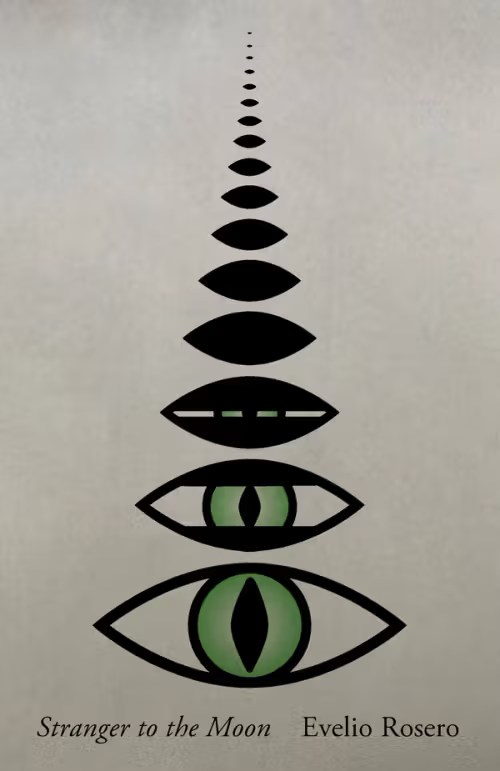
Stranger to the Moon [1992] – ★★★★
“What’s important to me is that I can see without being seen” [Evelio Rosero, translated from the Spanish by Victor Meadowcroft & Anne McLean].
Evelio Rosero is an author from Colombia, and this is his completely surreal, nightmare-inducing novella which starts with a being emerging from a wardrobe. He is a member of the clan of the “naked” ones who are crammed into one enormous house. They are ruled over by the “clothed” ones, the more powerful beings, who continuously use, mistreat and abuse the weaker “naked” ones. Sometimes, the “naked” ones, who are also described as having “two sexes”, venture outside their house, and it is there their biggest misfortune awaits them – their horrific encounter with the “clothed” ones, and this meeting may even lead to death. The “clothed” ones do not suspect, though, that our narrator, that “naked” one from the wardrobe (“a wandering gaze”), starts having rebellious thoughts as the idea of revengeful killing is slowly taking hold in his otherwise submissive mind. This highly imaginative, disturbing, but also fascinating, novella is an allegory of deep societal distress, inequality, control, power, and oppression.
In his novels, Rosero often grapples with his country’s violent history and ongoing conflict, and, in this story, surrealism meets brutality, as the author portrays the extent of oppression and exploitation through this fantastical story of two groups of people, one dominant and one totally submissive. It is as though Rosero wants us to see how the true innocents of his country, such as children, are often trying to make sense of the horror present around them, and they do so through the only prism they know – cautious, timid exploration of what must and must not be done to stay alive and unhurt.
Oppression in the story is symbolised by the packed house shared by the “naked” ones. They are so crammed together that some of them even suffocate to death. Power is conveyed in the novella by who has a say in the house and who doesn’t, who is naked and who is not, and dehumanisation extends to other things as well, such as the “naked” ones having no names: We have no names, but they name us, on a whim, depending on the day of the week, the weather. There are some who get a different name every night; others receive their names according to taste, a character quirk, a mood” [Rosero/Meadowcroft, McLean, New Directions, 1993/2021: 34]. And, the “clothed” ones do not only torment the “naked” ones, but also entertain themselves at the expense of the “naked” ones, and there are nights of partying in the house through which the author also emphasises the theme of enslavement and human rights abuse: “We allow them to use us, finally, to meet any necessity: as plates, as candelabras, as vessels, as tables for their food.” It is during one of those parties that the “clothed” ones took a special interest in our narrator (“the greatest exception”, “the dangerous, beloved monster”) because of his unusual height, slender build and long hair.
The persecution of the “naked” ones at times resembles the Nazi atrocities towards the Jews because of the level of dehumanisation portrayed and since spies (animals and even vegetation) also exist in the world to keep the “naked” ones in check, but the whole story may also be a parable of human existence throughout much of the history. The “naked” ones function in the survival mode all the time, existing in what is essentially the state of nature, fending for themselves in whatever way they can in this very unjust world. Food is so scarce that even cannibalism is not off-limits: “Nobody here has ever felt full and stopped thinking for even one miserable minute about his or her meals…”
The less is said in the novel, the more is implied, and the greater the sense of dread. The horror lies in the incomprehensible, in the supposed, and in the imagined. The story hints at the unknowability of terror to come, and this aspect is the most terrifying: “trying to guess what horrible form of death we will encounter — is in itself a horrible way to die.” In a way, Rosero is perhaps trying to convey the idea that the moment one makes any distinction between people, evil and injustice arise. Racism comes to mind. Arguably, the injustice is inherent in the distinction itself. One cannot treat equally someone that person has already categorised as “different” or “other” in their mind, or put them in a certain category. It is best to emphasise what makes us similar and what unites us, rather than ponder on what separates us or what makes us different (babies and little children do not differentiate people based on their outward characteristics – for them, one can be a “friend” or a “stranger”, not “black” or “white”, or some age, gender or nationality). Incidentally, this is the view taken by actor Morgan Freeman who promotes a more “unified” understanding of identity rather than separating people by race.
💀 Stranger to the Moon can perhaps be defined asOlga Ravn’s enigmatic dystopian novella The Employees meeting Agustina Bazterrica’s horrific and distasteful Tender is the Flesh, perhaps by way of Stefan Wul’s sci-fi Oms en série. The novel depicts what can only be described as pure hell, and falls squarely into the literary categories of speculative weirdness and disturbing surrealism. This is a very short, but punchy (in the gut) read.


Sounds like an interesting book.
And yes, categories… Any distinction can lead to a racism of sorts.
A MAGA author talks of “unhumans” as he refers to “the left”, i.e. the Democrats. A revival of the “untermensch”. Sigh…
Thanks for the review.
LikeLiked by 1 person