

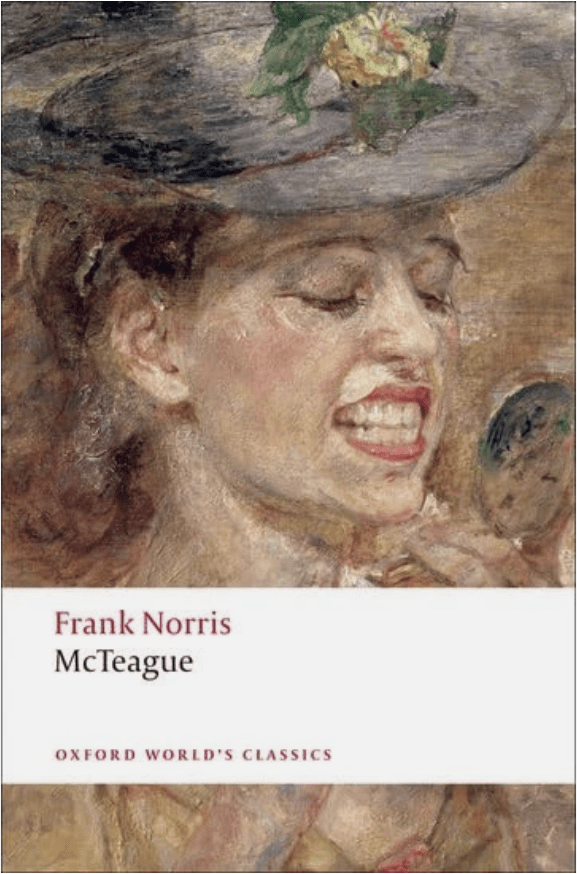
McTeague: A Story of San Francisco [1899] – ★★★★
Perhaps better known as the silent film Greed (1924) and based on a real murder case that shook San Francisco in 1893, McTeague is Frank Norris’s naturalistic novel about a sham dentist named McTeague and his “prim” wife Trina Sieppe, who at first have all the attributes of becoming members of the respectable middle class, but who then slowly spiral into degeneracy and destitution. ASan Franciscostory through and through, McTeague first focuses on one unlikely romance and one equally unlikely marriage before transitioning into a dramatic tale of a fight for survival.
The story starts almost too quietly and ordinarily, unfolding with the pace of a lazy Sunday afternoon. We are transported to San Francisco at the turn of the twentieth century. The city is a bustling one, but it nevertheless gives the air of a tight-knit community, a feeling felt in particular on Polk Street, where immigrants rich and poor rub their shoulders as they come into contact through trade and leisure. The proximity of the ocean expands the residents’ vision and ambition, and the cable car, the city’s proud symbol, further emphasises the cosmopolitan, connected and efficient way of life. In the midst of this, we find McTeague, a dentist, who lives in his “dental parlours”, a one-room flat on Polk Street. He is one’s common man, not particularly bright, but sturdy, loving his simple pleasures and having even simpler aspirations, one of which is to have better advertisement for his small business, such as “to have projecting from that corner window a huge gilded tooth, a molar with enormous prongs, something gorgeous and attractive” [Norris, Penguin Publishing, 1899/1994: 7]. Another ambition only arises when McTeague’s intimate friend and neighbour, Marcus Schouler, introduces him to his “delicate” cousin, Trina Sieppe, and only because Trina needs “dental help”, having recently suffered a fall and cracked her two front teeth. McTeague falls in love with Trina, but it is not so easy to win a woman who appears socially so “above” oneself.
With regards to Trina, McTeague is in the grip of sexual fever, and, Trina, in turn, though at first reluctant, acquiesces out of sheer tiredness and probably fascination as to their outward differences (the “beauty and the beast” scenario). It is in relation to this romance that Norris employs one of the most effective “mirror” contrasts. McTeague and Trina’s “practical”, business-like first meeting and then, rather earthly, almost animalistic on McTeague’s part longing and relationship is contrasted with the soulful, purely platonic sunset-years’ romance between McTeague’s two elderly neighbours – Old Grannis and Miss Baker, whose antics provide comic relief in the story. The two are spending each and every day of their lives sitting and listening to each other’s breathing and movements through the thin board partition that separates their rooms. Never daring to talk to each other, they are still acutely aware of each other, as well as of each other’s romantic interest.
The first time gold slips into the narrative, it does so almost incidentally, emphasising the practical side of things. That first time, gold is not portrayed as some coveted treasure, but as a daily necessity. McTeague wants a giant gilded tooth mounted on top of his business so as to advertise it better, and he also mixes gold with some powder to feel cavities of his customers. It is only later that money begins to play a leading role, and the final chapters are all about the “gold rush”. This makes this book a story of two halves: the “quiet domesticity” of the first half is contrasted with the second, which is sensationalistic, gritty, and full of cruelty and want. But, McTeague and Trina’s downfall probably began much earlier, with the latter buying and then winning a lottery ticket – five thousand dollars in the bank without lifting a finger. That money is invested, the percentage is paid monthly, but Trina’s personality soon also undergoes a marked change. She turns from a good, economical housekeeper into a stingy-to-the-point-of- cruelty woman: “her avarice had grown to be her one dominant passion; her love of money for the money’s sake brooded in her heart, driving out by degrees every other natural affection” [Norris, Penguin Publishing, 1899/1994: 269].
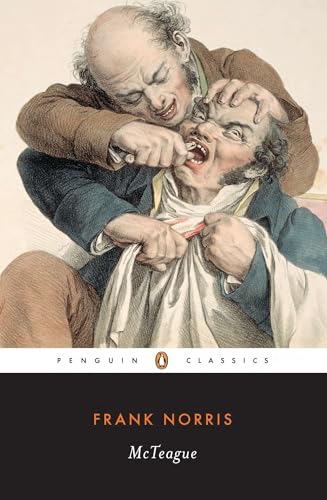
There are two main themes in the novel – chance and ownership (greed). It is only by chance that Trina and McTeague met (Trina happened to break her teeth), and it is also by pure chance that Trina won her lottery ticket, which set her off on her “greed trail”: “chance had brought them face to face, and mysterious instincts as ungovernable as the winds of heaven were at work kitting their lives together” [Norris, Penguin Publishing, 1899/1994: 73]. The possession theme is also striking. If Trina starts to covet money and is a veritable “hoarder”, McTeague at first delights in his possession of Trina, his giant gilded tooth, his canary, and his concertina, and is a veritable “spender”. These caricaturish characters are also caught in between the two extremes. On the one hand, McTreague and Trina have the example of the higher, spiritual and devotional love that they witness from Old Grannies and Miss Baker, but, on the other, they are also exposed to the completely coarse, transactional and violent affair between cleaner Maria Macapa, and delusional, obsessed-with-gold Mr. Zerkow. It is soon clear which path Mr. and Mrs. McTeague start following, and the story culminates in male rivalry gone haywire, in our characters displaying and unleashing their most atavistic urges.
Norris takes a rather illiberal stance in the book, implying that people cannot really escape who they are or their initial circumstances, and perhaps this is one of the reasons, together with the author’s worrying views on heredity (Norris was a Cesare Lombroso reader), that his novels are not read as much today. This view of the inescapability of one’s personality and destiny clashes with one of the greatest novels of all time – Dostoyevsky’s Crime and Punishment, where there is the clear message of one being able to rise above one’s current traits, including the initial “evil” state, and to seek redemption. Norris’s ideas, however, do not make McTeague a novel of a lesser sort because the masterful storytelling is there – the author draws us in with San Francisco’s easygoing vibes and funky characters (such as Trina’s soldierly dad) before changing his direction and delivering not one, but two sensational narrative “blows”. This makes the read rather “cinematic” with some powerful imagery, and Norris does emphasise his objects. The two objects, in particular, become symbolic: McTeague’s gilded cage with a canary in it, and his giant gilded tooth, once used to advertise his business. McTeague was forced to sell the tooth (representing “professional/middle-class dreams crushed”), but he never let go of the canary, that may stand for childlike wonder.
🦷Though Frank Norris died of a ruptured appendix at the age of just thirty-two, he had had enough time to make a name for himself, being called “American Zola”, and despite his unsavoury – though not altogether uncommon for that time – opinions, his narratives remain appreciated. McTeague reads like a novel from an author in full command of his narrative thrust, and who is also keenly aware of the power of contrasts and vivid characterisation.


2 thoughts on “Review: McTeague by Frank Norris”