

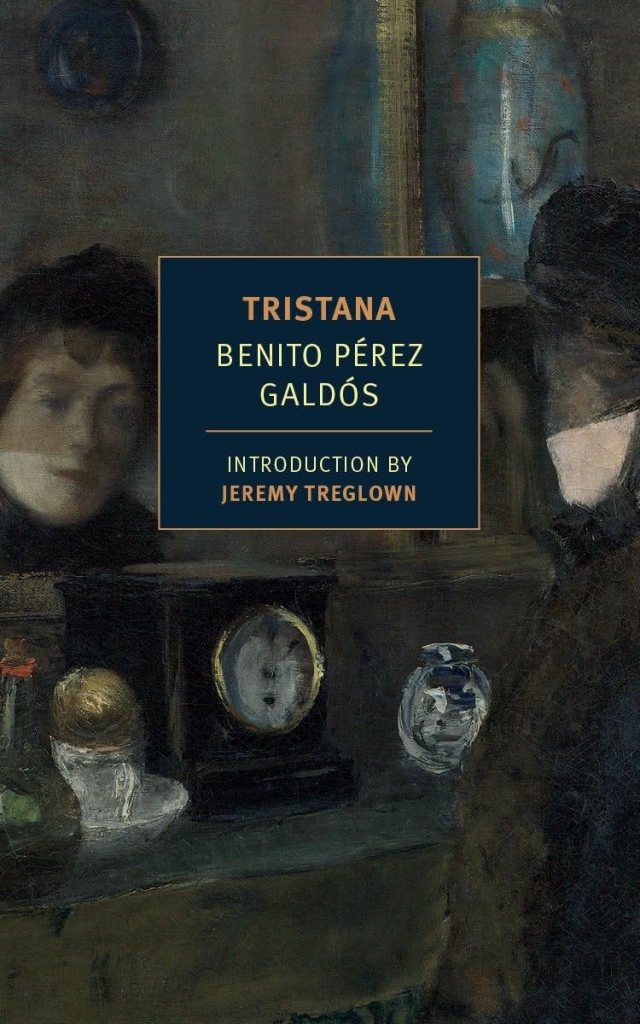
Tristana [1892/2014] – ★★★★1/2
“…the young woman had
her own ideas, hurling herself into the empty spaces of thought and
displaying the boldest of aspirations…” [Benito Pérez Galdós, Margaret Jull Costa, NYRB Classics, 1892/2014].
Don Lope Garrido was a man already past a certain age when he took under his wing the daughter of his friend, who died in bankruptcy. The girl, Tristana, found herself orphaned, penniless and facing a sorrowful fate – but she did not realise it back then. Don Lope took advantage of pristine, innocent Tristana and started living with her as his wife, without marrying the girl, of course, and Tristana’s gradual re-awakening to her plight forms part of this Madrid tale, which at first looks like a simple tale of female emancipation, but soon transforms into something more thought-provoking – a “circular” story of rising hopes and dreams, and the final resignation.
“I want to live, to see the world and find out why we’re here. Yes, I want to live and be free“, proclaims Tristana, but she is told by Don Lope’s maid Saturna, her only friend, that freedom is a nice word, but it “isn’t one that sounds good in a woman’s mouth“, and that there are “only three careers open to those who wear skirts: marriage…the theatre…” and the third, “unmentionable” one. Tristana doesn’t even have enough time to process this when she spots an attractive young man whose eyes also begin following her around. Is he her ticket to escaping the clutches of increasingly possessive and paranoid Don Lope? Or, will this handsome man, Horacio, allegedly a painter, present a new form of slavery? Or, being a “prisoner” to one’s freely chosen love isn’t bondage at all?
In no other novel, perhaps apart from du Maurier’s Rebecca, is a character’s absence felt as deeply as in Tristana. When the girl does not appear in the novel’s beginning, we can only speculate, and when Horacio is absent at some point, his inaction and absence are more potent in the story and say much more than any character’s speech or action. Benito Pérez Galdós (1843-1920) is considered to be the greatest Spanish author after Miguel de Cervantes, and his flowing prose contributes to this short novel being so exquisite. He stretches and moulds his drama carefully, and the result may not be the subtlest (with some odd pacing here and there), but it is surely memorable.
Much of the plot takes the form of letters, and the author was certainly interested in character interactions, and what situations and aspects of personalities bring forth this or that turn of events. There are unmistakable notes of Hardy’s Tess of the d’Urbervilles in the plot, and it is exciting to read how Tristana finally finds not only a small voice, but also a shout in the story.The tale contains an intriguing reversal of aspirations, and into its apparent simplicity, Pérez Galdós then smuggles a tragedy of immense proportions.
🎨Translated from the Spanish by Margaret Jull Costa, Tristana is an elegant, character-driven romantic drama by one of the greatest Spanish authors.
This short review is counting towards my Reading Around the World Challenge, a reading challenge for me to up my list of “read” countries from 50 to 80; country this time: Spain 🇪🇸
 Thoughts on Papyrus
This assertion – “I want to live, to see the world and find out why we’re here. Yes, I want to live and be free” – is such a poignant cri de cœur and must I suppose be the main theme in this novella. Not heard of this author before but this title certainly intrigues me. That she bears the name Tristana is presumably not a reference to the medieval Tristan legend but to the supposed root of the name, ‘tristesse’ or sadness, is that right?
LikeLiked by 1 person
Yes, it is probably in reference to sorrow. I recommend the author. I was pleasantly surprised.
LikeLiked by 1 person
(third attempt with comment; apologize if you end up with duplicates!)
I’ve read a couple of Galdós’ novels (Fortunata & Jacinta; Miaow) and enjoyed them very much — his rep is totally deserved! Your review reminds me that I really must get to Tristana, particularly since I’ve had a copy hanging around forever (well, since NYRB Classics reissued it!). Margaret Jull Costa’s translations, at least the ones I’ve read (Eça de Queiros’ The Maias & Galdós’ Miaow) are great; it sounds from your review that this one is in the same category!
LikeLiked by 1 person
It was my first intro to the author, so now I want to read Fortunata and Jacinta & Miaow. It’s great to know they are also good, thanks. The latter especially appeals to me since I love Kafkaesque bureaucracy stories. Yes, it was superbly translated, though I also read half of it in the original Spanish just to get a sense of the language. The translation is at times “poetic”, but I love it. I agree, Margaret Jull Costa is the best.
LikeLike
This review has piqued my interest in the book. Thanks for posting.
LikeLiked by 1 person