
This March I want to get back to my piano practice which I abandoned some time ago (lack of time). I have been in the beginner stage of my learning for far too long and can now finally say I have comfortably transitioned to the late intermediate stage. However, before I reach any advanced repertoire, I thought I would tackle both early and late intermediate piano pieces, and would like to present below seven beautiful pieces for early intermediate piano learner. I think these are great if a student has tackled his beginner pieces and is looking to bridge the gap between the beginner stage and more serious, intermediate pieces. Some of those below I have already successfully played, such as Old French Song by Tchaikovsky, while some I want to tackle this March and April, including Round O and Brahms’ waltz. My apologies if this post is not of interest to every reader of my site, but I hope it will provide a nice musical interlude.
“Lustig und Traurig”, Bagatelle in C major WoO 54 by Ludwig van Beethoven
Beethoven‘s whimsical piece Lustig und Traurig was written around 1798, showcasing the composer’s magnificent use of contrasts: joy, the cheekily flowing, light-hearted melody, and sorrow, the pompous, sombre tone, compete for our attention. One is easily replaced by another. A full drama of life takes place in one unassuming, but still masterful composition. It is great for this stage of piano learning because it opens itself to interpretations.
Book: Piano Exam Pieces 2019 & 2020, ABRSM Grade 4: Selected From the 2019 & 2020 Syllabus, ABRSM Publishing. 🎶
“Round O” by Henry Purcell
One of England’s greatest composers, Henry Purcell (1659-1695) was a prolific musician, though he had a short life. His lovely piece Round O (Rondeau) is adapted from his play Abdelazer. It is a catchy, rhythmic tune which also appeared in such films as Pride & Prejudice (2005) and Moonrise Kingdom (2012). I also loved playing Purcell’s elegant Air in D Minor when I first started learning the piano. The pianist in the video is Cubus.
Book: The Young Pianist’s Repertoire: Book Two by Dame Fanny Waterman & Marion Harewood, Faber Music. 🎹
“Tambourin” by Jean Philippe Rameau
Going from the English baroque music to the French one. Jean-Philippe Rameau (1683–1764), notable French composer, first wrote this piece for his 1739 opera-ballet Les Fêtes d’Hébé. He later included it in his Pièces de Clavecin book. The tune, with its sombre texture and hypnotic rhythm, is supposed to imitate the sound of a tambourin from the Provence region. Do also check out Rameau’s delightful Minuet in C Major (Rondino), which is perfect for an absolute beginner.
Book: The Young Pianist’s Repertoire: Book Two by Dame Fanny Waterman & Marion Harewood, Faber Music. 🎵
“Waltz No.3 Opus 39” by Johannes Brahms
What classical piano learner doesn’t love a waltz? I certainly enjoyed playing them as a beginner (including Kabalevsky’s Waltz No.13 Opus 39 and Smetana’s Waltz in G). Waltz No.3 Opus 39 is part of Brahms’ sixteen short waltzes which he composed while living in Vienna. No.3 in G♯ minor is particularly moving and gracefully melancholic. The version to the left is the simplified one, transposed to the G minor key.
Book: The Joy of Classics, Easy Original Piano Pieces as Written by the Masters, Yorktown Music Press. 🎙️
“Bagatelle in A minor”, Op. 119, No. 9 by Ludwig van Beethoven
This short piece by Beethoven is characterised by its spirited progression and waltz-like elements. It showcases the composer’s trademark wit and fun elements, too. It looks deceptively simple, but requires dedication at this level to make it speedy and effortless. The piece is a perfect “stepping stone” to transition to more advanced Beethoven, including Für Elise.
Book: Ludwig van Beethoven: Eleven Bagatelles, Op. 119 for the Piano, Alfred Publishing. 🎼
“Waltz in B minor”, No.6 Opus 18a, D145 by Franz Schubert
There is something deeply haunting about Waltz in B minor by Austrian composer Franz Schubert (1797-1828). I like its dark lyricism and the intimacy it creates. It is great for the practice of the steady left-hand, dynamics and the voicing. Speaking of Schubert, I have been listening a lot lately to both his Piano Quintet in A Major, D. 667 “The Trout”, and Lang Lang‘s rendition of Schubert’s 6 moments musicaux, Op. 94, D. 780: No. 3 in F Minor.
Book: Piano Lessons Book Three by Dame Fanny Waterman & Marion Harewood, Faber Music. 🎹
“Old French Song” by Pyotr Ilyich Tchaikovsky
Perhaps one of the best known compositions from this list, Tchaikovsky’s Old French Song forms part of the composer’s famous work for students Album for the Young (1878) named after Schumann’s Album for the Young. It is a sorrowful piece that does transport you to old times. A charming little tune. I thought it was used to a wonderful effect in Aleksei German’s masterpiece of a film Khrustalyov, My Car! (1998), which I re-watched last weekend.
Book: Album for the Young, Op. 39 by Pyotr Ilyich Tchaikovsky. 🎶
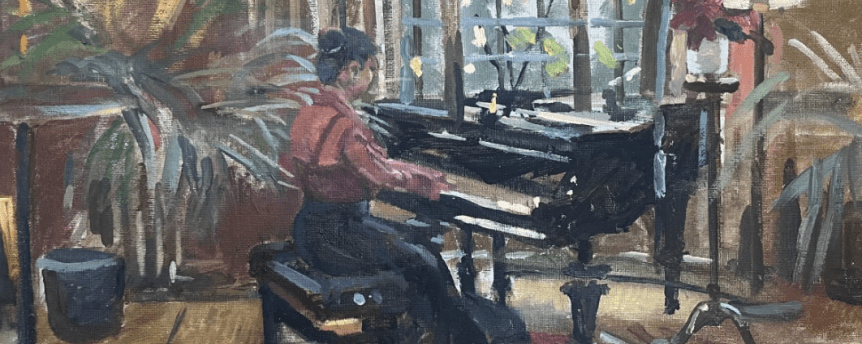
Chopin’s Waltz in A minor, which I previously shared, is also a good piece to learn at this stage. The painting in the header is Alan Lancaster’s Paulina Brahm Playing the Piano at Burgh House.
 Thoughts on Papyrus
What a lovely idea to share this! I am listening to the Purcell as I embark on my morning mail. Thank you!
LikeLiked by 3 people
Thanks! Yes, great for starting your morning with aplomb, he?
LikeLiked by 1 person
Very nice article. I’m sort of the same place you are with the piano. I could make a lot of suggestions, but kind of having a sense of you from your articles I’d suggest Schubert’s “Serenade”.
LikeLiked by 3 people
Schubert’s “Serenade” is exquisitely beautiful, thank you!
LikeLike
What a lovely selection, Diana, I envy you starting off with these on the next stage of your pianistic development!
LikeLiked by 2 people
Thank you! Yes, I am looking forward to it 🙂
LikeLiked by 1 person
A valuable post for any piano enthusiast; most excellent of you to send this musical postcard from your journey🎹🎼
LikeLiked by 1 person
Thank you, and for stopping by! I hope you are doing good.
LikeLike