

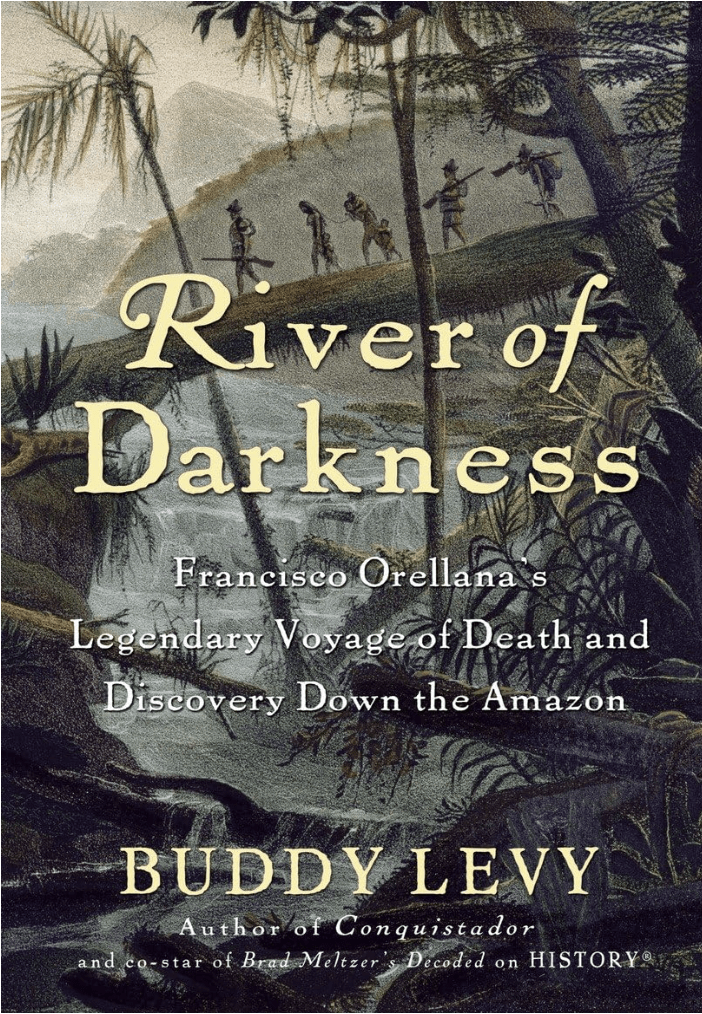
River of Darkness: Francisco Orellana’s Legendary Voyage of Death and Discovery Down the Amazon [2011] – ★★★1/2
After the success of the Spanish conquests under Cortés and Francisco Pizarro, much thirst still remained for the New World and all energy was thrown to discovering one thing that still stirred the imagination, making men restless – the mythical El Dorado, the City of Gold supposedly tucked away somewhere in South America. This non-fiction talks about the exploration of the New World by Francisco Orellana (1511-1546), a conquistador from Extremadura, Spain, who teamed up with his kinsman Gonzalo Pizarro in search of the City of Gold, and sailed down the entire length of the Amazon River in 1541, becoming the first ever European to do so. Levy’s narrative often reads like an exciting adventure story, rather than a historical non-fiction, and has certainly filled the gap in popular accounts of this part of the Spanish conquests.
The author begins his narrative by situating the Orellana expedition in its historic context. Previous expeditions have returned to Spain with unheard-of riches, as well as rumours that there is still much to discover beyond the Inca Empire. Some years previously, Francisco Pizarro, Gonzalo Pizarro’s half-brother, managed to capture the Inca Emperor Atahualpa and hoodwinked him into parting with the extraordinary amount of gold. Buoyed by these successes, Francisco Orellana and Gonzalo Pizarro came to the Amazon basin in search of their own gilded Emperor to conquer, and much of the book can really be encapsulated by these words of Socrates: “He who is not contented with what he has, would not be contented with what he would like to have.” It is avarice and insatiable curiosity working in tandem that pushed the men to even more dangerous undertakings than were previously deemed possible.
It is exciting to read about a time when one had to physically set foot on a piece of land to discover what was actually there and what wonders it held. This was part of the thrill of living in the Age of Discovery, when the New World was still shrouded in mystery (we have now taken this thrill to space exploration, even as we still know little about our own planet, for example, what is deep in the oceans). As Orellana and Pizarro started their journey from Quito and even before meeting any of the native population, they had already experienced unbearable conditions: nearly impassable terrain with thick bushes, floods, and encounters with dangerous animals and irritating insects: “Sleep came fitfully, if at all, amid the cacophonous croak of bullfrogs, then the unnerving thrum of cicadas, and the ever-present threat of vampire bats”/”they shared the ground with hordes of army ants and the dreaded conga ants, whose sting is among the most painful in the world, causing hallucinations in some victims and reducing even the toughest men to agonized writhing” [Buddy Levy, Bantam, 2011]. Orellana and Pizarro quickly realised that they needed to build a boat to carry them downstream, and, as the two started navigating in their newly-built boat, hunger overtook them and they split. Orellana marched forward with his men in the boat to search for food, while Pizarro stayed behind, making only small progress on foot along the river.
Knowledge is power, and as Orellana was making his way down the river, he was interacting with relatively friendly natives, trying to learn their language: “Orellana understood the tremendous importance of language and communication as a tool, and he began to keep a dictionary of vocabulary as well as practical words and phrases that would hopefully be useful in time” [Buddy Levy, Bantam, 2011]. Orellana’s knowledge of the native language is what helped save him and his men later on when they encountered a more hostile native population or wanted to communicate that they needed food. What I found most interesting was the way Orellana was “bending” history in his favour as he was making his journey down the Amazon river, having already built a second boat, named Victoria. He was drafting legal documents as he navigated, passing to himself the title of the Captain of the mission (previously held by Pizarro) and framing the documents in the way that absolved him of all responsibility (for desertion) since the men entrusted him to carry out the mission to save their lives.
Levy stretches many moments of Orellana and Pizarro’s journey for no apparent reason than to prolong and fill his narrative when it is already clear what had happened, and seems to rejoice in the contrast that gives the book its main spark – the juxtaposition between the orderly, more cunning and filled-with-linguistic-ability Orellana mission, on the one hand, and the less organised, more chaotic, lacking-in-languages, and reduced-to-“death marches” mission of Pizarro, on the other. The author also gets quite lost in his imminent and ongoing attacks by the native population, and we have many battle episodes that seem to blur into one, but not before we get a sense of the wonder of some tribes, such as the Machiparo and the intelligent and industrious Omagua: “the most noble of all the tribes; their language is the most sweet and copious“. During the battle with the Machiparo, shamanism was used to ward off the Spaniards: “four or five sorcerers…went about the war canoes…all daubed with whitewash and with their mouths full of ashes, which they blew into the air“.
Though the author does not clearly frame the Spaniards as “heroes”, his account is still form the point of view of greedy, murderous conquistadors conquering a much weaker, less advanced civilisation. There is a mass hanging of innocent natives, who were clearly just defending their homeland from the invaders, in the book, and though the story is written in the spirit of adventure, the author is also frank about the human cost and suffering that stemmed from the Spanish zeal to promote the glory of the Spanish Crown in the New World, talking about the protracted and tortious deaths of men, women and animals en route (mostly native porters, cooks and builders), the abandonment of devastated-by-smallpox natives, and the brutal torture and murder of captive Indians, previously interrogated for information, not be mention the bloody battles and the pillage.
🛶 River of Darkness could have been tidier as a book, more concise in some places and more elaborate in others, but the story almost tells itself, and Levy writes with a flair that is both dramatic and captivating.


If you like this you might like the Herzog movie “Aguirre, the Wrath of God,” but you made me think of Bernal Diaz’s book “The Conquest of New Spain,” a first person account written in 1568 of the Aztec conquest. I find contemporarily written treatments of historical matters (or those written very soon after the event) to capture the complexities and absurdities of history better than the sober treatments after. There’s also the famous William Prescott books from the 19th century you might like.
LikeLiked by 1 person
Yes, if you believe it, I was actually thinking about Aguirre, the Wrath of God all the time I was writing this review. I have just added The Conquest of New Spain to my TBR, many thanks. It looks like something I would really enjoy. I agree about the contemporary first person accounts being better. I previously loved book The Broken Spears: The Aztec Account of the Conquest of Mexico, which compiles first-hand account writings from indigenous people (link also above in my first paragraph).
I guess one can say that Levy also based his book on contemporary writings, that of missionary Gaspar de Carvajal, but it is impossible to differentiate Levy’s personal conjectures from that of the friar, unless he specifically quotes him, so I was never sure about the veracity, and of course, Carvajal himself presented the events that suited Orellana best. Thank you for another suggestion, I will also have a look at that Prescott book.
LikeLike
Orellana is quite a ‘myth’ though I dislike the term ‘mythic’ used too often these days.
They were after the gold. Definitely. The Incas didn’t have time to hide it. In Colombia the locals did. Thousands of precious pieces have been found in the 20th century and are on display at the Gold Museum in Bogotá.
I sidetracked myself. Like Aguirre you mentioned above, those “conquistadores” went for the gold and mostly found death and adventure. At one point, we’ll never know whether they realised that.
Cheers.
LikeLiked by 1 person
Interesting, thanks! It must be quite an experience to visit this museum to learn more. There is a passage in the book where it says that, at one point, Orellana forbade his men from showing interest in gold which they saw on the natives so as not to spook them and make them believe they were indifferent to gold so that Orellana men could buy time and make the natives reveal even more gold – and it worked in certain situations, but I guess these are just instances, as rumours of conquistadors’ lust for gold were spreading far and wide.
LikeLiked by 1 person
The meeting of Europeans and Native Americans must have been quite a shock for both. Montaigne wrote about that in his essays. In the late 1500’s he went to a French Harbour I think might have been Nantes, where a ship had landed from the Americas bringing Native Americans. When he saw them, Montaigne wrote something like: “I fear we have eyes bigger than our bellies.” It’s a sort of French expression meaning: our ambitions are larger than our capacity.
LikeLiked by 1 person
Fascinating. It rings true that the European man has never been more (over?) confident in his abilities than during that period of peak renaissance. With culture, learning and science growing by leaps and bounds at home, there undoubtedly was that feeling of total power and invincibility wherever they land and whatever they encounter.
LikeLiked by 1 person
Technology, i.e. gunpowder, played a major role. See Jared Diamond’s “Guns, germs and steel”. I don’t like all his approach, but he has a point.
LikeLiked by 1 person
Rumours spread fast…
LikeLike
PS. The current tenant’s on Penn avenue love/lust for gold and gilded pulls us back a few centuries Alas.
LikeLike
“It is exciting to read about a time when one had to physically set foot on a piece of land to discover what was actually there and what wonders it held.”… What lies in the depths of The Oceans is a mystery I love to ponder… I feel it’s easy to assume there is nothing except water and the sea creatures we’ve discovered. And that’s also why it’s the perfect hiding place!
LikeLiked by 1 person
Yes! And deep-ocean creatures look completely alien! It’s unreal!
LikeLike