
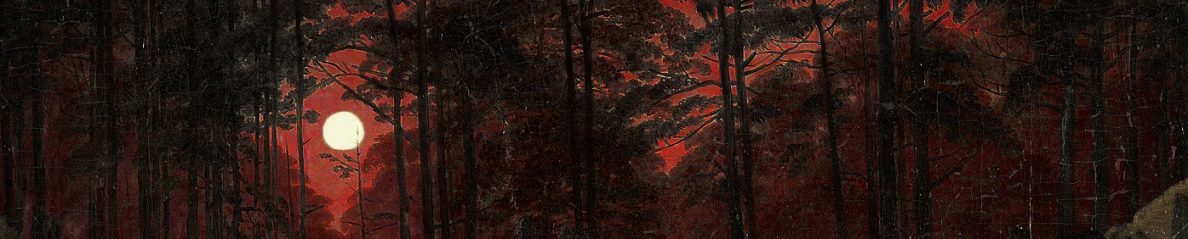
Richard Wagner (1813-1883) was a German composer known for many of his pieces that paved the path to modern music, including The Ring of the Nibelung. Tristan and Isolde is an opera in three acts by the composer which is largely based on the twelfth-century romance by Gottfried von Strassburg. Below is the haunting prelude from the opera that was also used in many famous films, including Lars von Trier’s sublime Melancholia (2011).
Month: October 2021
Recommendations to Boost the Halloween Spirit!

Following from my previous post of top ten disturbing books for this Halloween season, here is my post of some recommendations to soak up and enjoy that spooky atmosphere surrounding Halloween, my favourite time in the whole year. I am presenting four sections (short stories, films, music and ambience videos) that include four recommendations each:

- SHORT STORIES: (i) Don’t Look Now and Other Stories [1971] by Daphne du Maurier – In this collection, Don’t Look Now is a particularly eerie story about a couple John and Laura on their trip to Venice. In my review, I said that du Maurier makes “Venice claustrophobic, day-to-day reality – enigmatic, the mind – paranoiac, and ordinary people – full of threatening agendas“; (ii) Murder in the Age of Enlightenment (and other Stories) [1918] by Ryunosuke Akutagawa – This collection of short stories by Japanese author Akutagawa includes his unforgettable horror story Hell Screen; (iii) The Signal-Man [1866] by Charles Dickens is an incredible, frightening ghost story which has its own unique atmosphere (see also the short film adaptation (1976) of the story here); and (iv) Shirley Jackson’s The Lottery [1948] (my review).
10 Most Disturbing Books I’ve Ever Read
It is that time of the year again when we indulge in spooky stories, so I have compiled this list of ten most disturbing books I have ever read (not necessarily horror, but rather unsettling/upsetting reads and they are in no particular order).

I. A Clockwork Orange [1962] by Anthony Burgess
I read this book a long time ago, but its disturbing aspects stayed with me. In this story, sociopathic Alex and his gang participate in random acts of extreme violence until Alex is caught, convicted and is forced into a special conditioning programme that is designed to make him averse to violent actions in future. The book may be on a short side, but it is full of thought-provoking, philosophical issues, for example, implicitly commenting on the nature vs. nurture, and free will vs. determinism debates. Stanley Kubrick based his 1971 film on this novella by Burgess.

II. Sleepers [1995] by Lorenzo Carcaterra
This book talks about a group of boys who are into pranks of all kinds until they are sent to one juvenile detention centre for their misbehaviour and there endure horrific abuse at the hands of people in authority. There is still a dispute whether Carcaterra based this book on his own story or that of his friend (and perhaps added some details), but the book is still compelling and harrowing. The film Sleepers by Barry Levinson and starring Kevin Bacon, Brad Pitt and Dustin Hoffman is also one of the most disturbing films I have ever watched (and thus I do not really recommend it to anyone).
Continue reading “10 Most Disturbing Books I’ve Ever Read”Review: Foucault’s Pendulum by Umberto Eco

Foucault’s Pendulum [1988/89] – ★★★★
“…the important thing is not the finding, it is the seeking, it is the devotion with which one spins the wheel of prayer and scripture, discovering the truth little by little” [Umberto Eco/William Weaver, Vintage Press: 1988/89: 33].
Through one dense, rich and enigmatic narrative, Umberto Eco tells the story of Casaubon (our narrator) and his friendship with two employees of publishing house Garamond Press – Belbo and Diotallevi. This trio of intellectuals, who are simply in love with all kinds of knowledge, historic mysteries and brainy puzzles, start their own intellectual “game” of drawing connections with seemingly unrelated things using one clever word-processing machine and a suggestion from one Colonel Ardenti which concerns the order of the Knights Templar and perhaps mysterious resemblances. Little do they know that their amassed knowledge will be too diverse and their power of belief – too strong for a game which started on a whim and so childishly. When certain deaths and disappearances occur as they the trio’s search for their ultimate and absolute truth continues, it may be already too late to seek the way out. But is Eco’s story even about that? Perhaps it is about something else too, and about something else, and, equally, about something else. From the intellectual hub of Milan to esoteric, mysterious corners of Brazil, Umberto Eco takes the reader on one uncanny literary journey and presents a narrative which informs, surprises and exhilarates, as it also confounds, exhausts and overwhelms.
Continue reading “Review: Foucault’s Pendulum by Umberto Eco”National Day of Spain: Isaac Albéniz’s Cantos de España
Today, 12 October, is Spain’s National Day and I am sharing Isaac Albéniz‘s Cantos de España (or Chants d’Espagne). Isaac Albéniz (1860 – 1909) was an influential Spanish virtuoso pianist and composer and some of his best-known compositions incorporate Spanish folk music.
Review: Aquagenesis by Richard Ellis

Aquagenesis: The Origin and Evolution of Life in the Sea [2001] – ★★★★
May be on an academic side and now a bit dated, but the book is still a perceptive and engaging account of the mysteries that still surround the evolution of life in the sea.
“That we live on land is, in the grander scheme of things, best regarded as an anomaly, or even an eccentricity – albeit with sound evolutionary justification. The story of life is, if we retain a true sense of proportion, a story of life at sea“(Philip Ball).
After I read Monarchs of the Sea by Danna Staaf last year, I wanted to read a deeper work on this topic and chose Aguagenesis by marine biologist Richard Ellis. The author aims to demonstrate how life originated in water some 3.9 billion years ago, what species evolved first in water and why, what species followed them and how evolution changed courses multiple times with various animals choosing to dwell on land next and then returning to waters. Richard Ellis starts his book by discussing the origin of water itself and a 2 inch-long shrimp-like creature without eyes capable of subsisting on hydrogen sulphide alone, which is poisonous to most living creatures, before talking about more complex and diverse marine life that roamed the oceans in the final stages of the Cretaceous period, some 65 million years ago. “More than 99% of all the species that have ever lived on Earth are [now] extinct” [Ellis, 2001: 22], says the author, and that makes that extinct life even more fascinating, especially in what it can tell us about the diversity of life and our own, human, origin.
Continue reading “Review: Aquagenesis by Richard Ellis”The Poetry of Thomas Hardy
I have been a huge admirer of Thomas Hardy and his books for a long time (my favourite books are Tess of the d’Urbervilles, The Woodlanders, Far from the Madding Crowd, Jude the Obscure and The Mayor of Casterbridge, and in that order), but I never previously had a chance to read his poetry and finally bought a collection of his Wessex Poems. Some find Hardy’s poems in this collection too grim, but I think they are simply hauntingly beautiful. Below I share my brief review, as well as two poems from the collection.

Wessex Poems and Other Verses [1898/2017] by Thomas Hardy – ★★★★1/2
I thought this was a wonderful collection of Thomas Hardy’s poems, touching on such themes as country life and romance, human character, doomed love, relative fleetness of youth and beauty, death and attempts to reconcile the depth of love with the passing of a loved one. There were a number of “supernatural” and “otherworldly” poems in this collection too, which makes it a perfect reading for a cosy autumn evening in or near Halloween. Melancholic, full of longing and simply beautiful, some of my favourites included Unknowing, the She, to Him series of poems and Her Immortality. Others are narratively interesting too, for example, The Dance at the Phoenix is about a woman of sixty who is swept by her memories when she hears the King’s-Own Cavalry is in town and goes dancing to unpredictable or maybe and sadly, predictable results, and in The Two Men, Hardy shows how two men are bound to meet the same destiny having the same schooling and similar inner beliefs.
Continue reading “The Poetry of Thomas Hardy” Thoughts on Papyrus