

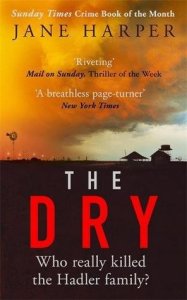
The Dry [2016] – ★★★1/2
This bestseller is a debut novel of Jane Harper. It is a murder mystery with two tragedies at the heart of it. The setting is a small town of Kiewarra, Australia that was shaken by the gruesome murders of the Hadler family: Luke, Karen and their son Billy. The official version is that Luke, the father, killed his family before committing suicide. But is this open-and-shut case as straightforward as it seems? Aaron Falk, a police officer in Melbourne, arrives to his native town of Kiewarra for the funeral of his estranged pal Luke, and finds out that there is more to the deaths than first meets the eye. The Dry turns out to be a good, atmospheric book, but not necessarily because of the story. The story is actually quite typical in the genre of “small community” mysteries and not something extraordinary or special at all. What elevates this book above many others is the assured execution of the plot, the particular atmosphere conveyed, as well as some insightful character study. All this provides for an emotional and engaging read.
It is impossible not to be drawn into this story from the very first pages. Upon arriving to Kiewarra, Falk teams up with the local Sergeant Raco, and the two immediately draw up the list of suspects to the Hadlers murder, for example, Mal Deacon and his nephew Grant Dow, the duo of community troublemakers, as well as Jamie Sullivan, the last person to see Luke alive. Falk and Raco also notice that something about the Hadlers murder does not add up, such as the presence of foreign cartridges and the circumstances in which Billy, the son, was killed. As Falk delves deeper into the murder, he starts to reminisce about his past and some vivid pictures emerge. In his younger years, Falk had been friends with Ellie Deacon, a girl who tragically drowned in the local river under suspicious circumstances. Falk is convinced that Luke’s murder can shed light on Ellie’s death, and he is determined to rekindle his relationship with Gretchen, Luke’s ex girlfriend. All the memories are transmitted by way of the italic font in the story, making them even more powerful, and they may be called “flashbacks” if the story is ever made into the movie. The sense of nostalgia is definitely there as the Hadlers murder case gets complicated by Falk’s recollections of the past. The story becomes all about how the past can colour one’s perception of the present.
I particularly like how the atmosphere/setting is incorporated into the story. Kiewarra is experiencing a dry season and it has not rained for almost two years. The local community is in despair because almost all families are farmers and the drought means no income. Harper references the heat of Kiewarra a number of times quite effectively, saying that “Falk’s skin was already tingling from the heat” [Harper, 2016: 39] and that “Falk felt heat creep up his chest and neck” [Harper 2016: 160], while emphasising that the location is such where “the heat makes everything worse” [Harper, 2016: 200]. Harper also ensures that “stylistically” her story is also about the heat, writing at some point that [the argument] “clung to them like the heat” [Harper, 2016: 159]. These observations immediately transport the readers to that desperate, lonely place which is Kiewarra, where families’ happiness is always tainted by the local tragedies, as well as the feelings of hopelessness, guilt and regret.
Falk’s character study is also intriguing. He is a hero who battles his own inner demons, and is described as someone “who had a habit of keeping people at arm’s length, collecting acquaintances rather than friends” [Harper, 2016: 180]. The fact that he is one of the suspects to one of the murders makes the story even more interesting. The story then builds nicely on some character contrasts. There is a father-son relationship emphasised. Falk and his dad are contrasted with Mal Deacon and his nephew Grant Dow, and they, in turn, are contrasted with and Gerry and his son Luke. Moreover, unlike Turton’s The Seven Deaths of Evelyn Hardcastle [2018], we actually begin to care about some characters in the story.
In terms of style, Harper’s writing is very confident and assured, especially for someone penning their first novel. The novel is actually cleverly-written because Harper ends each of her small chapters on the most interesting bit and her short sentences and words carry much meaning. Some of the negatives are that The Dry is not a strictly literary novel and prefers dialogues over descriptions. Although it has an unexpected finale, it is also a rather ordinary thriller story which portrays a small town in Australia rather stereotypically. There are stereotypical characters all around, from the almost “prodigal” son returning home to the beautiful homecoming queen who never manages to achieve a successful private life. There are also the usual characters of the sad and misunderstood teen who ends up dead and the “baddie” who terrorises the town. In that way, The Dry does not strike as something original or extraordinary, and the story’s beginning is much stronger than its ending.
🏜️ Jane Harper’s novel is not as thought-provoking or imaginative as one would have hoped. However, what is clear is that The Dry is a page-turner with a number of suspects in the case emerging and past tragedies resurfacing. The book atmosphere, writing style and character studies all ensure that the account is interesting, emotional and bitter-sweet.
 Thoughts on Papyrus
Je l’ai lu et j’ai adoré ! le climat du récit est très bien rendu 🙂
LikeLiked by 1 person