Muriel Barbery rose to international fame with her bestseller The Elegance of the Hedgehog, a quirky novel that revolves around one Parisian apartment block and its concierge Renée Michel. But, before The Elegance of the Hedgehog, Barbery published her debut Gourmet Rhapsody, which is as unusual an offering, and would also delight fans of extravagant, charismatic narrators. Pierre Arthens is a world-renowned food critic, but is now on his deathbed, craving that final forgotten taste that eludes again and again. He looks back on his life full of culinary discoveries and pleasures, as people he once knew also have their say on the man and his place in their world. With the economic ingenuity of a sumptuous three-course meal in some upscale French restaurant, Barbery delivers a different perspective and much food for thought within each of her elegantly presented short chapters.
In this short story collection, Cho Nam-Joo (Kim Jiyoung, Born 1982) focuses on the lives of eight Korean women, showcasing issues in contemporary Korea. In the titular story, even before starting her first day at her new job in a hospital advertisement agency, a young woman gets more than an eyeful of that company at an organised workshop for employees hosted over a weekend. Her predecessor, mysterious Miss Kim, a lowly employee, seems to have run the agency almost single-handedly, but where is she now and what happened to her? Cho Nam-Joo’s story idea and its beginning are definitely much stronger than the somewhat underwhelming finale, but this is still one memorable “a person against the system” tale that provides an incisive, humorous insight into the workings of a Korean company filled with nepotism and incompetence. I read this short story in Miss Kim Knows and Other Stories by Cho Nam-Joo [translated by Jamie Chang, Scribner UK, 2023].
The Glass Shield [2006/23] by Kim Jung-hyuk – ★★★★
Translated by Kevin O’Rourke, this is a story of two inseparable young men (our narrator and M) who go to a series of job interviews together because they cannot bear the thought of not working for the same company. They try very unconventional techniques to impress their interviewers (including untangling a yarn), but because of their togetherness and unique interviewing style, they have had no luck so far landing anything. That is, until the two friends-pranksters become an internet sensation, and finally have a chance to shine in the crowded job market. This story brims with comic originality, and is about trying to triumph through one’s eccentricity and individualism in a big city governed by monotony and predictability. It ends on the reconsideration of one’s life purpose. The story is part of The Penguin Book of Korean Short Stories [edited by Bruce Fulton, Penguin Classics, 2023].
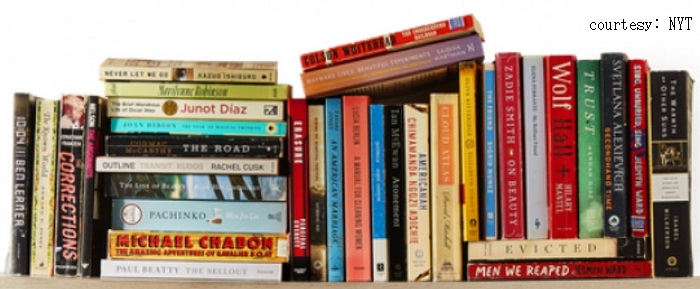
This summer, The New York Times (NYT) published list “100 Best Books of the 21st Century”, compiled from a survey of “hundreds” of novelists, non-fiction writers, academics, editors, journalists, literary critics, publishers, etc. (you can see the full list of the titles here since the original list is on the other side of the paywall). I am late to comment on this, but because I had to be absent from this site this summer, I thought I would do so now, since I also enjoyed reading takes on it over at The Book Stop and The Reader’s Room. I do understand all the drawbacks of such lists, and my point is not to put down any undoubtedly great books or authors featured on this list, but just comment (i.e. rant) on the list overall.
I would like to thank Cathy at 746books for recommending this book to me after I compiled list 7 Great Novels Revolving Around Visual Art. Tuesday Nights in 1980 presents New York City’s art scene of 1980. At the centre are three people whose destinies collide in the background of creative bohemia filled with liberties of all kinds, boundless artistic inspiration and ambition, and spurs of unusual creativity: James Bennett is a misunderstood person and a renowned art critic who has synaesthesia, a condition which means that he experiences ideas, people and objects as colours or a combination of colours; Raul Engales is a “free spirit” and up-and-coming Argentinean artist who left behind in his country one past better not recalled; and Lucy Olliason is a girl from Idaho who has just recently arrived to NYC and is open to everything and anything. Evocatively, even if exaggeratedly, Molly Prentiss captures in her story the thrill of being young and artistic in NYC, which itself starts to undergo many changes. Amidst obsessive art-making and pleasures of falling in love, there are also a transitory nature of success, creative doubts and personal tragedies.




 Thoughts on Papyrus