

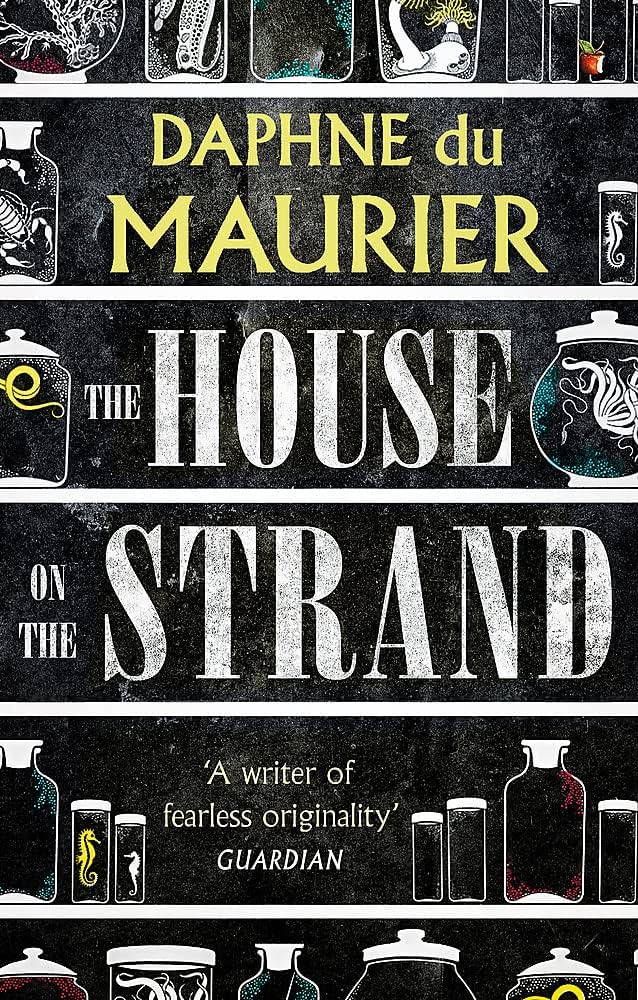
The House on the Strand [1969] – ★★★★
“If you get bitten by the past…whether you’re historian, or an archaeologist, or even a surveyor, it’s like a fever in the blood; you never rest until you’ve solved the problem before you” [du Maurier, Victor Gollancz/Virago, 1969: 229].
The House on the Strand is a time-travel novel, but because at the helm is none other than author Daphne du Maurier, it is far from being one’s usual, run-of-the-mill sci-fi fantasy. The premise is intriguing: Dick Young is a forty-something married man working in publishing who decides to spend his holidays at the house of his friend, Professor of Biophysics Magnus Lane. The house, Kilmarth, is in beautiful Cornwall, overlooking the sea, and Dick is awaiting the arrival of his wife Vita and his two stepsons from the US. Meanwhile, Magnus asks Dick to ingest his most recent research discovery: a potion that apparently transports a person to…the past. Dick should be thinking about his family, his new career option and his holiday, but instead, taking this drug, he becomes addicted to a different reality opening to him, to past events that happened in Cornwall in the 14th century and that involve political intrigues, adultery and a possible murder. But how safe is this potion drug that Dick is taking? And what could be the consequences of stepping into another world and gaining its secret knowledge?
Continue reading “Review: The House on the Strand by Daphne du Maurier”



 The Woman in the Window is a 2018 debut thriller and international bestseller by A. J. Finn (Dan Mallory), which sold millions of copies, with the film based on the book to be released in 2020 starring Julianne Moore. Daily Express called the book “masterpiece of storytelling” and Stephen King said that it was “unputdownable”. Saving April is a 2016 lesser-known book by Sarah A. Denzil, released two years before The Woman in the Window and first being available in an e-book format. As I will show below, the similarities between the two books are overwhelming, both in their scope and in their nature, and, clearly, Finn took everything that he possibly could from Denzil’s thriller to write his bestseller. Jane Harper noted that Finn is “a tremendous new talent”. By the end of my comparison, it may become clear that the only talent Finn possibly has (apart from insolence) is taking nearly all of other writers’ ideas, elaborating on them slightly and then passing others’ stories as his own.
 Both books undoubtedly drew inspiration from classic film noir, especially from Hitchcock’s Rear Window [1954] and Amiel’s Copycat [1995] as well as from such books as Gone Girl [2012] and The Girl on the Train [2015]. However, even though The Woman in the Window feels like a more accomplished and elaborate book that Saving April, it is still the same exact story as Saving April and the similarities between the two are too numerous in their number and too close in their nature for there to be any talk of “inspiration” or “simple source”. In fact, the two stories are so similar that Saving April can be the first/second/third draft of The Woman in the Window. Reading the two thrillers side-by-side, one may become immediately confused which part they read in which book – so similar they are in virtually every way.
 Thoughts on Papyrus