

Alien Hearts [1890] – ★★★★
Known primarily for his short stories, French author Guy de Maupassant (1850 – 1893) nonetheless wrote some novels, and Alien Hearts (Notre Coeur) became his last. This is one unexpectedly riveting foray into matters of the heart, centring on two people – “talented and astute, but lazy” André Mariolle and beautiful and charming, but proud Madame de Burne – who become romantically involved. Since both are intelligent, witty, rich and free, the question is: what can possibly go wrong when these two start their union? It turns out – much, since people do not exist in a vacuum, and love without self-interest and vanity is rare, apparently and at least in the highest echelons of the Parisian society frequented by Mariolle and de Burne. Maupassant’s short novel is a delicate study of falling in love, enjoying its bliss and then being tortured by love’s poisonous darts. Subtle in its contours, but bold in its themes, this tale of being at cross-purposes with one’s beloved must be one of Maupassant’s finest literary achievement.
There are three sections to this novel, each with its own narrative goal. As the story starts, composer Massival suggests that his friend Mariolle attends one of the famed soirees hosted by popular Madame de Burne, and Mariolle unwillingly agrees. Little does he imagine what lays in store for him. Madame de Burne is a rich widow of much beauty, charm and intelligence, cultivating around herself a tightly knit artistic circle, whose talent she nourishes daily, largely by playing the role of a muse. A coquette by nature, she is always surrounded by her talented male admirers. Can André Mariolle become one, too? He is single, well-to-do and bored. So far, he has dabbled into many things, including sculpture, writing and the violin, but without any distinctions to his name, apart from being known as “aloof” and “interesting”. The story underlines how unlikely it is for these two self-sufficient and proud people to meet and be completely besotted with one another, as Maupassant dissects a curious segment of society, where money is never an issue, and the riches ensure lassitude and boredom since there is no “hard-earned” adventure in sight which the lack of money could have necessitated.
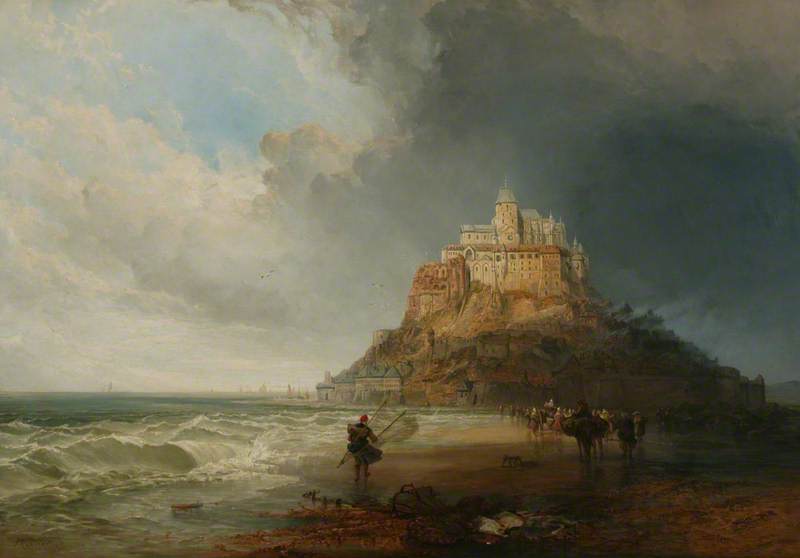
Maupassant’s melodrama transports the reader from the stifling atmosphere of Parisians salons to the intoxicating beauty of France’s coastal vistas. Mariolle’s obsessive love for Madame de Burne reaches its peak during their “impromptu” meeting near Mont St. Michel, a historic site in Normandy, whose singular architectural structure mirrors the singular passion that starts to form between Mariolle and de Burne. Maupassant is more than willing to dissect the psychology of the attraction. Mariolle finds his beloved quite unique, and what often strikes one about one’s beloved is their apparent uniqueness. People are surprised to find in another the familiar characteristics they have always sought out and cherished, not realising that, at least in part, they unconsciously sought them out and precisely because they represent their own selves and mirrors them perfectly. So, Madame de Burne’s personality contradictions become the reason for Mariolle’s love, not an obstacle: “…the very characteristics he disliked in her were just what seduced and conquered him in spite of himself”.
There is a degree of selfishness in every obsessive love, which Maupassant also wants to explore, but he is also interested in the differences between what it is like “to be loved” and “to love”. Most would want both, and one may think that these are two sides of the same coin, but the truth is that to love without being loved in return may turn into a lifetime full pain and grief, whereas to be loved by, but not to love a person can just be a mere inconvenience. This is one imbalance in power dynamics.
Maupassant also tries to underline the tragedy of seeking and granting pure and selfless love in a society whose only concern is searching and maintaining fame and reputation, presenting coquettish fronts and appearances, getting lost in trivialities, spreading gossip, warding off boredom, and making fleeting romantic conquests. In such a society, where does the depth of feeling come in, or the genuineness of emotion? “Love is nothing now except a legend, to be sung in ballads or read in silly novels”, the book observes. Madame de Burne is a modern woman, attuned to and desiring the high society’s admiration and rewards. Mariolle’s raw and sudden passion for her or his “forever-lasting” love is not something to believe in the first place, let alone cherish. It is also that kind of a love that Onegin recognised in young Tatiana in Pushkin’s poem Eugene Onegin, but chose to flee from, since he valued his bachelor status and was too much in love with his image of a carefree dandy.
Much like Japanese literature, French literature can be surprisingly subtle and understated, and Maupassant’s elegant prose is a testament to that. Some sentences culminate in delightful insights, even if they are not totally original: “every authentically loved being is a kind of god”, and, at other times, Maupassant’s character descriptions leave the reader in another world: “the faded –flower expression of her eyes gave her face a sort of disturbing mystery”.
💞 Alien Hearts is a bit of a paradox because it is both straightforward and complex, subtle and bold, and its passages can surprise with their delicate insight on one page only to leave the reader bewildered at the bluntness of some development or action in the next. The ending is precisely that blunt, abrupt, unexpected literary “weed” in what has so far been a refined “love garden” of a novel, a fine literary exposé of romantic disillusionment.
 Thoughts on Papyrus
Nice review! I like the quote about faded-flowers and how you suggested what the end is like without spoiling. I’ve never read this author but this sounds like a good place to start.
LikeLiked by 1 person
Yes, I think it is a good place to start! Thank you for stopping by!
LikeLike
Great review!
I think Maupassant was a great author, not enough recognized today
LikeLiked by 1 person
Thank you! Definitely, he had an elegant, flowing style. I know he wrote many short stories, and at least in terms of content, I also thought Alien Hearts did not go beyond the confines of a short story, especially since it can even be said to be unfinished.
LikeLike
Have you read Bel Ami? A novel, exquisite psychological study.
Le Horla is probably his most famous short story, in my generations, all 6th graders had to read it.
It is actually such an amazingly modern text!
LikeLiked by 1 person
I am actually still to read Bel Ami, but I did read Le Horla.
It is interesting how you say that Maupassant’s story feels so modern because I was just thinking of how certain the then contemporaries were so different from one another in style and it is astonishing to even think that they were actually contemporaries. For example, it is funny to think that Thomas Hardy and Henry James were actually contemporaries (born just a few years apart) because Hardy’s style is so classically naturalist, whereas James’s novels feel so modern, already employing themes, concepts and techniques we would later see way into the 20th century. I guess the same with Zola and Maupassant in some way…
LikeLiked by 1 person
Exactly, yes, well put!
And Le Horla is probably his most “modernist” text
LikeLike
I had to look up what I’d read of his – and immediately remembered it when Google supplied a list and I recognized The Necklace, a perfect gem.
Not too long if you haven’t read it – stuck with me now for fifty years.
LikeLiked by 1 person
It is great to hear that The Necklace is so good. I can’t wait to read it now, thanks!
LikeLike
It’s like Shirley Jackson’s The Lottery – I’m always surprised when people have not only not read it, but haven’t heard of it.
Autodidacts tend to think that is it’s in the standard English and American Literature anthologies, everyone must have read it – and will remember it. ‘Tain’t so. 🙂
LikeLiked by 1 person
I tend to be less surprised re people’s knowledge of short stories – there are so many and it is not like some classic tome one cannot just miss. I have started reading them in earnest only these past four years, and am thinking about doing list near December – “10 Best Short Stories I Read This Year”. I think you would be shocked what short stories I read for the first time only this year! 🙂
LikeLike
You might be shocked at my ignorance!
LikeLiked by 1 person
You just made me wonder if maybe worrying about being up to date on reading ISN’T my place in the world, but that making sure the past (such as I had and remembered) isn’t passed by.
I shall think of myself differently from now on.
LikeLiked by 1 person