Review: Nip the Buds, Shoot the Kids by Kenzaburō Ōe

Nip the Buds, Shoot the Kids [1958] – ★★★★1/2

Kenzaburo Oe’s debut should remind of Lord of the Flies [1954] by William Golding, but, undoubtedly, the author had other inspirations too. In his first book, the Japanese Nobel Laureate tells of a group of boys from a reform school that get stranded high up in forested mountains and forced to confront hostile villagers, the possibility of a plague, starvation and inhumane conditions. As the boys take matters into their own hands, their boyish desire to play and youthful confidence/hopefulness clash violently with the necessities posed by the war and traumas experienced by the most desperate. The boys finally realise that they have to choose between truth, principle, loyalty and compassion, on the one hand, and their own lives, on the other.

Continue reading “Review: Nip the Buds, Shoot the Kids by Kenzaburō Ōe”

Review: Miracle Creek by Angie Kim

Miracle Creek Book Cover

Miracle Creek [2019] – ★★★★

There are no facts, only interpretations” (Friedrich Nietzsche). 

Angie Kim centres her story around a pressurised oxygen chamber or the Miracle Submarine that is used as an experimental treatment device in Miracle Creek, Virginia. The Miracle Submarine belongs to Pak Yoo, an immigrant from South Korea, who tries to do his best in the US so that his wife and daughter can find happiness in this foreign to them country. When a fatal accident happens at Pak’s treatment facility, one leading suspect emerges, but is the case as clear-cut as it appears at first? Soon, secrets, lies, and surprising relations between Pak Yoo’s patients emerge, complicating this seemingly open-and-shut case, as Angie Kim also makes insightful points on cultural divisions, on the issue of using certain experimental, controversial treatments to treat disabled children, and on the trials of parenthood.

Continue reading “Review: Miracle Creek by Angie Kim”

Review: There There by Tommy Orange

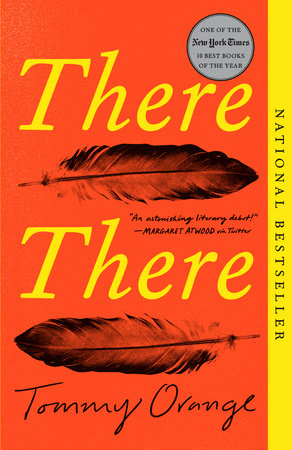
There There Book Cover There There [2018] – ★★★★

There There is a debut book by Tommy Orange, a Cheyenne and Arapaho author who has a goal to draw attention to the lives of Native Americans living in an urban setting in the present day US. We follow twelve different characters who all live in Oakland, California and struggle in some form in their lives. From marginalised and criminally-minded Tony Loneman to internet-obsessed and lonely Edwin Black; and from history-inspired Dene Oxendene to poverty-stricken, troubled sisters – Opal Bear Shield and Jacquie Red Feather, Tommy Orange presents a heart-wrenching overview of the struggles of the people who want to re-connect with their families and their Native American heritage. The characters’ lives are intertwined and there is a feeling like they are all moving towards an explosive finale in the story. The result is a powerful tribute to Native Americans living in big US cities today, trying to make their heritage feel relevant and important, even if Orange’s story as a narrative falls short of its mark because of its overly-ambitious multiple perspectives’ focus, as well as its dissatisfying ending. Continue reading “Review: There There by Tommy Orange”

Review: The People in the Trees by Hanya Yanagihara

The People in the Trees CoverThe People in the Trees [2013] – ★★★★1/2  

Yanagihara fuses pseudo-factual scientific writings with some fantastical elements to rather impressive results, and it all would have been rather pleasing if the content were not also so devastatingly horrific.

The People in the Trees is a debut novel of Hanya Yanagihara, a writer now best known for her second book A Little Life, a 2015 Man Booker Prize nominee. The People in the Trees is partly an anthropological travelogue, partly a jungle adventure mystery, and party a covert character study, having enough disturbing elements to make its readers feel uncomfortable. However, these do not make the book any less masterful.

Beautifully-written, The People in the Trees reads for the most part like a memoir detailing Dr Norton Perina’s travel to an isolated Micronesian island country in the 1950s to find and study a “lost tribe”. He did so alongside a talented anthropologist Dr Tallent (who is himself a mystery) and Tallent’s colleague Esme Duff. The mysteries Perina uncovers on the island are shockingly significant, revolutionising what is known about science/medicine and having to do with immortality. The only thing that lets this ambitious book down is that Yanagihara cannot quite manage to strike a balance or make a smooth transition between the book passages that detail the implications of Perina’s island discovery and later elements which deal with Perina’s own character insights.

Continue reading “Review: The People in the Trees by Hanya Yanagihara”

Review: Moth Smoke by Mohsin Hamid

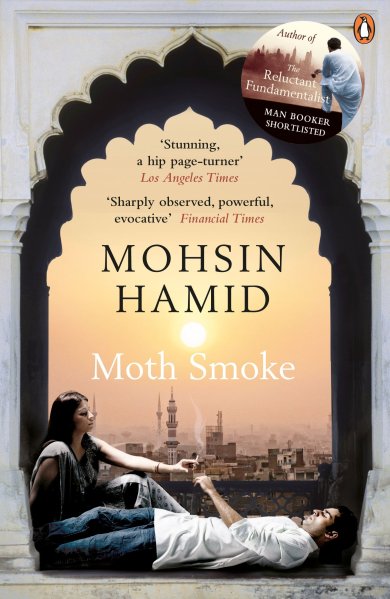
Moth Smoke Cover

Moth Smoke [2000] – ★★★★1/2    

In Moth Smoke, Darashikoh Shezad or Daru is a hash-smoking banker living in Lahore, Pakistan who rekindles his friendship with his childhood friend Ozi, who is now an influential and rich man living under the protection of his equally influential, but corrupt father. Daru also realises that he is attracted to Ozi’s wife Mumtaz, and, among his friends is also a shady character named Murad Badshah, who sometimes acts as his drugs supplier. After Daru is fired from his job, his societal divide from influential and rich Ozi grows even further, and he finds himself on the dark path towards immorality and crime. Moth Smoke is a fascinating, eye-opening journey into Lahore’s criminal underbelly, which makes observations on the societal class divisions and the east vs. west mentality conflict. But, it is also so much more than that: it has an experimental structure and style (with at least four unreliable narrators); employs symbolism and fable-like story-telling; and becomes a book about the limits of morality, friendship and love, while also exploring the nature of guilt and the malleability of truth.

Continue reading “Review: Moth Smoke by Mohsin Hamid”

Review: Tangerine by Christine Mangan

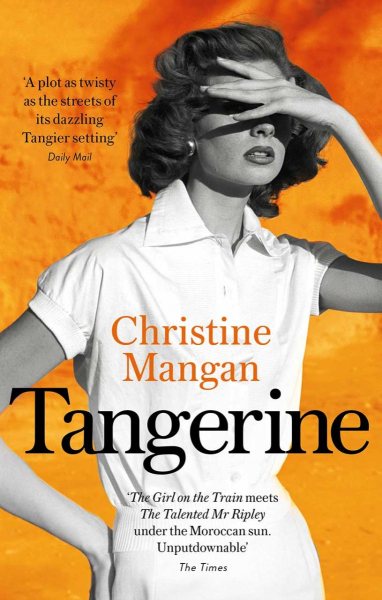
Tangerine Book Cover

Tangerine [2018] – ★★★★   

Tangerine is a debut novel which is now both gaining visibility and provoking some strong reactions – there are apparently as many people who love this book as there are those who hate it. The story is about two women – Alice and Lucy, who take turns in the story to share their thoughts on past and present events. Alice, who shared friendship with Lucy in the past, is now married and lives with her husband John in Tangier, Morocco. Unexpectedly, Lucy also arrives to Tangier to rekindle her friendship with Alice after a year of separation. When John disappears, Alice and Lucy have to question both their relationship and their lucidity. The downside is that Mangan’s book gets much too close in its plot and characters to Patricia Highsmith’s novel The Talented Mr Ripley [1955], but it is still an intriguing and enjoyable read. Mangan uses simple language and manages to weave a thriller which is slow-burning and deeply psychological, while also vividly evoking the colours of Morocco. 

Continue reading “Review: Tangerine by Christine Mangan”

Review: The Dry by Jane Harper

the dry cover1

The Dry [2016] – ★★★1/2

This bestseller is a debut novel of Jane Harper. It is a murder mystery with two tragedies at the heart of it. The setting is a small town of Kiewarra, Australia that was shaken by the gruesome murders of the Hadler family: Luke, Karen and their son Billy. The official version is that Luke, the father, killed his family before committing suicide. But is this open-and-shut case as straightforward as it seems? Aaron Falk, a police officer in Melbourne, arrives to his native town of Kiewarra for the funeral of his estranged pal Luke, and finds out that there is more to the deaths than first meets the eye. The Dry turns out to be a good, atmospheric book, but not necessarily because of the story. The story is actually quite typical in the genre of “small community” mysteries and not something extraordinary or special at all. What elevates this book above many others is the assured execution of the plot, the particular atmosphere conveyed, as well as some insightful character study. All this provides for an emotional and engaging read.

Continue reading “Review: The Dry by Jane Harper”

Review: Burial Rites by Hannah Kent

Burial Rites Book Cover
Continue reading “Review: Burial Rites by Hannah Kent”

Review: The God of Small Things by Arundhati Roy

The God of Small Things Cover

The God of Small Things [1997] – ★★★★★

Once in awhile a book comes your way which is so powerful in its message, so inexplicably poetic in its presentation and so wondrous in its understated emotion that you may wonder how come you have not read it yet. The God of Small Things by Arundhati Roy is that book to me. The notable feature of the book is that it is a debut novel which won the Booker Prize for Fiction in 1997. It takes a cross-generational approach to tell the story, but at the heart of the plot is a pair of twins – brother and sister – seven-year old Estha and Rahel respectively – who grow up in Ayemenem, part of Kerala, India, in the late 1960s. This is a turbulent time to grow up because there is political unrest and uncertainty in the country, and financial and other hardships, as well as all kinds of injustice, are seen as just part and parcel of life. However, the twins are not concerned with the Big Things, and are eagerly anticipating the arrival of their nine year-old English cousin Sophie Mol. Her father and the twins’ uncle Chacko are welcoming his ex-wife Margaret and his daughter to India. At the height of all the excitement, however, everyone is quite oblivious to the dangers lurking just on the periphery of their lives, and these dangers seem to just wait for all the circumstances to conspire in their favour to strike the final blow into the very heart of the small lives of Ayemenem.

Continue reading “Review: The God of Small Things by Arundhati Roy”

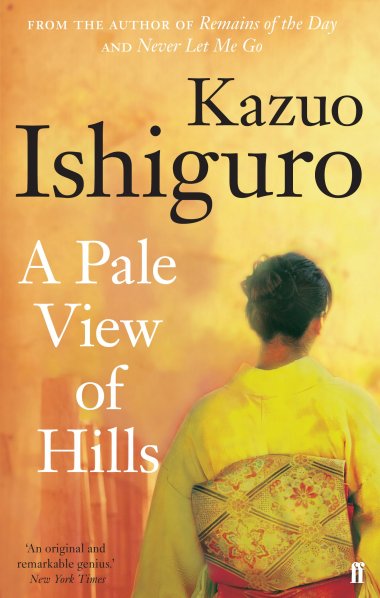
Review: A Pale View of Hills by Kazuo Ishiguro

A Pale View of Hills Book Cover

A Pale View of Hills [1982] – ★★1/2 

<<This review may contain spoilers>>

Kazuo Ishiguro’s debut novel is quite a puzzle. In the story, we first meet Etsuko, a middle-aged woman from Japan who is now residing in the English countryside, while her younger daughter Niki lives in London. As Niki comes from London to visit her mother, Etsuko starts to reminisce about her previous life in Nagasaki, Japan. We eventually start to guess that Etsuko’s memory of the suicide of her older daughter Keiko in England is somehow linked to Etsuko’s recollections of her friendship with strange woman Sachiko and her daughter Mariko at the time that she lived in Nagasaki.

This short novel is an easy and, at times, intriguing read, with Ishiguro sometimes making insightful points about Japanese culture and the effect of the passage of time on his characters. However, it seems that this subtle novel also asks too much from its reader. If there was a mystery somewhere in the novel’s midst, then it was not sufficiently elaborated upon or given sufficient space to breathe for the reader to really care; and, if there was no real mystery, then the point of the novel is partly lost. Ishiguro seems to have wrapped his story in too many layers of subtlety, thereby forcing his readers to make a giant leap forward in terms of imagination so that they finally decide to start unwrapping the unwrappable. It is unlikely that there will be a satisfactory meaning or explanation found by the novel’s end. Besides, while the reader may want to delve into possible interpretations of what he or she has just read, there is also the possibility that the interest will be lost half-way through. 

Continue reading “Review: A Pale View of Hills by Kazuo Ishiguro”