
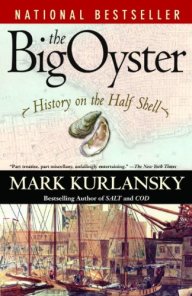
 The Big Oyster: A Molluscular History of New York [2006] – ★★★★★
Kurlansky’s book is an engaging, quirky historical account of one of the most famous cities in the world told through the story of once one of the most misunderstood salt-water mollusc.
“The history of New York oysters is a history of New York itself – its wealth, its strength, its excitement, its greed, its thoughtlessness, its destructiveness, its blindness and – as any New Yorker will tell you – its filth. This is the history of the trashing of New York, the killing of its great estuary” [2006: xvi], so begins this marvellous non-fiction book by Mark Kurlansky, who is also the author of such popular books as Cod [1997] and Salt [2002]. The Big Oyster tells the story of the city of New York through the prism of once one of its most famous and prized commodities – its unparalleled oysters. Currently, New York is known for its skyscrapers, its shopping and its business (among other things), but for a long time in history when you thought of New York, you first thought of its delicious and plentiful oysters [2006: xvii]. There was, indeed, a time when New York was known for its “sweet air”, enviable water and tidal systems, and its marine produce, especially its oysters. Through engaging historical accounts, literary anecdotes, culinary recipes and some of the most famous New Yorkers, Kurlansky tells a story of New York like you have never read or known it before and one we should never forget, especially in today’s ever-rising environmental and climate change concerns. Continue reading “Review: The Big Oyster by Mark Kurlansky”

 Nearby, there is also the infamous and majestic-looking, in all its Gothic glory, Dakota Building, which was built in 1884 across from Central Park and was the city’s first luxury apartment block. It notoriously housed a number of celebrities, including Leonard Bernstein, Rosemary Clooney, Boris Karloff, Judy Garland and Rudolf Nureyev. The interesting trivia here is that the building has its own in-house power plant to provide heating for its notable residents, and the applicants who were rejected by the board to be residents include Cher, Madonna and Antonio Banderas. The site can now be considered strangely eerie and tragic since in the building’s entrance corridor occurred the murder of John Lennon and the building also features in the psychological horror by Roman Polanski Rosemary’s Baby [1968].
  Thoughts on Papyrus