

Review: A Lost Lady by Willa Cather

A Lost Lady [1923] – ★★★★1/2

A charming novel with a deceptively simple, beautifully-written story that reveals so very slowly & elegantly its moving & provoking character study.

Her eyes, when they laughed for a moment into one’s own, seemed to promise a wild delight that he had not found in life. “I know where it is”, they seemed to say, “I could show you!“….She had always the power of suggesting things lovelier than herself, as the perfume of a single flower may call up the whole sweetness of spring” [Willa Cather, 1923: 136, 137].

Continue reading “Review: A Lost Lady by Willa Cather”
Review: Death Comes for the Archbishop by Willa Cather

Death Comes for the Archbishop [1927] – ★★★★

This novel, which spans from 1848 to 1888, focuses on Jean Marie Latour, a young Frenchman recently appointed as Vicar Apostolic in the state of New Mexico, a part of land which has only recently been annexed to the US. The Father becomes a new Bishop in the region and he came there with his loyal friend and compatriot Father Joseph Vaillant. The two priests face a whole array of problems in establishing a religious jurisdiction in the new area, from the region’s isolation and merciless climate to authority challenges on the part of Mexican priests. This historical novel can be called a “descriptive tour de force”, rather than a straightforward narrative story. It is more of an anthropological/historical travelogue, focusing on the nature of land and on the people living on it, rather than a linear story. However, this does not make this book a “lesser” novel. On the contrary, Cather leaves plenty of space in the book for colourful descriptions of exotic environs, paying attention to the particular themes, including the ardour of religious duty and the dilemmas of missionary work.

Continue reading “Review: Death Comes for the Archbishop by Willa Cather”

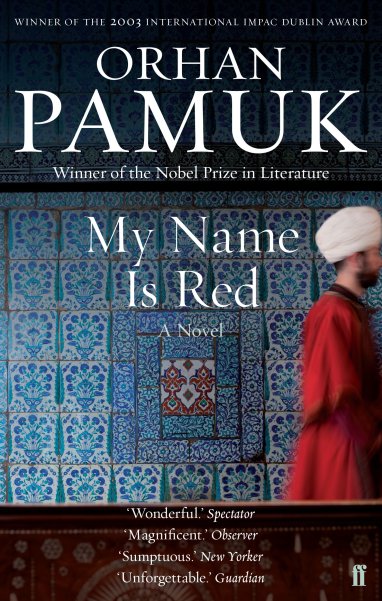
Review: My Name is Red by Orhan Pamuk

my name is red My Name is Red [1998/2001] – ★★★★★

A rich, tightly-woven literary tapestry whose secrets lie in elaborate details, red herrings and in the depth of the soul of its maker, celebrating the beauty, imagination and intelligence of ancient artworks and methods of painting. 

Why does man not see things? He is himself standing in the way: he conceals things.” “What are man’s truths ultimately? Merely his irrefutable errors“. (Friedrich Nietzsche) 

In My Name is Red by Nobel Laureate Orhan Pamuk, the murder of one miniaturist – Elegant Effendi – was committed within the circle of miniaturists working for the Sultan in medieval Istanbul. At the same time, thirty-six year old Black returns to his hometown of Istanbul after the absence of twelve years to seek once again the hand of his beloved Shekure, an opportunity that was denied to him twelve years previously. Unwittingly, Black becomes entangled in the intrigues of miniaturists working under Enishte Effendi, Black’s uncle and Shekure’s father. Masterfully, Pamuk takes us deep within the art circle of medieval craftsmen who labour to produce a mysterious new book, a circle replete with professional jealousy, narcissism, hidden love and, above all, differences as to the proper way of painting and representing pictures under one strict religious canon. In this historical novel, Persian art-forms clash violently with rising Venetian art influences as Black starts to realise that, in order to find the murderer of Elegant Effendi, it is necessary to go deep into the worldviews and art opinions of each of the three suspected miniaturists – “Stork”, “Olive” and “Butterfly”, testing their loyalties and beliefs.

Continue reading “Review: My Name is Red by Orhan Pamuk”