
Mini-Review: The Genius of Birds by Jennifer Ackerman 

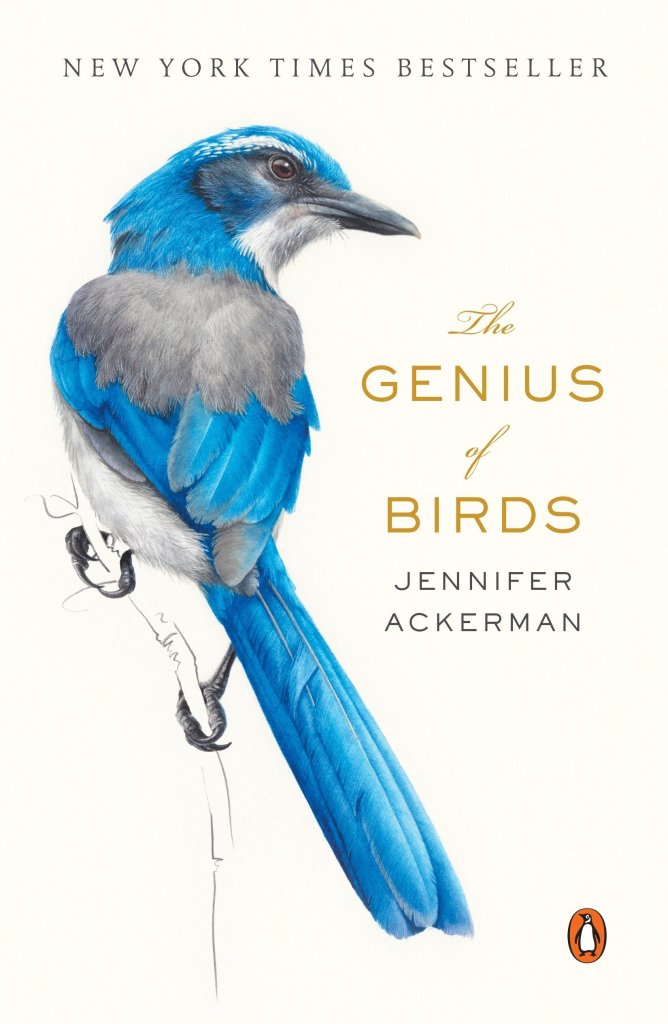
The Genius of Birds [2016] – ★★★★

November is a “Non-Fiction” month, so I am trying to read more non-fiction books. Nature books are something I have been neglecting for some years now, so I have picked up Ackerman’s 2016 bestseller The Genius of Birds. Birds are some of the most remarkable animals on earth, but they have also been very misunderstood and it was only in the second half of the previous century that the scientific community had finally started realising their full complexity and intelligence. Now, in lists (for example, see list 1 and list 2) of the most intelligent animals in the world, birds (parrots, crows and pigeons) take their places alongside such animals as chimpanzees, gorillas, dolphins and octopuses. Some birds are capable of inventing new solutions to problems, making and using tools, leading active social lives, recognising themselves in a mirror, remembering people or places they have not seen in months or years, and reproducing up to sixty different songs which they have heard only a few times. Ackerman’s book explores the technical, inventive, musical, artistic, spatial and social abilities of birds, opening up a side of birds and their intelligence you never knew existed.

Continue reading “Mini-Review: The Genius of Birds by Jennifer Ackerman “

Review: A History of the Universe in 21 Stars (and 3 Imposters) by Giles Sparrow

A History of the Universe in 21 Stars [2020] – ★★★1/2

In this new non-fiction book, the author explains key scientific discoveries through stars: from Polaris and the calculation of sky angles/directions and the discovery of Mizar’s double nature and what it ultimately said about star systems, to the mysteries of sunspots and the discovery of the existence of black holes through the exploration of Cygnus X-1. Although A History of the Universe does engage in a lot of confused “cherry-picking” of scientific facts and discoveries, and the language does get quite annoying, the book can still be described as a pure “starry” wonder and a good read for all those interested in stars and key scientific discoveries related to them.

Continue reading “Review: A History of the Universe in 21 Stars (and 3 Imposters) by Giles Sparrow”

Review: Quantum Enigma by Bruce Rosenblum & Fred Kuttner

Quantum Enigma Book Cover Quantum Enigma: Physics Encounters Consciousness [2011] – ★★★★ 

Ask, and it shall be given you; seek, and ye shall find; knock, and it shall be opened unto you” (Matthew 7: 7- 8, The King James Version of the Bible).

The universe begins to look more like a great thought than a great machine” (Sir James Jeans).

Did you know that it has been experimentally proven in physics that the way you decide to look at something (your observation) changes that something or dictates/creates its locality/position? This happens on the atomic level and no one disputes that finding in the scientific community because this has been proved through the so-called “double-slit” experiment. However, virtually no one in the scientific community wants to consider what this finding means beyond its practical application. Quantum Enigma is a book that explores the divide that has emerged in science between Einstein’s theory of relativity, governing big objects in the universe and, the quantum theory that governs objects on the atomic level. The book provides a good historical overview of the knowledge so far on quantum mechanics, delving into the famous “double-slit” experiment and the Schrödinger’s Cat Paradox. In this sense, it is a great book for those completely unacquainted with the topic because it explains concepts in a very clear and unhurried way. The downside of this, of course, is that the book is needlessly repetitive and provides very few, if any, fresh ideas beyond the already established knowledge.  Continue reading “Review: Quantum Enigma by Bruce Rosenblum & Fred Kuttner”

Review: If the Universe Is Teeming with Aliens…Where is Everybody? by Stephen Webb

Book Cover If the Universe is Teeming with Aliens…Where is Everybody?: Seventy-Five Solutions to the Fermi Paradox and the Problem of Extraterrestrial Life [2015] – ★★★★1/2  

I am continuing with my Non-Fiction November Reading Challenge with this curious book on the Fermi paradox. This paradox states that, if there are billions of stars out there in galaxies, and they are similar to and much older than our Sun, there is a high probability that those distant systems have planets that resemble our planet Earth. In turn, the typical nature of our planet means life must have developed and accelerated on other planets too, and, if beings there developed interstellar travel, they should have visited Earth already (or at least sent their probes). The paradox is that we do not see/perceive any extraterrestrial activity. Dr Stephen Webb is a theoretical physicist who proposes and discusses seventy-five solutions to the Fermi paradox in this book, solutions which he divides into three sections: (i) Alien Are (or Were) Here; (ii) Aliens Exist, but We Have Yet to See or Hear from Them; and (iii) Aliens Do Not Exist. This is an enjoyable, mentally-stimulating book that impresses with the number and diversity of different solutions and theories that may explain the Fermi Paradox. Continue reading “Review: If the Universe Is Teeming with Aliens…Where is Everybody? by Stephen Webb”