

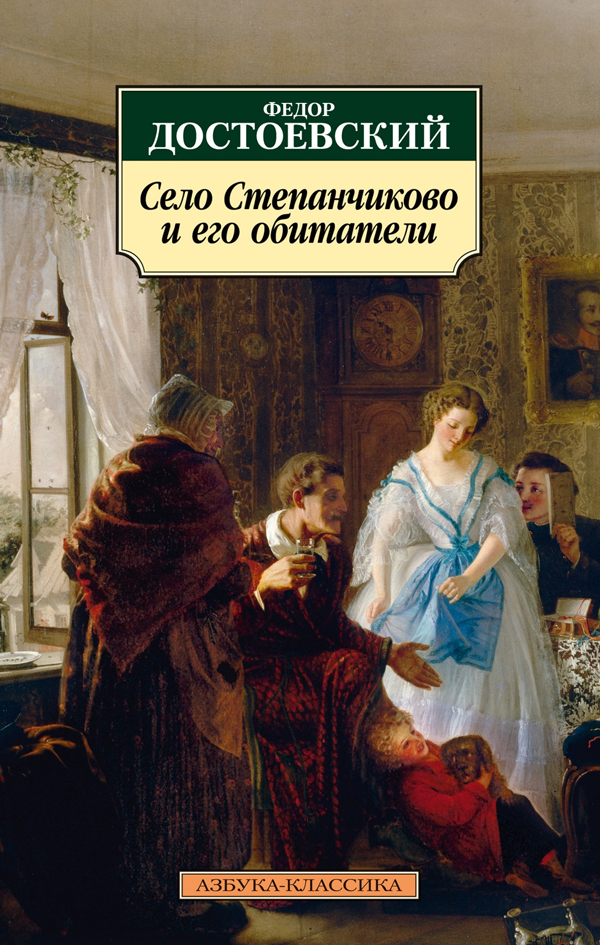
The Village of Stepanchikovo and Its Inhabitants [1859] – ★★★★1/2
When a young man named Sergei received a letter from his uncle, retired Colonel Yegor Rostanev, summoning him to Rostanev’s village to meet a potential bride, never in his wildest dreams did he imagine the absurd situation that would confront him at his uncle’s house – or the uncle’s strange, submissive state, all stemming from the immense influence and control that a mere “nobody,” a penniless, petty and resentful middle-aged man called Foma Fomich Opiskin, exercises over the whole house and village. But, who is this man really, and why does he have everyone under his thumb? This most Gogolian of Dostoyevsky’s works, which was first conceived as a play, is a whirlpool of dramatic events and nightmarish scenarios that introduces the most colourful of personages who each, in their turn, play their roles in a wild sequence of astonishing incidents, including romantic rendezvous, forced elopements and covert money-making schemes. This is a highly entertaining comedy revolving around insidious villainy and blind, cult-like worship that infected the whole village like a contagion.
It seems that Dostoyevsky is not interested in anything subtle or delicate. This is not one of Gogol’s light plays where a whole system of corruption is exposed or Chekhov’s tenderly construed realisms. The Village of Stepanchikovo is bold, introverted, psychological and claustrophobic. Dostoyevsky probably took great pleasure in exaggeration and farce, as each scene in his book is pushed to its extreme. On that basis, some critics note that The Village of Stepanchikovo is merely a parody on Nikolai Gogol and his works, notably, Gogol’s Selected Passages from Correspondence with Friends, while others, such as literary scholar Mikhail Lotman, see in Dostoyevsky’s novel a parody of the character Rudin from the novel of the same name by Turgenev, published just three years prior to Dostoyevsky’s novel. There, Rudin is presented as a prototype of an outsider to society, “a superfluous man”, who is an enthusiastic, eloquent idealist characterised by his inability to turn his flowery words into action.
The funny thing is that Dostoyevsky’s novel is quite brilliant – if you don’t compare it with other major works by the author, and consider it on its own merits. The story is very dramatic, and events move at lightning speed with a sense of unreality as to what is going on. Even before Sergei, our narrator, came to the village Stepanchikovo, he already got his head filled with wild rumours about his uncle and Foma’s machinations, all courtesy of his uncle’s friend, Stepan Alekseyich Bakhcheyev, whom Sergei met on the way to his uncle’s village. Bakhcheyev fled Rostanev’s house because he could not stand the humiliation rituals inflicted by Foma on people even slightly rebellious to his ideas. And, then, there is also a rumour that Rostanev may give his other village to Foma as a gift, making Foma a nobleman overnight. Can this be true? At first, Sergei is in disbelief at what Bakhcheyev tells him, and then thinks it is his duty to go and rescue his uncle, pulling him out of his curious situation. However, during Sergei’s first tea-drinking session at his uncle’s house, he finds himself at a complete loss, thinking that everyone simply got mad at Stepanchikovo, and wants to flee the whole absurd situation himself.
Sergei has all the reasons to: his uncle Colonel Rostanev, a respected, selfless man, who only sees the good in others, has lost his head completely over the most tyrannical and wretched of people – fifty-year-old Foma, but if his uncle is a fan, then his entourage is even more so. Rostanev’s mother, Agafya Krakhotkina, a demanding, recently widowed woman nicknamed Madame la Générale, worships Foma’s very image, and her confidante, malicious Miss Perepelitsyn, seems to be Foma’s right-hand. Then, there are two odd, young male presences in the house – Ivan Mizinchikov, Rostanev’s distant cousin, and Pavel Obnoskin, the family’s guest, who both may have hidden agendas in the house, and perched between them is Tatyana Ivanovna, an eccentric thirty-five-year-old woman-child who deals with mental health issues, but who has also recently inherited a fortune. The strange servants complete the picture: pretentious valet Grigory Vidoplyasov is obsessed with the ridiculousness of his own surname, beautiful house-boy Falaley has an irresistible urge to recount his dreams to everyone, and they always feature a white bull, and Gavrila, Rostanev’s ageing valet, becomes the latest familial sideshow when he is forced to learn French at Foma’s whim. Only Sasha, Rostanev’s fifteen-year-old daughter, and Nastasya Yevgrafovna, the children’s governess, seem to be rational or completely sane, but what voice do they have in the house? The most extraordinary, tense situation is unfolding in Rostanev’s house, and the young and naive are the first to jump through Foma’s hoops.
Dostoyevsky is clever to keep Foma at a distance in the first few chapters of the book and that builds tension and intrigue. We only meet Foma around chapter seven when he arrives late to the table for tea, and at first does not even pay attention to the newcomer Sergei. Most of the time, Dostoyevsky fleshes out the situation “from zero to hero”/“from rags to riches”, or in Russian – “из грязи в князи” (“from dirt to princes”), taking inspiration from and satirising Gogol’s play The Government Inspector, where a highly imaginative man is mistaken by the whole village for a governmental inspector who travels incognito, and hilarity ensues, whereby he is loaned money and shown all kinds of deference. In The Village of Stepanchikovo, however, Dostoevsky implies that certain conditions are enough for hilarity, and there is no need for any mistaken identity at all. Everyone knows in his story who Foma really is – an ignoble “nobody”, but it does not matter – through his bluff and pretences, Foma becomes everything, a genius, a morally superior “benefactor”.
Foma is like the Queen of Hearts from Alice’s Adventures in Wonderland who can make anyone feel “beneath” him and can persuade anyone that black is white and white is black. Audacious, emotionally manipulative, arrogant, tyrannical, power-hungry, but also unintelligent, egotistical, useless, cowardly, pathetic and ignoble, Foma establishes control over such people as kind-hearted Yegor Rostanev by sowing seeds of guilt in them, and then making them apologise or change their behaviour. Foma pretends that he does good in the long run, but all he does is humiliate others. He is so silver-tongued, nearly everyone in the story falls under his spell, even, perhaps, the reader in certain scenes. Critic Ivanov linked Foma to the King who constructs his own “court” at the house, having his own jester – Ezhevikin, dancing buffoon – Falaley, and lackey – Vidoplyasov. Having constructed his “court” around his persona, Foma then will stop at nothing to keep others’ attention, and to maintain his leadership and control over his “subjects”, even if that means going against his own initial wicked plans (as the ending shows). How much Foma realises his own bad behaviour and how much he believes in his own superiority is anyone’s guess, and this question is also a point of fascination in The Village of Stepanchikovo.
“He read aloud to them works of spiritual edification; held forth with eloquent tears on the Christian virtues; told stories of his life and his heroic doings; went to mass, and even to matins; at times foretold the future; had a peculiar faculty for interpreting dreams, and was a great hand at throwing blame on his neighbours” (description of Foma, Dostoyevsky/Contance Garnett, 1859/1995).
At times it seems like Dostoyevsky’s point in the story is not that Foma is so-and-so, but that he is listened to and believed. Even with all his traits, Foma would not have had any power if he were not taken seriously. Cult leaders are nothing without their followers. The essence of their power is the effect they have on others, and it is this effect and how people respond to Foma that are of interest to the author. The compassionate and kind Yegor Rostanev, probably a distant prototype of Prince Myshkin from Dostoyevsky’s The Idiot, provides the sharpest contrast to the selfish and capricious Foma. Also, as in some of his other works, Dostoyevsky tries to show the side of humanity which is not good, which is self-interested, and the author’s argument is that these people also have their own (twisted) reasons for their actions. And, that applies not only to Foma, but to a number of characters in the story, for example, to Ivan Mizinchikov, who dressed up his immoral intention of marrying the naive and childlike Tatyana Ivanovna for her money as a noble deed to provide her with lifelong protection.
🌾 Dostoyevsky is known for the philosophical depth of his works which probe into human nature, and even in this novel of humour and caricatures, there is nothing light or superficial. Even in his comedy, Dostoyevsky is deep. There are scenes of psychological “chaos” and “destruction” in his story, which are invariably followed by scenes of “resurrection” and “redemption”. The Village of Stepanchikovo is an intelligent, nightmarishly comic study of characters and behaviours.
 Thoughts on Papyrus
Not come across this one before, sounds like D was making some very clear criticisms of the church, and potentially also prescient of the hero-worship of certain twentieth-century ‘leaders’ and their entourages. Never too late to learn, but will we?
LikeLike
This one isn’t much read in English, I think, and I’ve been curious. It does sound pretty fascinating. Thanks!
LikeLike