
I hope all my followers and readers had a very Merry Christmas, and I would like to wish all a very Happy New Year. We are now in January, named after Roman God Janus, who is in charge of beginnings and transitions. He is often portrayed as having two faces, one looking into the past “with memory” and another – into the future “with foresight”. This duality somehow reminded of the myth of Orpheus and Eurydice that I am sharing below. This a moving tale of the power of love and music as its hero journeys to the Underworld to try to bring his beloved back to life.
In Greek mythology, Orpheus was a bard and legendary musician who descended to the Underworld (the realm of the dead) to bring back his wife Eurydice, who died from a snake bite. The legend says that Orpheus, being a mere mortal, could only able to enter the abode of Hades and Persephone, the God and Queen of the Underworld, because he used his uncanny musical abilities. He enchanted the rulers of the Underworld with his song, love and devotion, and, in consequence, they reluctantly agreed that he could take his wife out of the Underworld, but only one condition: he should lead the way and she must follow him, and he must never look back to check on her until they both reach the upper world. Orpheus and Eurydice started their journey back, but Orpheus was full of doubt. He had not seen Eurydice, and had no sign or evidence that she was truly following him. The temptation to confirm her presence and his belief proved too great for Orpheus, and just as they neared the Underworld’s exit, Orpheus looked back at Eurydice, at which point she disappeared into thin air forever, being claimed by the realm of the dead, as she had not yet reached the land beyond and Hades’ condition was broken.
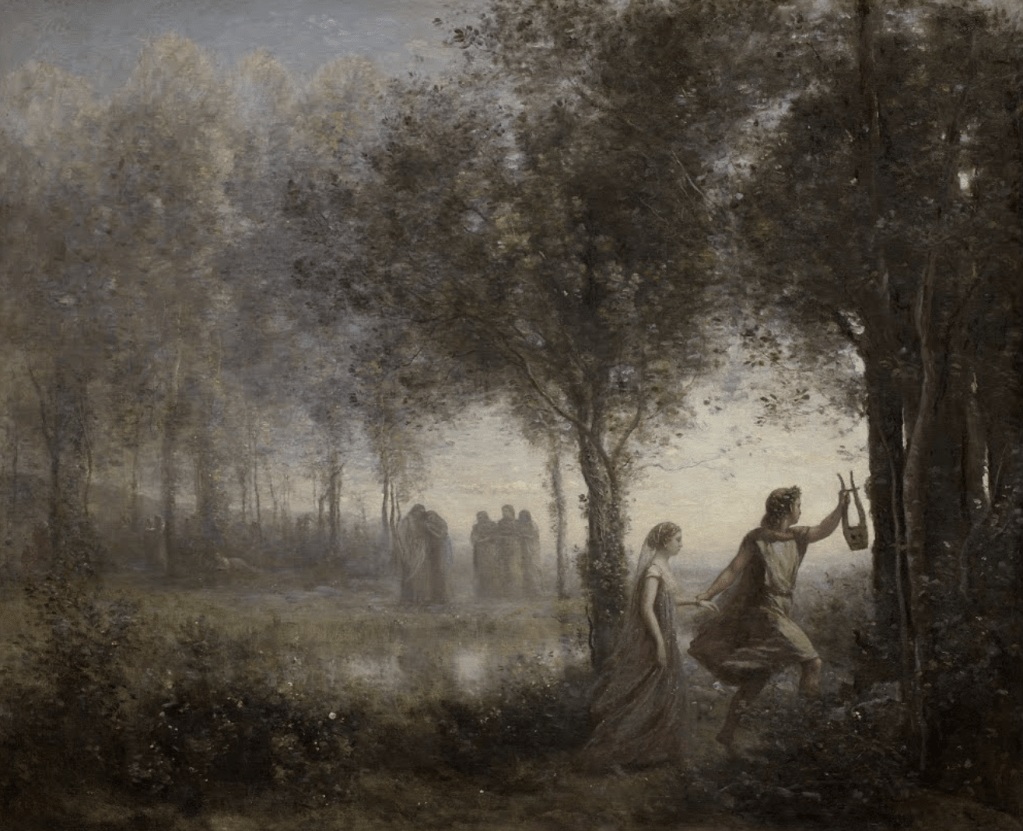
The painting above by Camille Corot is a dreamy presentation of the scene of Orpheus leading Eurydice out of the Underworld. With his lyre in one hand, Orpheus is seen making his way confidently amidst all the spectral trees, clearly turning his head away from ghostly Eurydice, while she follows close behind. In the background, there is a lake or river where spirits have gathered (could it be a portion of Lethe, the fabled river of Oblivion from which spirits must drink to forget the world above?)
Austrian poet Rainer Maria Rilke (1875-1926) wrote poem Orpheus, Eurydice, Hermes, which details the passage of Orpheus with Eurydice in the Underworld, emphasising the emotional states of Eurydice and Orpheus. In the poem, the third character is Hermes, the messenger of the Gods and the communicator between the living and the dead, who also guides the souls in the Underworld. In some myth interpretations, Hermes helps Orpheus to retrieve Eurydice. In Rilke’s poem, the centre stage is Orpheus, who loves too much and loses it all simply because he has a fear of losing, while “the other two” are Hermes and Eurydice, who is alreadyliving “beyond”, being equated with “depth” and “silence”. “It was as if his senses had been split:/for while his sight ran like a dog ahead,/then turned around, came back again, and waited/at the next — but distant — pathway’s turning,/his hearing lingered after like a scent./At times it seemed to him it reached as far/back as the footsteps of those other two/who must be following the whole ascent./But then it only echoed his own steps,/or else his mantle’s luffing breath behind./But still he told himself that they were coming./He said the words aloud…and heard them die./They were still following, but they/were two who walked in quiet fear…” Rainer Maria Rilke, translated by Len Krisak.
The myth of Orpheus and Eurydice has been interpreted in many ways, and one idea is that one has to carry on and keep one’s faith no matter what – even when there is no seen confirmation of their belief, faith or hope. As Saint Augustine said: “faith is to believe what you do not see; the reward of this faith is to see what you believe“. Ultimately, it is doubt, suspicion, fear and the loss of his faith that cost Orpheus everything, and Eurydice was lost to him forever. The tragedy is even more acutely devastating when you consider that Orpheus had achieved what was considered completely impossible – he managed not only to enter the Underworld as a mortal, but also had its rulers consent to a dead person returning to life once again – an impossible task set and almost accomplished. His journey mirrors the journey of the soul on the path of life or through the torments of love. One is never sure of the future: one has to keep faith – even if it is blind.
Interestingly, the same reasoning can be applied to religion, and, actually to the creation of art, as well. Orpheus may represent the creator and Eurydice the unsaying truth. One cannot see it and there is no confirmation that it even follows one, but one must, nevertheless, simply have faith, including self-belief, and blindly hope and trust in the creative journey until that work is completed. Any doubt or loss of faith (that glance behind) may signal the end of everything, destruction. God(s) reward(s) the most patient, the most blindly devoted.
 Thoughts on Papyrus
This is perhaps one of my most favorite takes. I feel it has impacted us in so many obvious and subtle ways and irreversible shaping society in the process.
LikeLiked by 1 person
“faith is to believe what you do not see; the reward of this faith is to see what you believe“… There’s probs comparison to be made to the double slit electron experiment, but I’ll most certainly butcher it— Gotta have FAITH🙌 If you grasp too hard at certainty, at control, you lose it. So it goes with life. I like the parallels you draw to art and religion, toying with perspectives, different ways to interpret this allegory of Orpheus and Eurydice. Also, I realized there’s a character named “Janus” from 007 Goldeneye who was definitely named after The Roman God because his character follows the myth. Happy New Year! Hot start!👍
LikeLiked by 1 person
Thanks, and a very Happy New Year to you, too!
LikeLike
Happy New Year, Diana! Your blog is always a joy to read. I wish you all good things in 2026!
LikeLiked by 2 people
Thank you, and a Happy New Year to you, too!
LikeLiked by 1 person