

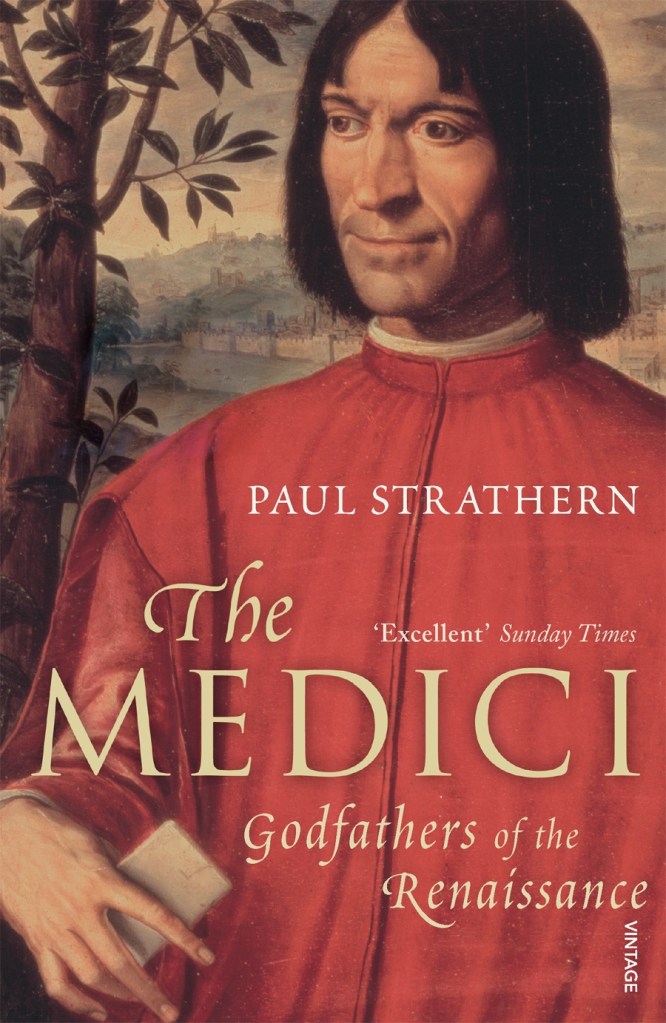
The Medici [2003] – ★★★★1/2
The Medici. No other family in history stirs the imagination as much while, at the same time, inducing so many contradictory feelings—awe, amazement, trepidation. One of the most powerful and influential families in history, the Medici ascended from banking experts to the height of papal rule and European royalty, an astounding achievement. Their contribution to the Renaissance movement was unparalleled. Based in Florence, then an independent republic, they were overseeing the works and being behind the scenes of most major Renaissance projects, from Brunelleschi’s Dome of Santa Maria del Fiore to Michelangelo’s fresco The Last Judgement in the Sistine Chapel, influencing and/or providing finance to such major Renaissance figures as Sandro Botticelli, Leonardo da Vinci, Rafael, Michelangelo, Machiavelli, Galileo Galilei, and others. Paul Strathern’s book traces the family’s ascend and fall, zooming in and out of major events that shaped the course of Italian and European history. This non-fiction laces historical information with interesting trivia, being an almost perfect blend of insight and entertainment.
The story starts with Giovanni di Bicci de’ Medici, an expert banker who established a head office in Florence in 1397, which is also the date of the founding of the great Medici Bank, that became one of the most prestigious in Europe, with offices everywhere, from Bruges to London. Giovanni di Bicci de’ Medici also oversaw what became the first Medici artistic patronage as he was the judge of the winner of the competition to create new bronze doors for the Baptistery. “Giovanni di Bicci had began to understand that there was more to life than banking and its attendant risks. Money could be turned into the permanence of art by patronage, and in the exercise of this patronage one gained access to another world of timeless values, which appeared free from the corruption of the religious authorities, or the devious politics of power and banking” [Strathern, 2003: 46]. His son Cosimo di Medici will continue his father’s legacy, but adding a new layer –that of artistic curiosity and humanism. “Cosimo’s power was everywhere; as a foreign envoy to the city remarked: “It is Cosimo who does everything…without him nothing is done.” Yet his power was also elusive; he was not the government, merely the power behind it, and such power was difficult to oppose or eliminate” [Strathern, 2003: 115].
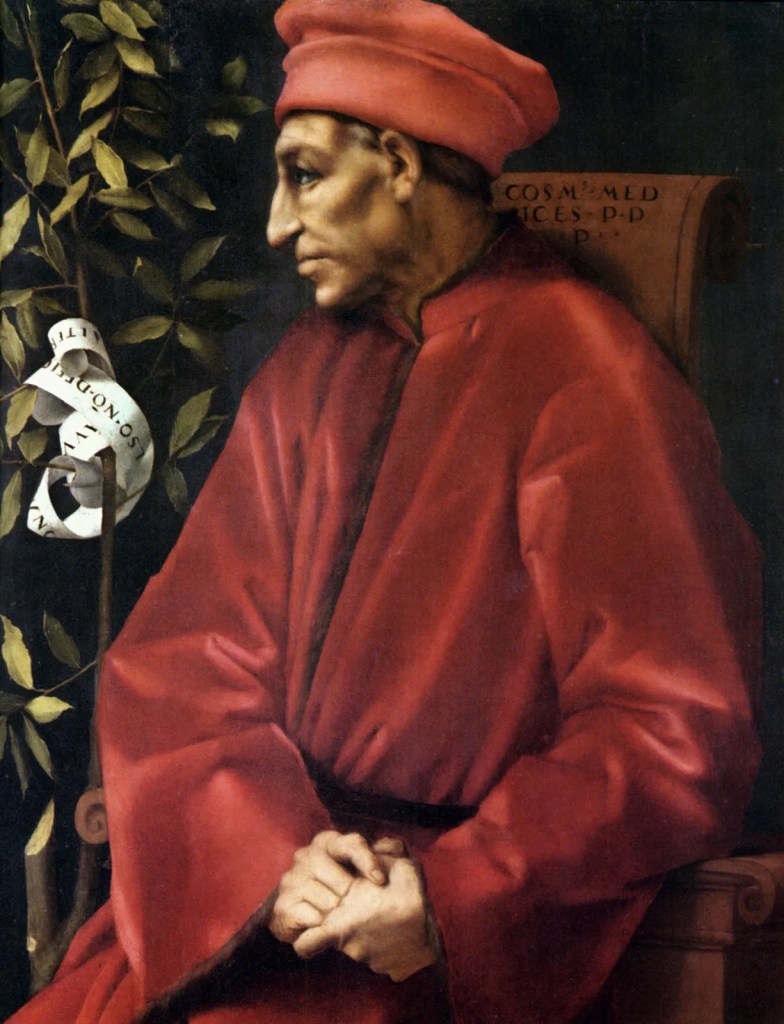
The Medici’s hold on the city and its inhabitants always had to coexist with one complex political situation in the region. A fine balance had to be reached, with just the right amount of persuasion, gifts, diplomacy, pressure and show of strength exercised daily, not least towards the Signoria, the government. Despite the best efforts, Cosimo went into exile in 1433, and emerged from it “the richest man of his age, the founder of a dynasty, the man who encouraged the first flowering of the Renaissance” [Strathern, 2003: 79]. One of the people who gained patronage under Cosimo was Niccolo de’ Niccoli, a humanist who “presided over intellectual life of the city almost like an unofficial minister of culture”. It is Niccoli who bequeathed to Cosimo upon his death a library of some 800 manuscripts. Cosimo added his own manuscripts to the existing ones, and there emerged the first extensive public library in Europe. It had at least two distinctive features – first, it was public, open to any scholar to scrutinise any manuscript, and, secondly, it produced knowledge from a source other than the Church. The curious trivia here is that Niccoli’s clear, distinctive forward- leaning script that he used to copy manuscripts were later adopted and developed by the first Italian printers. It became known as italic.
One of the most thought-provoking questions asked by the author is – “why did the Renaissance movement originated in Florence, why not in Naples, Venice, Milan or Rome?” All these cities had wealth and connections, and, yet, only in Florence, the movement took root and flourished. In fact, only in Florence it could. The author details how Rome was under the rule of different popes, which hampered freedom and innovation, and how Naples and Milan were subjected to autocratic rulers. And, Venice had a patriciate. Florence, on the other hand, was a quasi-democratic republic, and its political instability contributed to boosting innovation and artistry. It also happened to have a “long tradition of civic patronage”, with traders accustomed to contributing financially to the glory of the city. The talents of Dante, Petrarch and Boccaccio did not originate in the vacuum – they originated and were moulded under such patronages. The intellectual tradition, and the rivalry between artists of all kinds flourished, and this was also conducive to innovation.
“The Medici were among the first to understand, and publicly acknowledge, that artists were more than craftsmen; at the same time, the artists themselves were developing a personal assurance that went hand in hand with the emergence of humanism. They were beginning to believe in themselves, in their unique vision of the world; indeed, it is from this period that we can date the concept of the artist as “genius”, and all that entails. Here we see the artist exhibiting exceptional talent, exceptional behaviour, exceptional self-assurance – and, paradoxically, as a result f all this, exceptional psychological torment” [Strathern, 2003: 138].
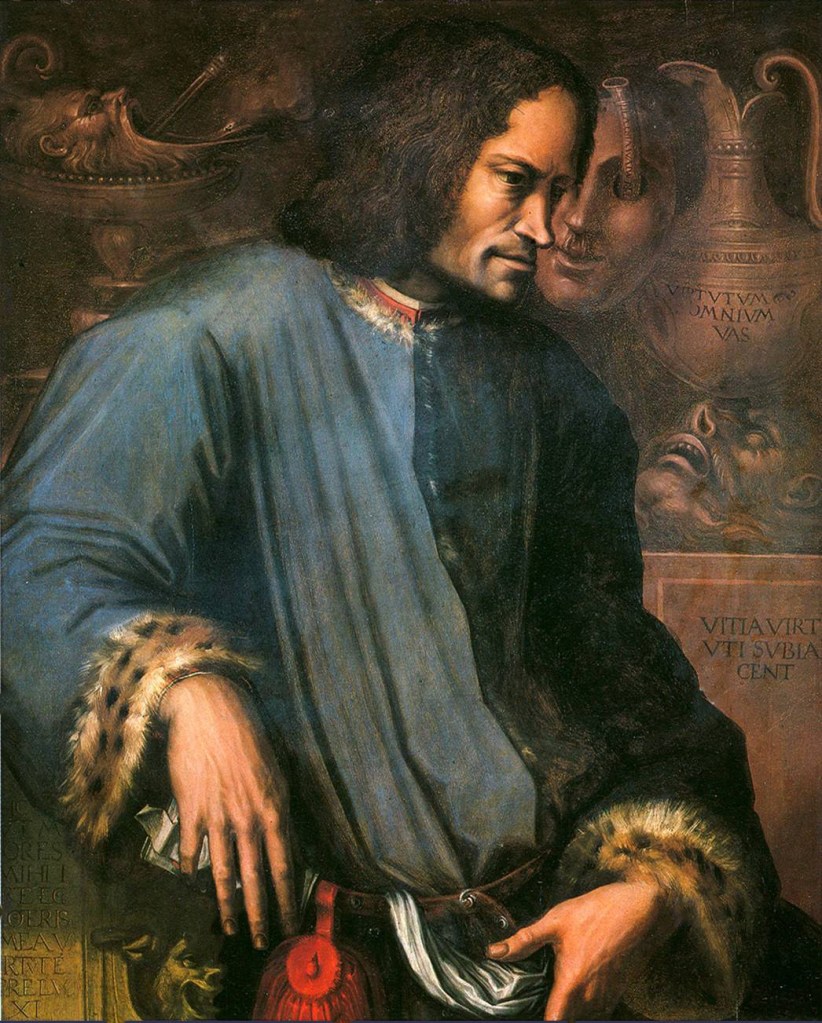
Cosimo’s grandson had an even more fascinating personality than Cosimo. Lorenzo de’ Medici was also known as Lorenzo The Magnificent (1449-1492), a man of abundant energy and detachment, who combined outward brilliance with contemplation. He would marry Clarice Orsini, a girl of Roman aristocracy, and just to put things into perspective and to show where Florence stood at that period, Strathern notes “Rome was considered provincial, and the Florentines regarded themselves as the new Romans, the inheritors of the mantle of Ancient Rome” [2003: 152]. Lorenzo saw and later contributed to the Renaissance movement in Italy. He was brought up surrounded by eminent artists, who were coming and going out of his home, Palazzo Medici. Lorenzo would later also contribute to their careers, including that of Leonardo da Vinci, financing and connecting him to many projects, before recommending his move to Milan. Art finally became associated with humanistic ideals, scientific principles and philosophy of life, moving away from strictly religious themes.
The book moves seamlessly between political intrigue and behind-the-scenes accounts of the making of the world’s greatest artworks, such as Michelangelo’s statue David. Strathern captures the most exciting historical moments, and the read is often one exhilarating drama, such as when priest Savonarola comes to the scene. This was an ascetic priest posted to San Marco convent in Florence in 1482. Savonarola gained immense popularity and following, challenging the Medici indirectly through the strict pleas to forgo sensual delights, pleasures and secular art in favour of living humbly, almost in poverty. Naturally, resentment towards the Medici grew. Piero, Lorenzo’s son, could not hold power for longer, but neither could Savonarola, who was hanged after refusing to submit to excommunication from Rome.
The last part of the book details Rome’s dominance over Florence as the centre of Italian culture. Sensing this shift in power to Rome, the Medici did not sleep and made their move. Cardinal Giovanni Medici, second son of Lorenzo, settled in Rome in 1495, later becoming Pope Leo X, the first to have come from Florence. And, even here, the Florentine traditional of artistic patronage is clearly seen as Pope Leo X would install Raphael as the new architect of St. Peter’s, giving him creative freedom. Lorenzo’s nephew, Giulio de Medici, will also become Pope Clement VII, the head of Catholic Church. Incidentally, it was Clement VII who commissioned many notable artworks, including those by Raphael, Cellini and Michelangelo, for example Michelangelo’s The Last Judgement fresco in the Sistine Chapel.
What becomes clear is that the Medici were “resurrecting” themselves throughout history like phoenixes rising from the ashes, surviving even in the most turbulent and complex geopolitical times. This is evident by the fact that after the assassination of Alessandro, the great-great-grandchild of Lorenzo, another branch of the family (descendants from Lorenzo, the younger brother of Cosimo) rose to rule in Florence once again. Another Cosimo established himself as a patron of the arts, befriending Giorgio Vasari (1511-1574), who was then responsible for the “entire artistic and architectural programme of Cosimo, acting virtually as his minister of arts”. Yet again, the author throws in fascinating insights, for example, the fact that in 1657, Leopoldo de’ Medici funded Europe’s first club for scientific study, welcoming scientists and amateurs alike. It was called The Academia del Cimento (Academy of Experiment). In comparison, the Royal Society of London was founded only in 1662 and the Paris one – four years later. Or, the fact that Catherine de Medici, who married into the French royalty in 1533, contributed to the French cooking methods and traditions by introducing Italian innovations, including the wide range of sauces, often made with tomatoes, garlic and herbs, and even the advent of the fork.
⚜️ The Medici is both exciting and erudite, shedding light on one very unique and complex family and its machinations, illuminating one of the most exciting periods in European history.
 Thoughts on Papyrus
Thank you for sharing this:)
LikeLiked by 1 person
This sounds like a very intriguing book! I think I’m going to jot down this title for a possible read when I get to this time frame in history in my personal studies (a plan of self-education I’m developing right now).
LikeLiked by 1 person
Excellent review, Diana, what an extraordinary dynasty! I reviewed this uber-biography (rather more briefly) back in 2014 and thought it was an excellent overview, aided by some acquaintance with Florence from stays there in the last decade of the 20th century and a little more recently. https://calmgrove.wordpress.com/2021/06/10/medici/
LikeLiked by 1 person
Thanks, Chris. It is great to hear you liked it too. Isn’t it something? I bought this book a long time ago and suddenly thought this Christmas time was perfect to plunge into it.
LikeLiked by 1 person
The Medici’s rise to power is fascinating – what drew you to this book about them?
LikeLiked by 1 person
I guess I have always found them interesting, and I also lived in Florence.
LikeLike
I’ve always been fascinated by the Medici family! We studied them back at school, as I used to live in Italy. This is a great review! This book goes to my TBR
LikeLiked by 1 person
Thanks, and I hope you love it. It was great.
LikeLiked by 1 person
Thank you! Wish you a wonderful reast of the week 🙂
LikeLiked by 1 person
The secret of Florence’s allure lies, in part, in the Medici dynasty. It’s fascinating to learn as much as possible about them. It’s wonderful that you introduced us to this book.
LikeLiked by 1 person