
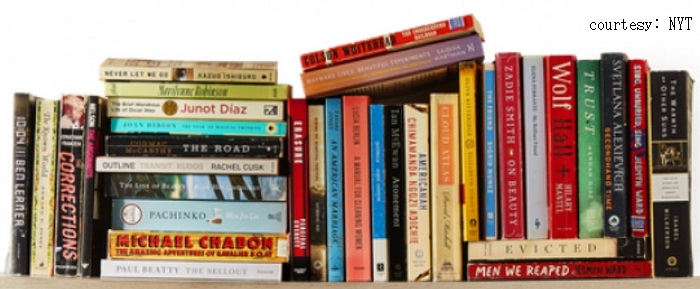
This summer, The New York Times (NYT) published list “100 Best Books of the 21st Century”, compiled from a survey of “hundreds” of novelists, non-fiction writers, academics, editors, journalists, literary critics, publishers, etc. (you can see the full list of the titles here since the original list is on the other side of the paywall). I am late to comment on this, but because I had to be absent from this site this summer, I thought I would do so now, since I also enjoyed reading takes on it over at The Book Stop and The Reader’s Room. I do understand all the drawbacks of such lists, and my point is not to put down any undoubtedly great books or authors featured on this list, but just comment (i.e. rant) on the list overall.
I am surprised how heavily anglocentric and best-sellers-inclined this list is, showcasing commercially successful, popular books over those that have true literary merit, and choosing trendy, “politically correct” titles over foreign language or small press ones. The list seems to follow the major awards’ trend, and it unduly favours narratives surrounding race, politics, poverty or queerness. Books on these topics are very important, of course, but just the focus on these topics should not mean that a book necessarily qualifies to be “the “best” in an objective sense over other titles with other themes. NYT’s list is definitely not the “Best Books of the 21st Century”, but a list of “The Most Popular (Largely) English-Language Literary Fiction Written in the Last 25 Years by Authors Largely Connected to NYT in Some Way” (as others noted, NYT list has a preference for authors who wrote for it or are/were members of NYT or New Yorker). Obviously, “popular” and “the best” are two completely different things (though many books are both).
- Books written in English = automatically better than the rest? Hardly, but NYT’s list thinks so. It lists three books by Jesmyn Ward alone, and has three books penned solely by George Saunders, while also featuring at least two books by each of the following authors: Zadie Smith, Philip Roth, Edward P. Jones, and Alice Munro. There are also books on this list by such authors as Ann Patchett, Marilynne Robinson, Torrey Peters, Lawrence Wright, Barbara Kingsolver, Percival Everett, Denis Johnson, Alan Hollinghurst, Rachel Cusk, Jeffrey Eugenides, Kate Atkinson, Claire Keegan, Emily St. John Mandel, Ben Lerner, Toni Morrison, Rachel Kushner, John Sullivan, Tayari Jones, David Mitchell, Richard Powers, Ali Smith, Sigrid Nunez, Helen Macdonald, Lucia Berlin, Justin Torres, and Helen DeWitt. All of them are either British, Irish, American or Canadian, and there are obviously many more English-language books on the list. So, Scroll, a digital publisher based in India, conveniently asks: “How much, and for how long, is America going to obsess over reading and dissecting itself? Why do reading lists emerging from the West claim authority on culture with such hyperbole? Is diversity in literature only worth mention if the story speaks of a Great War or unrest?”
- The very few foreign language titles that do appear on NYT’s list seem to be of a kind where one is basically “pinned against the wall” without the possibility of excluding them because of some author’s immense popularity in the West (Ferrante earned three! spots on the list) or some strong title popularity/awards’ buzz, for example, Kang’s The Vegetarian and Melchor’s Hurricane Season. What about the post-2000 works of authors José Saramago (Portugal) and Orhan Pamuk (Turkey)? Did these Nobel Laureates produce books that were worse than Zevin’s Tomorrow, and Tomorrow, and Tomorrow, which although published just two years ago, is already on the list of the “Best Books of This Century”? Certainly, time decides that – not some two years’ span of popularity. Saramago’s The Cave [2000] is not only one of the best books of the last 25 years – it is one of the best books of all time. NYT’s list contributors do not seem to read such authors, and their definition of “world literature” seems to be confined to the high intellectual world of Bolaño (nothing against Bolaño as such). In response, Scroll made their own list of more “nationally-diverse” books that includes works by such authors as César Aira and Damon Galgut. And, then, NYT does not even have any of Olga Tokarczuk’s works listed? Seriously? Min Jin Lee’s listed Pachinko was a good book, yes, but nowhere near Tokarczuk‘s brilliance, in my opinion.
- And, then, if NYT’s list is so determined to showcase the English prose talent (a great goal), where is Hanya Yanagihara or Susanna Clarke? Yanagihara’s command of the English language-narrative is one of the best I read from this century (together with Donna Tartt’s – who is included). Yanagihara’s A Little Life is very, very divisive, but, surely, a monumental achievement. And, Jonathan Strange‘s omission from this list must be the crime of this century. The NYT’s list does feature sci-fi and graphic novels, so could have included this literary masterpiece, albeit also a fantasy novel, by Susana Clarke, and one of the best books I have ever read, let alone published this century. The NYT list also does not include such authors as Margaret Atwood and Louise Erdrich, and I would personally put into the list The Blazing World by Siri Hustvedt, and The Luminaries by Eleanor Catton.
- Turning to non-fiction, the NYT list largely focuses on the American social condition, so we have such books as Barbara Ehrenreich’s Nickel and Dimed and Evicted by Matthew Desmond, and I would have loved to see there Susan Cain’s Quiet or David Grann’s Killers of the Flower Moon, or even Roberto Saviano’s Gomorrah and a title by Lindsey Fitzharris (The Butchering Art).
What are your thoughts on the NYT list? Do you like it, approve or disapprove of its choices? What fiction or non-fiction would you have liked to see on a similar list?


Diana – I completely agree with every word you say. I would take note though that by the end of this century maybe 5 or 10 of these books will still be on the list. If you look at the most popular and well regarded books of the 20th century say around 1940 you will find so many books that have been lost to oblivion. I was reading through John Cowper Powys’ list of 100 greatest written in 1920 which included several 20th century titles. Of the ones on the list I don’t think any of them are considered great today. Even Jean-Christophe for which Roman Rolland won the Nobel Prize is completely obscure now, mostly because it was dealing with the “obsessions of the time” – much as many of the ideologically focused books on The NY Times list – and when those obsessions fade into the dustbin of history, books dealing with universal truths and merit will triumph.
LikeLiked by 6 people
Now I see this is so true, thanks for making this point. You put it beautifully. Let’s hope so…undoubtedly many books on this list would disappear as time goes on, but it is still so shocking what is not there now that should be. Would these absentees be present near the end of the century, as they should? or will some other societal trend or topical issue (similar to racial injustice or migration) hijack the list near the end of the century? Let’s hope not 🙂
LikeLike
Thank you for this trenchant essay, Diana. It’s sorely needed in the literary world. How can a valid assessment of the best books of the 21st century be made when we don’t even reach the quarter-century mark until next year?
LikeLiked by 3 people
Exactly. What haste! Perhaps they followed a number of prominent film magazines and their lists of best films of this century, such as S&S, and decided to do the same with books (or was it other way around, who knows).
LikeLiked by 1 person
It’s a puzzlement, all right.
LikeLiked by 1 person
NYT is calling it “The Best” but in the opening paragraph of their post say the selections are, “…the most important, influential.” Not quite the same criteria is it. Sounds more like a popularity / diversity contest.
Susan Cain’s “Quiet” – I read that in undergrad right after learning I was an introvert – a life-altering realization. I referenced it in a paper / presentation… twice had the experience of being the only person, in rooms full of 12 and 20, to raise my hand to being an introvert. Everyone else identified as Extroverts. Like I said… life altering. Cain’s book was a refuge and a support system for me there for a brief period.
LikeLiked by 1 person
Yes, it seems they “forgot” to mention a lot in their opening title including adding “according to the US”… I am happy to know you are also an introvert. Me, too! We are so cool, right? It is also so surprising to know that in your class you ended up the only one identifying as such and I wonder if it may be group pressure or stigma involved so that no one followed your example. Popularity is still synonymous with extraversion, I guess – that’s why we need recommending Cain’s amazing book to everyone we meet. It also changed my life.
LikeLike
The Luminaries and A Little Life definitely deserved a slot! I agree that it was weird to see several titles by the same authors.
LikeLiked by 1 person
I’m glad you agree on A Little Life and Catton. For me personally the exclusion of Yanagihara, Catton and Clarke is very disheartening largely because I enjoy their dense prose inspired by such classics as Austen, Dickens and Tanizaki. Their exclusion feels like a message discouraging this style of writing which I absolutely love. If narrative plot is already considered “old-fashioned” in both books and films, and books gravitate towards aesthetics and atmosphere at the expense of that “old-fashioned” plot, similar to some beautiful Instagram posts, I have to admit I am a bit worried.
LikeLiked by 1 person
100% agree!
LikeLiked by 1 person
I definitely agree, Jose Saramago is a grievous omission. I would also have included ‘The Inquisitors’ Manual’ (2004) by the current Portugal phenomenon, Antonio Lobo Antunes.
When a newspaper makes a list like this, they have to also measure a book’s popularity with readers, so it never is all about quality which is a difficult thing to measure.
LikeLiked by 3 people
That’s interesting. I am still to try any Lobo Antunes. I hold Portuguese authors in high regard, and I am sure Act of the Damned is as great as you say it is. His Fado Alexandrino also appeals to me just for the challenge of it. Well, yes, and that popularity vector had no problem with Bolano with – not just one, but two! books’ inclusion? 2666 would make any Saramago feel like a walk in the park. 🙂
LikeLiked by 2 people
Oh Diana, I really hope you try Lobo Antunes!! Some of his stuff is amazingly good! I recommend you start with his early novel, translated as “The Land at the End of the World” by the great Margaret Jull Costa . . . it’s a short novel, and serves as a good introduction to his style (which can be very dense and complex in his other works) and his thematic concerns (the Portuguese colonial wars, the dictatorship . . .) .
LikeLiked by 3 people
Thanks very much for this recommendation! I see now that I have added The Land at the End of the World to my goodreads TBR awhile back, but never got to it – definitely now have to prioritise it! Margaret Jull Costa is incredible, isn’t she? Largely know her for Saramago, but what she did with Eça de Queirós’s mammoth The Maias is just so so admirable!
LikeLiked by 2 people
Yay! I hope you like it and I look forward to your review of it, whenever you have a chance to read it!
LikeLiked by 1 person
I agree that “The Land at the End of the World” is Antunes’ best. I mentioned “The Inquisitor’s Manual” because it was written this century.
LikeLiked by 1 person
I just had to add that one to my list as well =)
I thought I knew Portuguese literature, but I mostly know Saramago and Fernando Pessoa…
LikeLiked by 2 people
I hope you like it too! Lobo Antunes is a bit darker than Saramago . . . okay maybe a lot darker . . . but he is very intriguing and compelling when he’s at his best!
LikeLike
I couldn’t finish Tomorrow and Tomorrow and Tomorrow, it was so horribly written. No idea why that book is so hyped. Any list that includes it in its ‘best’ list has got to be suspect.
LikeLiked by 1 person
Yes, definitely agree on the hype of Tomorrow, and Zevin is a bit of a NYT critic herself, apparently.
LikeLiked by 1 person
Not to defend the NYT but they made a list to make their readers happy – it is safe. I’m a big fan of the writings by Carlos Ruiz Zafon, and I’ve read everything by Henning Mankell, and of course if in Sweden you have to read Stieg Larsson. Who cares about their list.
LikeLiked by 1 person
Yes, a safe list to please everyone…I do enjoy a good Mankell once in a while, and reviewed Faceless Killers. I haven’t read anything by Larsson, though, not even The Girl with the Dragon Tattoo, which I largely know as a film. You recommend, then? Sweden…I was virtually brought up on Astrid Lindgren, and I love Söderbergs’s classic Doctor Glas.
LikeLiked by 1 person
If you are going to watch a Dragon Tattoo movie it has to be the movies with Noomi Rapace as Lisbeth Salander. I enjoyed the books, the first is by far the best. I’ve also read Jo Nesbo.
LikeLiked by 1 person
I heartily agree — your alternate list title says it all.
LikeLiked by 2 people
Thanks for agreeing!
LikeLiked by 1 person
I completely agree with you, Diana — this list annoys me so much for these very reasons!!
LikeLiked by 1 person
Yes, there is of course a wealth, a wealth of English-speaking talent, but as they say, this is “21st century”, so I cannot see how any list titled “100 Best Books” can be so single-themed and single nation-focused.
LikeLiked by 2 people
Yes, and the connections you highlight between many of the these writers and the NYT/New Yorker also goes to show just how insular and elitist much of English-language publishing is, unfortunately. This is why so many of the English inclusions were pretty mediocre and puzzling — it’s so much more about “who you know” than “what you write”. This is why encouraging more literature in translation and opening our minds to other languages and cultures is so important.
LikeLiked by 1 person
Very true. It’s an endless cycle of self-praise, self-talk and self-promotion.
LikeLiked by 1 person
I don’t ever really take lists like this seriously but I enjoy them nonetheless. They remind me of books I’ve read, books I intended to read but didn’t, and books I will never read even if I were paid to! They allow us to argue and consider our own lists, and I always enjoy posts like this where an avid and knowledgeable reader expands the original list by highlighting all the books they feel should have been included! I shall now go off and count how many I’ve read and feel either smug or ashamed, depending on the total… 😉
LikeLiked by 1 person
Wise words! Yes, whatever else these lists do, they certainly prompt conversations. Love that you mentioned “books I will never read even if I were paid to”. I certainly know the feeling only too well, and we are supposed to be book lovers! hehe
LikeLiked by 1 person
I’m a rare American who reads…translated fiction. Sadly, “we” don’t consider other languages necessary–we don’t learn them, (I’m being facetous–I’ve studied a few) We like stuff with murder or sex or Bible verses or–what ever suits “our” group identity.
I mean this humorously but there’s a ton of truth in it, too, sadly.
Just keep pushing other cultures and books in translation –that’s all we can do.
LikeLiked by 2 people
Understandable, all the more reason that this promotion and recommendations should go from top publications down 🙂 shaking people out of their comfort zone. But, then again, sometimes I think I love American fiction just for that special comfort it gives me, which I haven’t actually found anywhere else. A sense of warmth and inner cosiness, even if themes are darkish. That especially applies to historical fiction for me, and from 21st century such titles as Rash’s Serena, Wolitzer’s The Interestings, or Jiles’s News of the World, all I liked as I now re-read my past reviews.
LikeLiked by 2 people
News of the World was a a very special book. Loved it. So sad Sam Elliott wasn’t cast in the main role for the movie, even if Tom Hanks was probably fabulous (I haven’t seen it yet–I will)
LikeLiked by 1 person
I agree that News of the World is very special. It is disarmingly charming. Its simplicity reminded me of Willa Cather. And, you probably know how these film adaptations go. The film is just fine (the usual “Tom Hanks” affair), but, of course, the novel is absolute gold.
LikeLiked by 1 person
Good comparison with Willa Cather.
LikeLiked by 1 person
It seems to me that any such lists of the best books are very subjective. But it is interesting to read them to understand how else people can approach the issue of choosing the best books. Sometimes, in the process of studying such a list, your eyes can open to something.
But it is, of course, naive to perceive such lists as a guide to action.
LikeLiked by 1 person
Those are some good points. I hadn’t realized how connected with the NYTimes itself many of the authors are. And yes, José Saramago should definitely be there, along with Isabel Allende and so many others!
I’m glad more and more people are realizing how anglocentric these lists are. Jack Edwards made an interesting video on YouTube about this (he was one of the people selecting the books). He also pointed out how literature target to young adults is also mostly absent from the list.
I was curious about the proportion of each country in one of those lists, so I did a full review of the “100 Essential Novels”, listing the nationality of every writer. And the bottom line is – 94% of the authors were either European or North American.
I really thinking of doing the same analysis for the NY Times list.
LikeLiked by 1 person
Thanks! I wonder what would be your analysis of the NY Times list. They definitely included many women, but again, those primarily writing in English. It is like the people they surveyed never even touched a translated work before (and I am sure they were some surveyed whose first language isn’t English). The list’s overwhelming focus on Bolaño and Ferrante just proves how narrow minded it is when it comes to world literature.
Your conclusion of “94% of the authors [being] either European or North American” in 100 Essential Novels list is a damning conclusion. The list looks to me just another list of 100 essential classics as defined by a fictitious “well-read” American. Certainly, Europe and America provides plenty of opportunity and contacts for publishing. And again, I see Bolaño there as representative of world literature. I mean, I love Bolaño, have nothing against Bolaño, but if they have Bolaño there, what stops them to include more authors from different countries? It is just a puzzle. Le Monde’s 100 Books of the Century also promoted French-language titles (naturally), but they had some written in Swedish, German, Spanish and Russian, and many English titles, as well.
LikeLike
I’m reminded of a famous New Yorker cartoon called something like “View of the World from 9th Avenue”, in which the rest of the world has about the same visual weight as a single New York block. Of course, we all have biases and limitations, but the sad thing is that the NYT editors don’t even seem to recognise theirs. It seems the books were voted on, but that just shows the limited circle of people they contacted.
If a Russian newspaper published a list of the Best Books of the 21st Century in which most of the entries were Russian, it would be dismissed as propaganda. If an African newspaper did the same with African titles, it would simply be dismissed. But the NYT thinks it has the right to do things like this. As you say, there are some excellent books and authors on there, but you have to question the huge blind spots.
LikeLiked by 1 person
Yes, very much agree, a very “NY bubble”-driven list. And, a good point on Russia or African lists. Unlike other countries, the US is also supposed to be multi-cultural, multilingual (Spanish at least), and having “the world’s largest immigrant population”, so one would think that they would make greater effort to include world literature (as countries that shaped it or something), even if anglophone countries are not really picking it up. Maybe, that’s also why, because their leading newspapers do not even mention it let alone promote it. That’s like a semblance of inner “diversity” within their own very strict and limited boundaries, or something.
LikeLike