

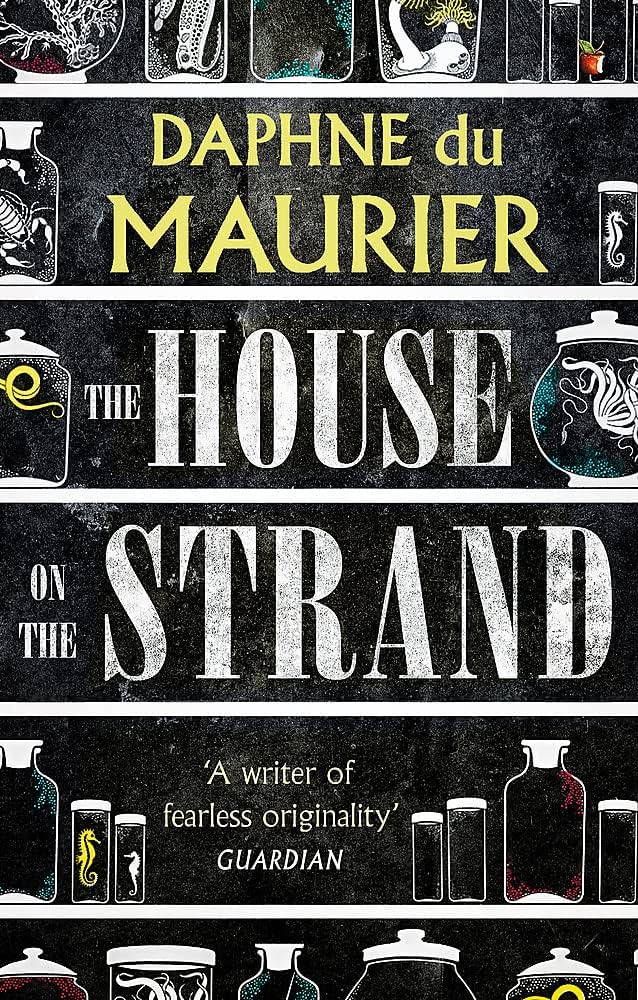
The House on the Strand [1969] – ★★★★
“If you get bitten by the past…whether you’re historian, or an archaeologist, or even a surveyor, it’s like a fever in the blood; you never rest until you’ve solved the problem before you” [du Maurier, Victor Gollancz/Virago, 1969: 229].
The House on the Strand is a time-travel novel, but because at the helm is none other than author Daphne du Maurier, it is far from being one’s usual, run-of-the-mill sci-fi fantasy. The premise is intriguing: Dick Young is a forty-something married man working in publishing who decides to spend his holidays at the house of his friend, Professor of Biophysics Magnus Lane. The house, Kilmarth, is in beautiful Cornwall, overlooking the sea, and Dick is awaiting the arrival of his wife Vita and his two stepsons from the US. Meanwhile, Magnus asks Dick to ingest his most recent research discovery: a potion that apparently transports a person to…the past. Dick should be thinking about his family, his new career option and his holiday, but instead, taking this drug, he becomes addicted to a different reality opening to him, to past events that happened in Cornwall in the 14th century and that involve political intrigues, adultery and a possible murder. But how safe is this potion drug that Dick is taking? And what could be the consequences of stepping into another world and gaining its secret knowledge?
Like du Maurier’s literary masterpiece Rebecca, The House on the Strand revolves around one manor house – this time –Kilmarth in Cornwall, where du Maurier spent the last days of her life. Thus, the novel is as much an exciting fiction story about time-travel as it is a tribute to this house and to the region’s beauty, history and mystery. The novel was also written at the height of the 1960s “drug culture”, and du Maurier portrays the realm that Dick encounters while taking the drug with much accuracy and vividness. The effect of taking such drug as LSD or having a completely lucid dream is often having one’s senses heightened, including smell, eyesight and hearing, and this is exactly what Dick experiences while on this new drug offered by Magnus. He has a “reality more vivid than anything”, being under “the blurred intoxication of a dream”. Suddenly, the ordinary world of Magnus full of responsibility towards his adopted children and care for his wife Vita is uninteresting and bland, and the new world of the past offered by Magnus is colourful, exciting and inviting. Who can resist this trip? Soon, Dick’s marriage to Vita is more of an obstacle to overcome, rather than a pleasant state to enjoy, and his Cornwall holiday could be said to be “hijacked” by this secret mission proposed by Magnus.
Dick’s guide to the past is Roger, a steward to Sir Henry Champernoune and owner of the 14th century mansion Kilmarth, and, through Roger’s eyes, Dick is introduced to and observes the past, which largely concerns beautiful woman Isolda and the hardship she suffers, including the turmoil concerning her secret lover, the betrayal and the struggle for power among her people. Isolda is soon adrift in the cruel world, and Roger emerges as her unlikely protector. Despite a series of truly fantastical, improbable elements of the story, du Maurier still manages to suspend our disbelief, handling the more bizarre elements concerning the nature of the drug elegantly in her story, and effortlessly dramatising the improbable scenario. The convincing first-person narration truly grips, and the story also unfolds on the strength of the intriguing relationship between the two men – dominant “mad scientist” Magnus, largely absentee, and submissive and willing experimental “guinea pig” – Dick. It is when Dick starts confusing the past with the present, and his fears about Isolda’s future starts to spill out into his own present life, that the real trouble starts to brew.
Despite its wondrous narrative pull, however, The House on the Strand has ideas just enough for a short novella, rather than a fully-fledged novel, and its narrative leads to an anti-climax of a sort, with little connection felt between the two parallel stories told (that of the past and the present). Moreover, as a main character, Dick Young grows more unlikeable and unsympathetic, perhaps intentionally so, and to the story’s “rescue” again comes the convincing portrayal of the male relationship and du Maurier’s insights into Dick’s mind that is increasingly like a mind of a gambling addict who suddenly relegates his family and relationship duties to a dusty shelf and craves the wonders of his new game – the observation of Cornwall’s past through Magnus’s new drug.
💊 The conclusion is that The House on the Strand may not be in the same league as du Maurier’s most famous literary accomplishments – novels Rebecca and My Cousin Rachel, but it is still a novel of much conviction and character insight, rendered in du Maurier’s beautiful prose. It falls into the category of much quieter, more introspective, but no less sophisticated, works by the author, among which are The Scapegoat and the author’s short stories. Daphne du Maurier was a master of concocting dreamy literary landscapes, permeated with nostalgia, romance and one-of-a-kind “unreality”, where the characters pain for the past, but still dream of a brighter future, and The House on the Strand is yet another memorable literary journey to uncover the events of England’s forgotten past.


Great review, Diana, of a book I also found VERY intriguing. Definitely one of the most interesting time-travel novels out there.
LikeLiked by 2 people
I’ve been meaning to read this for ages! It does seem to have some drawbacks but the premise is irresistible
LikeLiked by 1 person
Good review!
LikeLiked by 1 person
I loved this one – the two timelines were so vivid.
LikeLiked by 2 people
I need to keep exploring her. My latest by her was Jamaica Inn. Very impressive as well.
Thanks for your great review
LikeLiked by 2 people
This sounds so interesting! Du Maurice really explored so many genres and ideas in her writing.
LikeLiked by 1 person