
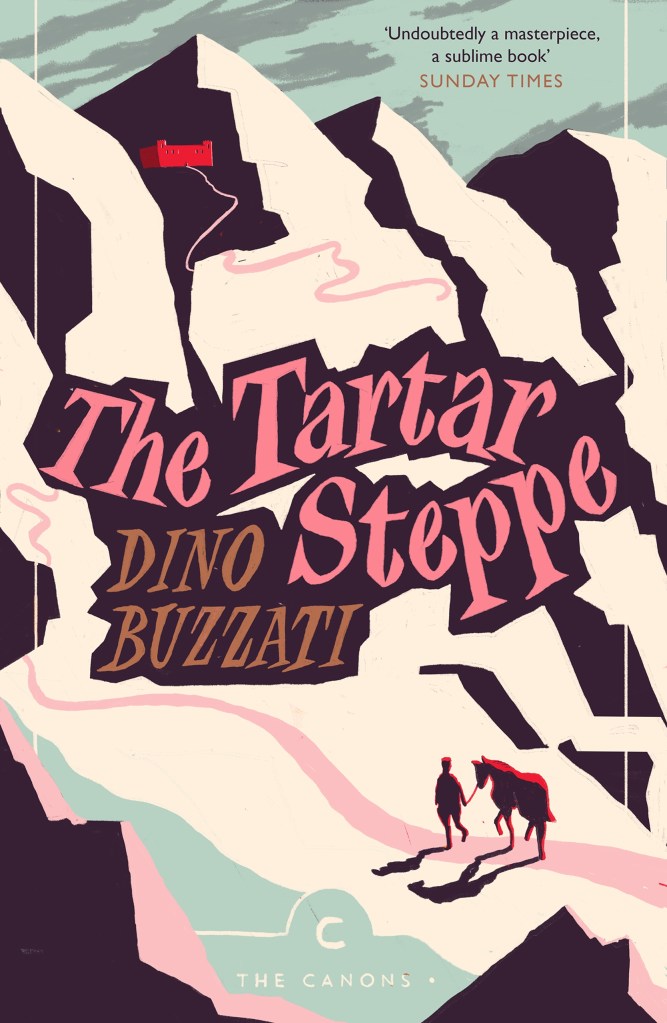
The Tartar Steppe [1940/2018] – ★★★★1/2
First published in 1940 and translated from the Italian by Stuart Hood, this novel is about young and idealistic Giovanni Drogo, a newly appointed Officer to Fort Bastiani, an obscure mountainous place near the country’s frontier. Drogo is excited about his first posting and hurries to his destination eagerly wanting to put to the test his soldiery skills, valour and discipline, as well as begin his new life. However, what awaits him is the unexpected: “the desolate steppe…which had mystery, but no meaning”, where “people [have] no knowledge of time” and where “everything [speaks] of renunciation” [Buzzati/Hood, 1945/1973: 22, 72, 82]. Fort Bastiani is a place in the middle of nowhere where no enemy has been seen since the time immemorial. Drogo soon feels rebellious, then depressed and lonely, and is finally completely enchanted by nothingness.
The Tartar Steppe is a masterful and subtle work which echoes the best work of Franz Kafka. It is a story about the traps that time lays to a man, about dashed hopes and missed life opportunities, and is a profound meditation on prisons that reside in the recesses of our own minds, in our beloved habits and dear ideals which we can never seem to cast aside no matter how nonsensical they may start to appear.
As Drogo arrives to his mysterious outpost in Buzzati’s story, thin comparisons can be drawn with both Gabriel Garcia Márquez’s No One Writes to the Colonel [1961] and Antonio Di Benedetto’s Zama [1956], with the latter especially since it also involves a stranded soldier. In these two works, one can also find the same themes of longing for something grand and the weight of unrealised potential and constant wait pressing on one’s shoulders. There is some kind of an existential crisis and despair growing from the incapability of facing one’s uselessness and stagnation. Very similar to Kafka’s work, especially to his story The Castle [1926], from the very opening pages of The Tartar Steppe, we are in the world of immense uncertainty, hidden hostility, and barely perceivable oppressiveness and claustrophobia. Individual will and freedom are being slowly eroded under the auspices of law, order and bureaucracy.
Before his arrival to Fort Bastiani, Drogo was an ordinary young man in love with life and everything youth can offer: the laughter of beautiful girls, the camaraderie of best friends and a sense of some glowing adventure awaiting somewhere in future. But, at Fort Bastiani, we are soon in the realm of a much darker and lonelier way of life. All sorts of absurdities start to emerge, including a well-equipped army being terrified of one lone horse. There is a sad pathos in the emerging situation of a young, well-prepared and brave soldier with his horse and sword ready to do battle and having no enemy to fight against; no enemy, that is, for a very, very long time. The loneliness and uselessness pain like nothing else and soon virtually everyone at Fort Bastiani imagine all kinds of things and their imagination give rise to all kinds of beliefs. Strange characters also people Drogo’s new posting place, such as Lieutenant Tronk and his obsession with useless regulations and Fort’s tailor who appears to be deluded and set to recreate the legend of Sisyphus.
🐎 The Tartar Steppe may just be a tad too quiet and aimless, and there is this impression that Buzzati might have tried different scenarios in his story and was not altogether sure which one would work so he included them all. Still, the author conjured up one uncanny world in his book, and the story, coupled with its bleak, but poignant ending, becomes deeply contemplative, Kafkaesque and unforgettable.
 Thoughts on Papyrus
Thank you – I’ve been circling this one for a while and I’m convinced I need to read it now!
LikeLiked by 2 people
OMG, I so enjoyed this one when I was a teen, maybe time to revisit it!
LikeLiked by 2 people
I thoroughly enjoyed this one — so much that I watched the solid Italian film adaptation The Desert of the Tartars (1976) with French actors Philippe Noiret and Jacques Perrin.
LikeLiked by 2 people
I absolutely LOVE “Zama” by Di Benedetto, so this sounds like another novel I need to read. I’m off to locate a copy! 🙂
LikeLiked by 2 people