


Five Points: The Nineteenth-Century New York City Neighborhood That Invented Tap Dance, Stole Elections and Became the World’s Most Notorious Slum [2002] by Tyler Anbinder – ★★★★
I love reading about the history of New York City, for example see my review of Mark Kurlansky’s The Big Oyster: A Molluscular History of New York [2006]. In Five Points, Tyler Anbinder focuses his attention on once the most notorious area in New York – the infamous Five Points, once a densely-populated, poverty, crime, riots and disease-ridden area. The area, which was once a green place with a lake called “The Collect Pond”, became by the end of the eighteenth century “a putrid nuisance” (due to local industries’ contamination) [Anbinder, 2002: 14] and, later, a place to be feared and ruled by criminal gangs. However, what became a place of danger for some, also turned into a place of fun and unthought-of opportunities for others. This non-fiction book is a very detailed account of the history of Five Points in the nineteenth century. Through documents, contemporaries’ accounts (each chapter starts with a “personal story” prologue), maps, graphs and old photographers, the author shows how Five Points gained such a vile reputation around the world and what made it so different from other New York neighbourhoods.
The book is divided into fourteen chapters: (i) The Making of Five Points, (ii) Why They Came, (iii) How They Lived, (iv) How They Worked, (v) Politics, (vi) Play, (vii) Vice & Crime, (viii) Religion & Reform, (ix) Riot, (x) The Civil War & The End of an Era, (xi) The Remaking of a Slum, (xii) Italians, (xiii) Chinatown and (xiv) The End of the Five Points. Tyler Anbinder begins his story of Five Points around 1825 when this already- growing-in-business area of New York had began to be populated by menial and immigrant workers. It was slowly turning into a centre for prostitution, too and became “a slum in the very centre of the city” [Anbinder, 2002: 20], because of its central location and immense overcrowding.

The author writes how first predominately German, Irish and Jewish immigrants slowly began to concentrate on their own blocks around Five Points, either fleeing famine in their home countries or just looking for money and opportunities they simply did not have at home. Anbinder emphasises the terrible conditions and unbelievable overcrowding in wooden and brick tenements at that time: “Five Points’ unusually high population density resulted not merely from landlords’ greed but also from the custom of some tenement dwellers to sublet space in their apartments to non-family members” [Tyler Anbinder, 2002: 77]. We really get the sense of some day-to-day challenges of living in pre-Civil War tenements in New York: the round-the-clock noise, filth and extremes of cold and heat. The work of Five Pointes was mostly on a lower scale. They were tailors, shoe-makers, peddlers, seamstresses and day labourers. Many children were fruit and corn sellers, newsboys and sweepers. It was interesting to read about The Old Brewery, once the cheapest renting space in the city that was proclaimed to be “the wickedest house on the wickedest street in New York”. It was a windowless, dark, filthy and labyrinthic place that, thankfully, existed only until 1852. After the Civil War, there were some attempts at renovation and tenements’ improvement, but still in 1873 the Mulberry Hall also got its reputation of a particularly awful place to live in: “Tenants [there] died so frequently that the Board of Health ordered the building to be vacated in November 1871” [Tyler Anbinder, 2002: 353]. The increasing wretchedness of what became known as “Mulberry Bend” had a death rate of “about 50 percent above the citywide average” [2002: 354].
The pastime of Five Pointers included bare-knuckle boxing, dancing, bowling, gambling and attending theatre, musical venues and saloons in the Bowery area. Tap-dancing evolved here, as well as two subcultures: the Bowery B’Hoys and the “sporting men”.
“Five Points had more fighting, drinking, and vice than almost anywhere else; but also more dancing and nightlife, more dense networks of clubs and charities, and opportunities both small and large for those who seized them. With its energy, brutality, enterprise, hardship, and constant dramas, Five Points was an extreme case, yet still a deeply American place” [Tyler Anbinder, 2002: 37].
Then, in the 1870s there was a rapid increase in the Italian population in the area: “Unlike Irish Five Pointers, who had quickly embraced American foods upon their arrival in America, Italians chose to bring their culinary staples with them” [Tyler Anbinder, 2002: 368]. I thought the book was particularly good in explaining attitudes and complex demographical situations of immigrants – “the uneasy ties between Five Pointers’ various ethnical groups” [2002: 394]. Italians started to replace Irishmen in many menial trades, including selling fruit and grocery, an image which still persists in New York. In 1880, when the Chinese population had also started to increase in the area, they took jobs in either tea trade, or were sailors, cigars sellers and peddlers. From this time, there was also an increase in purely Chinese establishments, such opium dens.
Tyler Anbinder writes how the end of Five Points was hastened by the razing of the worst tenements, by the end to mass immigration and by some “cleaning-up” reforms. Although the Five Points area in the city is no longer a filthy slum, the author writes that “life is still the same”, “immigrant street vendors are everywhere”, “food is still the most popular item for sale on the streets “, “ethic mixing” is prevalent and even ethnic tensions are still apparent [2002: 439, 440]. Italians have now dispersed throughout the centre and Chinatown has tuned into “an entertainment zone”.
Five Points maybe a book which is a little on a dry side and may contain too much detail, as well as some repetition, but it is still an exciting account of one unique historic place in New York where debauchery and crime gangs, including the Bowery Boys and Mulberry Boys, operated alongside immense opportunities, immigrants’ hopes and all kinds of innovations.
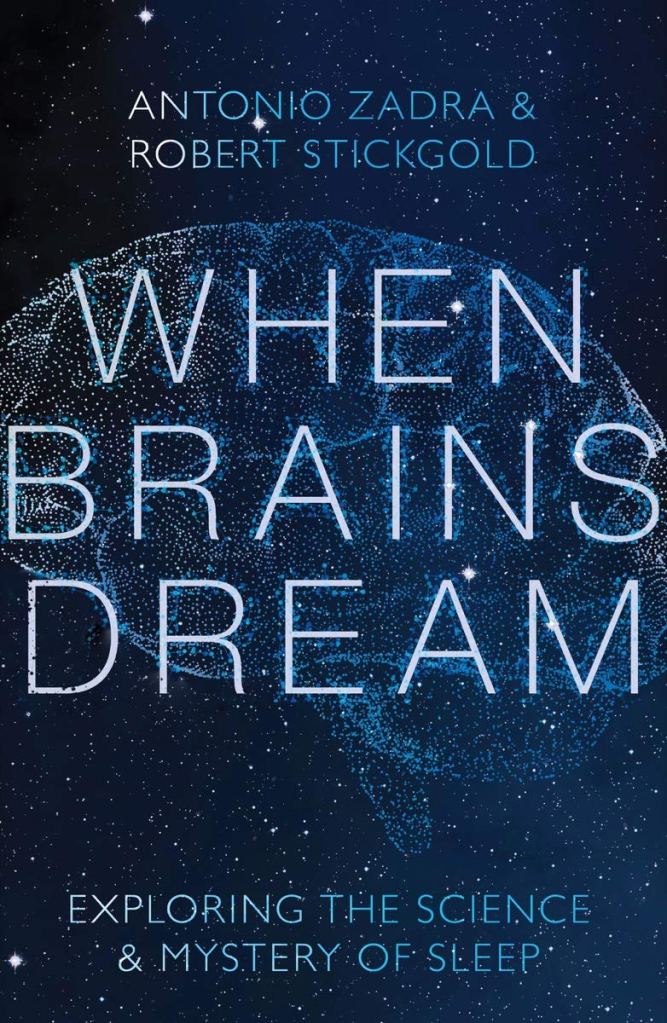
When Brains Dream: Exploring The Science & Mystery of Sleep [2021] by Antonio Zadra & Robert Stickgold – ★★★
This book was one of my most anticipated reads of 2021. In this book, the authors, Professors of the Université de Montréal and Harvard Medical School respectively, have a goal to explain the “dreaming brain” and start with the early research into dreams done by some Greek philosophers before talking about the dreaming theories of Freud and Jung. The authors then go on to explain REM (rapid eye movement) sleep and the discovery of it by Aserinsky and Kleitman in 1953. What follows are the explanations of some well-known theories about dreaming, for example those that relate to (i) memory; (ii) evolutionary advantage (“role-play”); (iii) problem-solving; (iv) creativity and (v) emotions. Antonio Zadra and Robert Stickgold then move on to sleep disorders in their book, talking about narcolepsy and sleep paralysis. The major issue in these book sections is that they are filled with too many obvious statements that could have been edited out. There are so many of these obvious statements in the book that it often reads like a sleep and dream manual series for “complete dummies”. For example, I certainly did not pick up this new book to find out to my “amazement” that “our brain and mind never rest” [Zadra/Stickgold, 2021: 270], that “just about everyone dreams”, that “the Frozen characters Olaf and Elsa don’t dream” [2021: 82] or that “absence of dream recall clearly is not proof of the absence of dreaming” [Zadra/Stickgold, 2021: 52], but that is what I found inside. The authors constantly refer to some future chapters in the book, and, most probably, an up-to-date college textbook on psychology may provide a more interesting and insightful overview of the topic.
I lucid-dream spontaneously since childhood and consider lucid-dreaming (a state where a person is aware that he or she is dreaming while having a dream) to be very important to our understanding of dreams and consciousness, but the problem is that the authors hardly offer any explanation of it or talk about its causes at length; rather, they offer some techniques of how to start lucid-dreaming, techniques which belong more inside some new age self-help books, rather inside such a serious non-fiction book as When Brains Dream penned by two eminent Professors. (Accurate) dream recall and vividness of dreams are important for the development of lucid dreaming (I have always had both), but from my own personal experience and side I can also suggest monitoring one’s thoughts during the day, day-dreaming (within reason, of course), connecting with one’s inner self (interpret this as broadly as possible) and becoming more aware of one’s feelings during the day. Some insight into lucid dreaming the authors nevertheless give: “When brains dream lucidly”, they write, “frontal regions that are associated with self-reflective awareness during waking, but that are normally turned off during REM sleep, become more active” [Zadra/Stickgold, 2021: 233].
Finally, Professor Zadra and Professor Stickgold offer their own theory into the nature of dreaming in this book. The so-called “NEXT UP” theory “suggests that the function of dreaming is to explain the past and predict the future, to discover what’s next up in our lives. This is the brain’s task while we dream” [Zadra/Stickgold, 2021: 269, 270]. To achieve that “the dreaming brain attempts only to show us what has been and what might be”. It shows us that we cannot yet fully explain [Zadra/Stickgold, 2021: 270]. The researches then note “dreaming is a unique form of sleep-dependent memory evolution, one that extracts new knowledge from existing information through the discovery and strengthening of…often previously unexplored associations” [Zadra/Stickgold, 2021: 271]. Of course, they cannot prove that empirically in any way, but this theory sounds logical, even if “limiting”. Undoubtedly, our brain works ceaselessly during the night, processing events from our lives, sorting memories, calculating, thinking, trying to come to terms with either unpleasant events or come up with internal solutions, etc. Perhaps, the dreaming brain really tries to predict the future and open our minds to the multitude of possibilities open to us in real life through the finding and presentation of new opportunities by the process of imagining, cataloguing, eliminating and making (unlikely) associations, but, is it ALL that it does? Knowing how complex our brains are, the explanation is a little simplistic and probably our brain does a million other things besides while we sleep, and dreams have a mountain of other reasons we cannot even imagine. The Professors’ theory seems be an “easy way out”, too. The researchers claim that their theory is new and inventive, but it is not – it is a mish-mash of other existing theories all put together – memory, evolutionary (the researchers’ “memory-evolution”) and maybe even Freudian theories (researchers’ “associations” wording).
Though When Brains Dreams is an engaging account of a dreaming brain that summarises well the research in this field so far, the book is also laden with obviousness and, unfortunately, focuses too much on the “why” question, as opposed to the “how” issue. The “relaxed” style of the book baffles, rather than says something insightful or concrete about dreaming, and the researchers’ own theory into dreaming is hardly something more than a clever “conglomeration” of all the others.

Year of Wonder: Classical Music for Every Day [2017] by Clemency Burton-Hill – ★★
Despite Year of Wonder‘s noble intention to enthuse people with classical music, the book comes across as misguided and superfluous.
Clemency Burton-Hill, an author, broadcaster and journalist, has one of the most wonderful and “noble” intentions regarding this book. Through it, she desires to show her readers just how varied, beautiful, inspiring and life-changing classical music can be. This is a splendid goal, and Burton-Hill presents 365 classical pieces for each day of the year in her book, with the chosen pieces ranging wildly in style and stemming from all kinds of composers. Apart from distinctively classical compositions, the author introduces religious music, traditional songs (from Indian to Danish), film scores, modern minimalist music and jazzy pieces. At one end of the spectrum we have such big names as Purcell, Lully, Scarlatti, Tallis, Bach, Mozart and Beethoven, etc., at another – such composers as Vivaldi, Wagner, Tchaikovsky, Shostakovich, Rachmaninoff, Brahms, Ravel, Smetana, Sibelius, Strauss, Chopin, Satie, Saint-Saëns, Ligeti, etc., and yet at another – Bernstein, Morricone and Glass. The author is to be applauded for including many women composers in her book, including Hildegard of Bingen (1098 – 1179), Isabella Leonarda (1620 –1704), Florence Price (1887 – 1953) and Germaine Tailleferre (1892 – 1983). Overall, the selection of musical pieces is good, though sometimes odd and hardly introductory to classical music.
The main problem with this book is that Burton-Hill also provides the most annoying commentary to her chosen pieces. The author is definitely very passionate about classical music and genuinely wants to share this passion with others, but she may be said to go completely “overboard” with this desire. Her commentary beneath each chosen musical piece is in a strange diary-like format where she mixes weird Wikipedia-like trivia about composers with some dull biographical information about her own life. We read where she first heard this or that musical composition (or about it) – at her friends’ wedding, at a Christmas party, on a tube, etc., and what an amazing impact it had on her, helping her to get over a break-up or through a washing time. We read what a particular piece of music did to her insides at page 260, and every single entry ends on something similar to this line – “I hope you fall as hard for it as I did” [2017: 83].
Clemency Burton-Hill also uses language that more annoys, than informs or inspires her readers, writing constantly phrases like “this is something else” or “stay tuned”. There is a line between admiration and sincere praise, on the one hand, and incessant fanaticism, on the other, and the author leans to the latter, with the result being that her undying and absolute love for each and every piece and composer becomes exasperating to read. Surely, we all know how amazingly great Bach or Mozart were, but phrasing it this manner “Bach’s brain was…supercomputer” or “Bach was the daddy” [of everything in music] [2017: 11] is beyond cringeworthy. Her other entries are hardly helpful, for example, on page 26, for 16 January, we have Etude in C Sharp Minor, Op. 2 No. 1 by Alexander Scriabin (1872 – 1915) and this description beneath it: “Look sometimes what we just really need in the middle of January is music that feels like a large glass of red wine”….then the author adds “with sincere apologies to non-drinkers or those attempting a Dry January”. Similar weird and toe-curling attempts at lightness and humour pervade this book as the author later also “advertises” French and Brazilian cocktails.
🎻 Going further, I have to say that I have never in my life read such a brazen and inconsiderate portrayal of Pyotr Ilyich Tchaikovsky’s life and death as I read in Burton-Hill’s book, and her degrading description of Alexander Pushkin’s death is beyond insensitive. I understand and appreciate “reader-friendly” language and material which is “fun to read”, but there is got to be some limit to it at least sometimes. Burton-Hill writes on a Glinka piece: “Pushkin, by the way, had been intending to write the libretto, but unhelpfully got himself killed in a duel with his brother-in-law after the latter attempted to seduce his wife” [Burton-Hill, 2017: 180]. Only a person who has not the slightest respect for this greatest of all Russian poets or who has absolutely no idea about the state of the duel practice in Russia in Pushkin’s time could have written something like this. I do not even know what is worse in Burton-Hill’s sentence, the passive tense hint [“got himself”], that can be read as both “objectifying” the poet and somehow blaming him for the duel position he found himself in, the word “unhelpfully”, which seemingly puts a libretto above Pushkin’s life, or the generalisation “the latter attempted to seduce his wife”.
 Thoughts on Papyrus
Since I don’t read very much non-fiction these days, I’m afraid I was primarily interested in only one of your three books, Burton-Hill’s Year of Wonder. It’s an interesting, if a little gimmicky, idea to center an introduction to classical music around the calendar, highlighting a piece for each day. I was getting ready to add this one to my TBR until I finished reading your discussion; like you, I’m afraid I’d just find it too irritating to handle. It’s a shame, because so many people are intimidated by classical music and good, non-technical introductions are really helpful.
Did you ever read Alex Ross’s All the Rest Is Noise? It’s a great introduction/overview of 20th century classical music. A much older introduction (the one I first used), which covers the earlier time periods is Ethan Mordden’s Guide to Orchestral Music, which includes piano concertos and composers like Bach. As for opera, well I still have my old copy of Phil Goulding’s Ticket to the Opera: Discovering and Exploring 100 Famous Works, etc., which I relied on pretty heavily at the start of my opera going days. It’s a little hokey and tries a little too hard to counter opera’s elitist image but it’s surprising
informative and useful.
LikeLiked by 2 people
I just could not believe what Burton-Hill was writing in her “commentary” to musical pieces. If anything, her “descriptions” put me off some pieces completely. I am all for non-technical introduction to classical music and opera, as you put it, but I really believe that constantly repeating “how I love this!” without giving any insight or repeatedly “hey-buddy” rapping about composers, that actually demeans them and their memory, is not really a way forward. Her commentary can only be twitter-worthy at best. The only thing I seemed to have learnt from the book it is that opera Eugene Onegin helped the author to get over her first love break-up…Interesting…for some, I am sure.
Thanks a lot for bringing to my attention these wonderful books! No, I have not read The Rest Is Noise and am adding it now to my TBR, thanks! I am sure Ethan Mordden’s book has none of the nonsense which made Burton-Hill’s book so annoying. Ticket to the Opera sounds interesting, too. I actually have a similar book which was published in Russia and in Russian language called “100 operas”, with story descriptions, themes and certain other details. I have also already used it extensively.
LikeLiked by 1 person
Burton-Hill can be equally irritating as a broadcaster, so what a waste of an opportunity this volume was. I shall avoid it like the … Coronavirus. In fact all three titles seem to have been a bit of an uphill struggle for one reason or another though Five Points seems to have been the best of the bunch.
LikeLiked by 1 person
Thankfully I am not as familiar with her as a broadcaster, but I can imagine. Yes, Five Points was the best read. There is a lot of unbelievable but true historical information about Five Points, so I guess the book almost wrote itself!
LikeLiked by 1 person