


The Japanese: A History in Twenty Lives [2020] – ★★★★★
In this new book, Dr Harding traces the history of Japan through the lives of twenty remarkable people that helped to shape the country, making a powerful impact on either its politics, business, religion, science, culture or just society at large, and – more often than not – against all odds and in very challenging times. From heroic personalities from mythology and ancient politics to people who changed business, music or literary scene, the author introduces each extraordinary individual in turn, focusing on their childhood, on Japan of their time and on their contribution to the country, with the result being that Japan finally became what it is now – a culturally rich country full of so many paradoxes, intricacies and hidden treasures that a lifetime will not be sufficient to know and understand them all. In this book, we get to know royalties, warlords, samurai, Buddhist monks, politicians, businessmen, scientists, poets, singers, revolutionists and Manga creators. Dr Harding’s book is a history of Japan in a bright new form that is a pure pleasure to read.

From the ancient era, Dr Harding talks about the legendary Prince Shotoku (574 – 622), who is “celebrated as [the] state’s founding father” [2020: 23]. He was the very first to see “beyond Buddhism’s ritual potential and appreciate its philosophical depths” [2020: 29], and laid down Nara as the new Imperial capital. Allegedly, the Prince was also the one responsible for the archipelago’s first Constitution [2020: 30], a document that stressed harmony and good faith, as well as renewed contact with China.
From the modern era, there is the “God of Manga” Tezuka Osamu (1928 – 1989), who was the legendary creator of the equally legendary boy-robot “Atom”, and who lived through the 1960s technological and economical boom. Inspired by Disney, Osamu opened his own production company in time, taking his Manga creations to the big screen. However, his heart always remained with his vision of making children think critically and be inspired creatively. “Tezuka himself was…interested in presenting children with the varied challenges of adult life – the fear, misunderstanding and discrimination” ; “too many people [according to Osamu] lived as though they were “programmed” to obey” [Harding, 2020: 359].
This is the list of all twenty celebrated people presented in the book:
- Himiko [c. 170 – 248] – Shaman Queen – Himiko was a mythical Queen of the realm Yamatai before there was such a country as Japan. Regarded by the Chinese as the shaman of extraordinary power, Himiko was a fierce leader before the existence of any any war lords and was able to unite her people and lead them to prosperity through metallurgy and rice cultivation.
2. Prince Shotoku [573 – 621] – Founding Father
3. Emperor Kanmu [737- 806] – Boundary Pusher
4. Murasaki Shikibu [c. 973 – unknown] – Court Reporter – This aristocratic diarist and lady-in-waiting created the world’s first novel – The Tale of Genji.
5. Hojo Masako [1157 – 1225] – The Nun Shogun
6. Shinran [1173 – 1262] – Power to the People
7. Zeami [1363 – 1443] – Master of Arts – A prolific Noh actor and playwright, responsible for such famous Noh plays as The Well-Cradle and Wind Through the Pines. He helped to elevate the traditional Japanese theatre into pure art through his attention to details, philosophy and aesthetics.
8. Oda Nobunaga [1534 – 1582] – Unity or Else
9. Hasekura Tsunenaga [1571 – 1622] – Voyager
10. Ihara Saikaku [1642 – 1693] – Amorous Man
11. Sakamoto Ryoma [1835 – 1864] – Revolutionary
12. Kusumoto Ine [1827 – 1903] – Building the Body
13. Shibusawa Eiichi [1840 – 1931] – Entrepreneur – Shibusawa was the “father of Japanese capitalism”. “His great aim in life was to elevate the business of doing business, liberating it from the old samurai contempt for merchants while avoiding the reputation for greed and selfishness that commerce acquired in some quarters of the West” [Harding, 2020: 241].
14. Tsuda Umeko [1864 – 1929] – Culture Shock
15. Ikeda Kikunae [1864 – 1936] – Taste-Maker
16. Yosano Akiko [1878 – 1942] – Poet of Peace and War – “Yosano made her name creating poetry for a generation of young women who aspired to a more than the sorts of marriages memorably described by Hiratsuka Raicho as slavery during the daytime and prostitution at night” [Harding, 2020: 300].
17. Misora Hibari [1937 – 1989] – Starlet
18. Tezuka Osamu [1928 – 1989] – Dream Weaver
19. Tanaka Kakuei [1918 – 1993] – Shadow Shogun
20. Owada Masako [1963 – present] – Uncertain Symbol – Amidst the late twenty century’s social problems of Japan, including overwork, and rising cases of depression and suicide, emerged “educated, progressive and cosmopolitan” Empress Owada Masako, once a brilliant, intelligent girl who set aside a promising career at Japan’s Ministry of Foreign Affairs to wed Prince Naruhito of Japan.
I particularly enjoyed reading about certain Japanese women and the mark they made in Japanese history:

Tsuda Umeko, born in 1864, was brought up as a typical American girl in Washington D.C. However, she got to America only because of one Japanese government’s regulation that stated in 1871 that a number of Japanese girls and boys of around six years of age would be sent to the US to be educated. Tsuda was one of those girls. Upon her return to Japan in 1882, she hardly recognised her country of origin. Women in Japan had very few rights and girls were forced early to arranged marriages, “living effectively as their husbands’ maids”. [Harding, 2020: 267]. While Tsuda Umeko received good education in the US that focused on such subjects as politics, science, literature and languages, the girls’ education in Japan was focused on needlework, cooking and etiquette.
Tsuda felt “useless” upon arriving to Japan and no employer wanted to employ her in a serious position. However, she was determined to do something about it: she published a book Japanese Girls and Women [1891] with Alice Mabel Bacon, that talked about the problem and provided solutions, including more challenging education for girls and more equal marriages, and opened her own school Joshi Eigaku Juku (Women’s English School) in Japan in 1900, which schooled girls in such subjects as English composition, literature and translation. “Current affairs were discussed in class…and students were encouraged to reflect on the status of women around the world” [Harding, 2020: 271]. Tsuda wanted every girl and woman to be independent and confident in their thinking and future. Her school received even more funding and became popular, even in the increasingly difficult political climate. Tsuda “pioneer[ed] a form of education that blended Japanese with Western values, shaping women who did not have to ask for respect because they commanded it” [Harding, 2020: 277]. Tsuda Umeko died in 1929 and her school was eventually renamed in her honour.
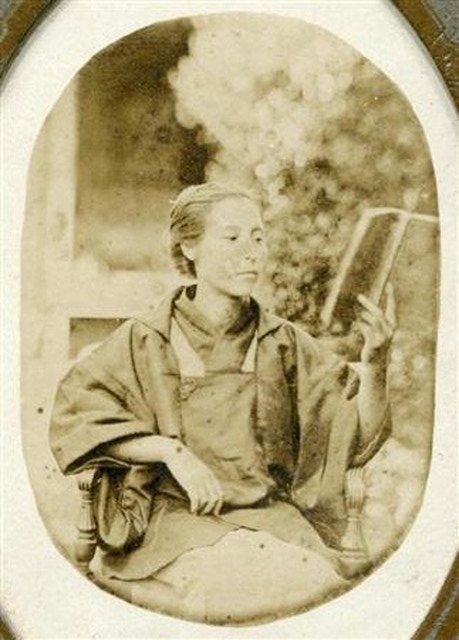
Kusumoto Ine (1827 – 1903) is “a woman with a strong claim to be Japan’s first female doctor trained in Western medicine” [2020: 217], writes Dr Harding. The daughter of famous Prussian physician and scientist Philipp Franz von Siebold, Kusumoto Ine was a “bibliophile from childhood” and chose medicine as her profession from a very young age (thirteen or fourteen), deciding to specialise in midwifery/obstetrics, as this was considered to be one of only a few medical professions “appropriate” and still open to women. Ine proved to be a brilliant midwife with deep knowledge of the procedure, related science and anatomy, eventually delivering some of the Emperor’s children. In 1870, Ine established her own clinic in Nagasaki and later in Tokyo. Though she later witnessed Western medicine being adopted freely across Japan’s official medical system, she felt more and more excluded from the profession due to the changing perceptions about women, their capabilities and societal roles in the country.
🎎 The Japanese: A History in Twenty Lives packs a wealth of exciting information about Japan, its history and culture. The author present Japan’s history in the most engaging and story-like manner, and the book really becomes a “must-read” for all those who want to understand Japan in any depth.
 Thoughts on Papyrus
Fascinating! Thanks for this recommendation, I’ll put this book on my TBR!
LikeLiked by 1 person
Ooh, sounds so good, adding to my list right away! Thanks for this gem
LikeLiked by 1 person
This sounds so interesting! I would love to know more about these incredible people.
LikeLiked by 1 person
This sounds really fascinating. I know very little about Japanese history, and learning about it through people who made major contributions is a much more interesting approach than the usual narratives. I read a book on the Georgian era last month which had taken a similar approach. Adding this to my list
LikeLiked by 1 person
It is really good, thanks for the comment and I hope you like it! I love non-fiction books that stand out from the crowd in some way. This one definitely has an original structure. Even though I did know some Japanese history and culture, and about some notable Japanese people, there were so many things in this book that were completely new to me and I thought it was pretty impressive that the author chose to focus on more “obscure” famous people like Kusumoto Ine rather than on those that are already familiar to the westerners, for example, Hokusai.
LikeLiked by 1 person
I will look this one up for sure; I like the focus on lesser known people, also the inclusion of women
LikeLiked by 1 person