
 The Mind in the Cave: Consciousness and the Origins of Art [2002] – ★★★
A chaotic and repetitive account on cave art and its origin, which is also not as insightful as one would have hoped, focusing primarily on shamanism and altered states of consciousness.
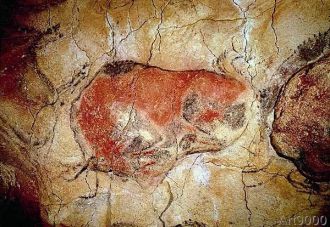
The Mind in the Cave is by David Lewis-Williams, a South African archaeologist known for his research into South African rock art, and, in his book, he describes the most breath-taking cave art from the Upper Palaeolithic Period (examples found in the Cave of the Trois-Frères, France and in the Altamira Cave, Spain), tracing the way people thought about cave art through the ages and trying to theorise on the question why Upper Palaeolithic people made such art and what it represented for them. Although the book is engaging, with interesting case studies and beautiful illustrations, it is also problematic and only sporadically informative on the question of consciousness itself – its origin and how this relates to the first known cave art.
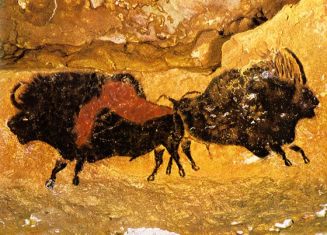
David Lewis-Williams makes it clear that art (as we define it now) started to appear in caves in the period of “Transition” (the period between 45.000 and 35.000 years ago), and it is during this period that Neanderthals gave way to Homo sapiens in Europe. The author also states that Neanderthals did not use their tools in such a diverse way as Homo sapiens, and did not borrow from Home sapiens such sophisticated rituals as certain burial techniques and image-making in caves. This is because Neanderthals possessed a different (inferior) “consciousness” capability. Thus, early Homo sapiens were the first ones to make “art” as we understand it.
All this is fascinating, but the author hardly touches on the topic of consciousness in these arguments, and approaches the topic from a rather odd perspective (it may be evident that he is no neuroscientist). It can be agreed that consciousness is a continuum, and that there are different levels of it, but, instead of focusing on self-awareness, memory, imagination or abstract thought as elements related to consciousness to explain first art-making, Lewis-Williams strangely talks about dreaming and its recall, which is a rather strange focus. The author’s musings on dreaming are also quite surprising as he provides certain explanations for dreaming as if they were undisputed facts, when, in reality, we still know very little why we dream and cannot say for absolute certain how the process of dreaming takes place. Lewis-Williams states categorically that dreaming is the product of a random neurological activity [2002: 123], without providing any evidence of this, and his explanation for dreaming does not take into account the simple fact that dreaming helps our learning or that we at times can find ourselves in a dream and are capable of controlling it (lucid dreaming).
Lewis-Williams’s other musings are even more startling. He states that altered states of consciousness can somehow explain cave art, which is an interesting thesis, but he also picks vivid dreaming and hallucinations as vital elements capable of explaining art, being capabilities of the first Homo sapiens (to which it may be replied that any cat can undoubtedly see vivid dreams, but it would not think of creating pictures of any animals on any walls). In that vein, Lewis-Williams does not attempt to answer the main question of the origin of consciousness when the first example of cave art appeared or elaborate on the link between the two (even though he clearly asks numerous times in the book this very question – how did human consciousness evolve?). To be fair, the author does venture an explanation for the consciousness origin by hinting that it might have evolved through a genetic mutation over a long period of time, but this is something little coming too late.
Lewis-Williams’s other statements and examples would have sounded clever if they were also not so obvious and overused. For example, he states “one cannot notice a presentational image in a mass of lines unless one already has a notion of images” [2002: 183], a rather self-evident “insight”, and produces as an example a much over-used and well-known allegory of the cave, without even stating that it was recorded by Plato (the only person referred to in the text is Socrates). The author’s other statements are as obscure and self-important-sounding as he undoubtedly wanted them to be – “art-making, if and when it appears, is an active member of a dynamic nexus of interdigitating factors” [2002: 73] (the author fails to clarify), and “art and cosmos united in a mutual statement about the complex nature of reality” [2002: 149]. Other unsupported statements also emerge in the book, including “body decoration could not have evolved into the making of two-dimensional images of animals on cave walls” [2002: 90], and the chaotic nature of the narrative is evident when one considers that Lewis-Williams jumps frequently in his book from topic to topic, debating altered states of consciousness and why sleep was necessary one minute, and discussing The Iliad and Shakespeare in the next [2002: 190].
🐂 The Mind in the Cave’s main problem is summed up in one sentence in Lewis-Williams’s book – “the fascinating issues of consciousness, self-awareness, introspection, insight and foresight… remain, and they are not a destination of our present inquiry and can be circumnavigated” [2002: 105]. Arguably, our logic and rationality dictate that this inquiry is actually essential to the topic. Overall, The Mind in the Cave provides a good overview of cave artworks found mainly in France, as well as of speculations as to why ancient people made those artworks (the author brushes off the idea that art may be made for art’s sake). The book contains Lewis-Williams’s social (shamanic) interpretation of the art found in ancient caves, but touches only very briefly and unsatisfactorily on the central question or mystery that is considered to be one of the main ones in science – how consciousness could have began and how cave art may shed some clues that lead to an explanation.
 Thoughts on Papyrus
What a shame that such an engrossing subject was missing the science of such an important subject. Terrific review, Diana!!
LikeLiked by 2 people
Thank you!
LikeLike
It sounds as though there was a lack of solid research behind the book?
LikeLiked by 1 person
Great review. I have long had a fascination with cave art (I have actually posted about it) and I have been meaning to read this book which I have long heard about, but I think I will give it a miss and stick with my Bataille.
LikeLiked by 1 person
Thank you! Yes, we do share many interests. Your blog I love the most!
LikeLiked by 1 person
Ah thank you. I am blushing. Can I send the link for the post.
LikeLike
Sure, thanks 🙂
LikeLiked by 1 person
https://cakeordeathsite.wordpress.com/2019/07/02/the-birth-of-art/
Tell me what you think.
LikeLiked by 1 person