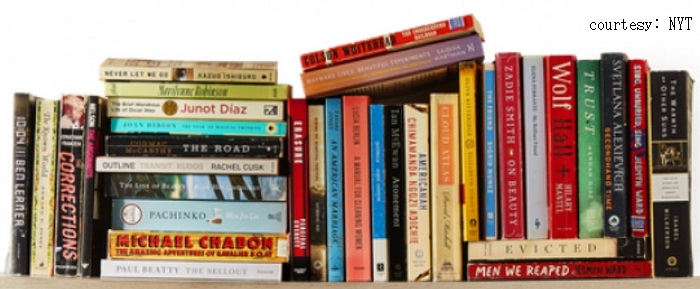
This summer, The New York Times (NYT) published list “100 Best Books of the 21st Century”, compiled from a survey of “hundreds” of novelists, non-fiction writers, academics, editors, journalists, literary critics, publishers, etc. (you can see the full list of the titles here since the original list is on the other side of the paywall). I am late to comment on this, but because I had to be absent from this site this summer, I thought I would do so now, since I also enjoyed reading takes on it over at The Book Stop and The Reader’s Room. I do understand all the drawbacks of such lists, and my point is not to put down any undoubtedly great books or authors featured on this list, but just comment (i.e. rant) on the list overall.
Continue reading “NYT’s Best Books of the 21st Century: Some Thoughts”Tag: book discussion
Nobel Laureates for Literature: My Stats & Preferences
To follow up from my post on the Booker & Pulitzer Fiction Prize winners, I have decided to do a similar discussion post, but this time focusing on the Nobel Laureates for Literature, providing below my stats and winner preferences (I read roughly 42 Nobel winners out of some 119). The Nobel Committee has at times been accused of being political in its nominations and awards, and it is also important to bear in mind that such renowned authors as Leo Tolstoy, Anton Chekhov, James Joyce, Marcel Proust and Vladimir Nabokov never, as preposterously as it may sound, actually won this prize. Nevertheless, I applaud the recent trend to recognise the achievements of women in literature (as Olga Tokarczuk and Annie Ernaux were awarded the prize in 2018 and 2022 respectively).
Nobel laureates:
who are my FAVORITE authors:
Thomas Mann, 1929:
“principally for his great novel, Buddenbrooks, which has won steadily increased recognition as one of the classic works of contemporary literature”.
José Saramago, 1997:
“who with parables sustained by imagination, compassion and irony continually enables us once again to apprehend an elusory reality“.
Orhan Pamuk, 2006:
“who in the quest for the melancholic soul of his native city has discovered new symbols for the clash and interlacing of cultures”.
Albert Camus, 1957:
“for his important literary production, which with clear-sighted earnestness illuminates the problems of the human conscience in our times“.
Kenzaburō Ōe, 1994:
“who with poetic force creates an imagined world, where life and myth condense to form a disconcerting picture of the human predicament today“.