

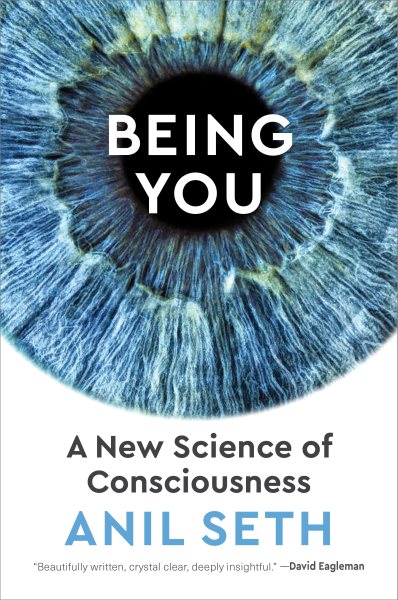
Being You [2020] – ★★★★
“The hint half guessed, the gift half understood…” T. S. Eliot
Consciousness is considered the “last frontier” of science, the deepest and most elusive of all scientific mysteries. It seems incredible that, although we explored the whole planet Earth (at least the land), built robots, and are now rolling out detailed plans to go to Mars, we still have little to no clue as what is really going on inside our own heads, and how our most primary function operates – our consciousness. Anil Seth, Professor of Cognitive and Computational Neuroscience at the University of Sussex, looks at a number of theories on consciousness in his book before proposing his own – consciousness is a form of “controlled hallucination”. Evolution made sure that we survived. It had no imperative to make sure that what we perceive in our daily life is, in fact, the true objective reality.
Anil Seth starts his book by saying that consciousness is simply a subjective experience – fair enough. He then details how some attempted to explain it using such theories as functionalism, panpsychism (consciousness is a natural property of the universe) and mysterianism (humans will never be “clever” enough to grasp the explanation for consciousness). The author then focuses on three aspects of consciousness – “conscious level”, measuring the degree of consciousness (being awake is not the same as being conscious), “conscious content”, which is about being conscious of sights, sounds, smells, emotions, etc., and “conscious self” – the experience of being a specific person having a subjective experience.
The book is quite illuminating when it discusses the measurement of consciousness, focusing on a
number of recent experiments. It has always been my belief that consciousness is not a switch on/off mechanism, but one that has phases and gradation. One can be minimally conscious, and overly conscious (certain drugs induce much more awareness than our everyday conscious states allow). It is also incredible that we, as humans, are “rendering ourselves” completely “unconscious” every night (as it happens in slow wave sleep) and do so for the majority of our lives, finding this perfectly normal (ah, the assurance of definitely waking up the next morning!). Professor Seth discusses the research of Marcello Massimini on electrical echoes that could be used to distinguish different levels of consciousness, as well as research by Giulio Tononi and Gerald Edelman, who observed that conscious experiences must be both informative (unique) and integrated (consciousness appears as unified scene).
After all that, Professor Seth finally comes to the main thesis of his book – the content of consciousness
is a kind of “waking dream”, a controlled hallucination. This rings true on an intuitive level. It seems we are presented with the very imperfect picture of the world outside, and perception is judgement and inference (Plato’s “Allegory of the Cave”). The author underlines that the brain is constantly making predictions of what it is supposed “to see/hear/sense” next based on many things, including sensory input, past behaviour, and expectations. In other words, relying on Helmholtz’s idea, we infer things, and the true nature of reality is hidden behind our sensory veil. There is a persuasive argument supporting this view which concerns colour – “colour is not a definite property of things-in themselves”, but in fact “the subjective, phenomenological aspect of the perception process”, says Professor Seth. Experiments that involve optical illusions support this theory.
“The entirety of perceptual experience is a neuronal fantasy that remains yoked to the world through a continuous making and remaking of perceptual best guesses, of controlled hallucinations.” Anil Seth
The rest of the book is somewhat predictable, maybe a tad too predictable, especially the chapter on machines filled with pop culture references and life vs. artificial intelligence debates, but still fun. The author tests his theory of perceptual expectations affecting conscious perception, and delves into the more trickier terrain of “the (volitional) self” being yet another perception, another controlled hallucination (“experiences of unified selfhood do not signify the existence of an “actual self”; “indeed the experience of being a unified self can come undone all too easily” (certain mental illnesses/drugs “untie” us from ourselves), Seth, Faber & Faber, 2020: 197). The last part of the book gravitates towards philosophy as opposed to science.
I have to admit that I am far less optimistic than the author when it comes to one day discovering what consciousness is. Professor Seth writes “as we get on with explaining the various properties of consciousness in terms of their underlying mechanisms, perhaps the fundamental mystery of “how consciousness happens” will fade away, just as the mystery of “what is life” also faded away” (Seth, Faber & Faber, 2020: 153). In my opinion, there is a whole lot of difference between explaining “life” (visible processes of a single cell observable by all, for example) and consciousness (an intensely subjective experience confined to one’s mind and, as studies have shown, subject to individual differences, expectations, presence of various substances, etc.) I also believe that the way forward to explaining consciousness is through the explanation of sleeping and dreaming (the latter being a getaway to the conscious processes) as in these states the brain mediates between unconscious and conscious processes, as well as creates, responds and in some cases is actively conscious of the experiences created (lucid dreaming), while also doing so without any external stimuli. Whoever discovers the secret of dreams will discover the secret of the brain.
Overall, the book’s theory intrigued me, not least because it relates to a question I have been thinking about (a form of mysterianism, perhaps) – how do we know that what we perceive is objective reality if we only have human brains? We are necessarily limited by our own brains just as cats have poor close-up focus or horses have limited depth perception. The only reason we feel so superior is that there is no creature on planet Earth (as far as we know) that surpasses us in intelligence or awareness of the world (though some animals have greater awareness than us in relation to other senses). That also means that science as we know is also “inadequate” or “incomplete” just by virtue of the fact that this is only the science as perceived and elaborated by our human brain – that has limitations (and proven to have them). We constantly talk about “objective reality” and yet we have “subjective” brains/minds, how does this make sense? Relying on this reasoning, we can never truly know what is “out there” in the same way that dinosaurs could not “grasp” equation E = mc2 though this scientific reality existed during their time. What else is there that we have no knowledge of, or cannot be aware of, simply because we are we?
🧠 Being You is never dull or meandering. Professor Seth makes many thought-provoking points, and it is certainly tempting to think that the answer to the consciousness problem lies in our own subjective experience (“The kingdom is within” (Bible)). Our minds are simply too wondrous, too unpredictable, too imaginative and too multifaceted for us to settle instinctively for some explanation that the brain is merely a very good, unbiased computer or machine, objectively inputting and outputting all the relevant information. Reality seems beyond our grasp and so does consciousness – at least for now. It seems we cannot see what underpins all the magic behind the conscious experience because we are also the essential part of the magic trick. As the X-Files iconic tag-line goes – “The Truth Is Out There.”
 Thoughts on Papyrus
Thank you so much for this detailed review, it’s fascinating to think about this stuff. I am not one to be alarmed by AI but I do think there are aspects that we should be cautious about, i.e. what happens to the developing brain when students (including university students) get AI to do some (or all) of the thinking for them? What is going on with our own consciousness when AI is forging the connections between ideas or information instead of us? To give a banal example, when using the AI satnav in my car, does that free up my brain to be more conscious in ‘reading the road’ or am I more likely to ‘switch off’ from the driving and be more conscious of whatever’s on the car radio or the mega adverts that are plastered everywhere these days? And will I remember the route that I took for future trips to the same destination? The answer to that seems to be no…
LikeLiked by 1 person
I very much agree. We have to make effort, experience discomfort, make mistakes, and even, even waste our precious time on repeated activities to truly grow and learn. AI is removing a large part of that and that’s why over-reliance on it is no good. AI, as society itself, is very much results-oriented, saying to us “you want success, and I will get you there in the shortest period of time”, but we forget that it is the process itself that is beneficial to us. The process of doing something ourselves engages our brain, keeps it curious and expands our mind, such as copying texts by hand (I personally believe it is important) or poring over texts just to find a single bit of information. That’s how the brain makes sense of things even if we are not consciously aware of it. The benefits of it are long-term, while AI is all about short-term benefits.
I recently thought about the same thing but taking the piano as an example. AI may tell a piano beginner what keys to impress and in what order to produce a song, and maybe a song will come out, but that’s just copying movements not gaining understanding by one’s brain of how to play the actual instrument – by following notation for example. The important thing is learning itself and figuring stuff out for yourself. I think that’s where true understanding lies. Brain needs repetition and patience – it is ironic to me that AI “conveniently” removes the need for both.
LikeLike
As with Lisa, I’m grateful to you for drawing attention to this title, and for a review that discusses its principal themes. I may have to look out a copy for myself now!
LikeLiked by 1 person
These are such interesting ideas. I often think ideas and talk about ‘mind’ and ‘consciousness’ assume the existence of something which as you say we know nothing about. The ancient wisdom of buddhism talks about nine consciousnesses: the first five equating to our five senses; the sixth a function which assimilates information so we can make sense of it. The seventh is the sub-conscious layer concerned with individual identity. The eighth a sort of river or karmic layer, and the ninth equates to our lives in pure form, Buddhahood.
Buddhism doesn’t talk about ‘controlled hallucination’ but it does talk about ‘delusion’. Anyway, sorry, long comment but this is one of my great interests. Thank you for another fascinating review.
LikeLiked by 1 person
Thanks for reading. It’s interesting what you say about Buddhism, and “delusion” is probably the right word for what we experience (the brain is constantly making sense of “reality” and we see everything bathed in logic and rationality when in fact this is probably not the case when it comes to “true reality” that is out there). Today on X I spotted post about scientist Hoffman claiming that “the brain is like a virtual reality display that renders objects only when needed, similar to how gamers do not see the code behind a game”. That’s a very interesting idea, too. “Consciousness…then precedes brain activity and the physical world.” It seems similar views are gaining more and more popularity in recent years. Also, the more we find out about the workings of science, especially quantum mechanics, the more it seems to be aligned with mysticism/Buddhism, etc.
LikeLiked by 1 person
It’s fascinating. Thank you.
LikeLike
A very interesting subject. Thanks for your review. Scientific American has an article on consciousness in the March issue.
LikeLiked by 1 person
Of course, we are always dreaming. The problem with consciousness is that we need consciousness to understand it. Object and subject fall in one.
The Fab Four of Cley
🙂 🙂 🙂 🙂
LikeLiked by 1 person