
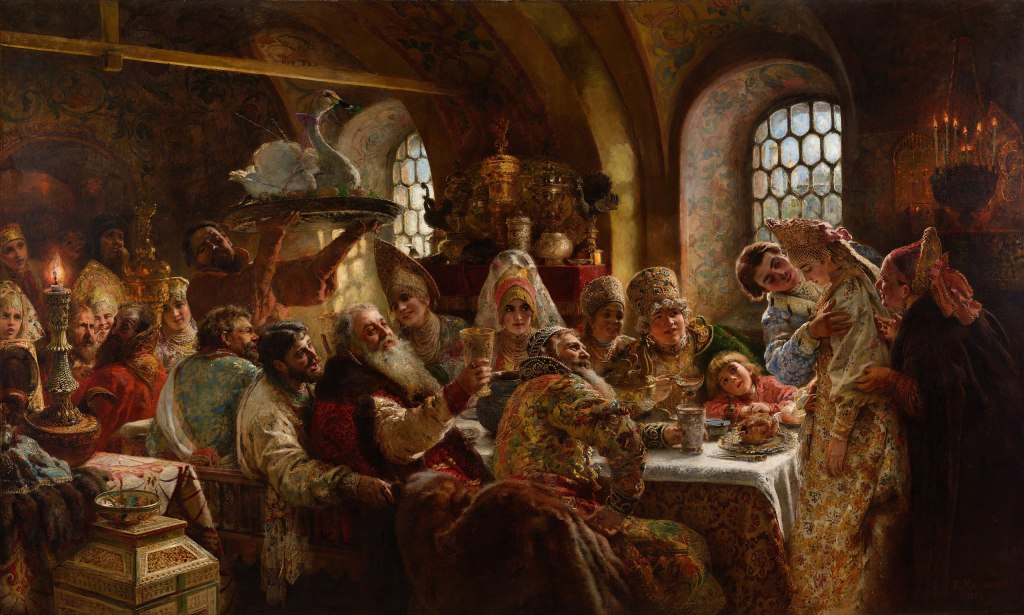
A Boyar Wedding Feast is a painting by Konstantin Makovsky that showcases a very important social event in old Russia, a wedding feast that united two prominent Boyar families. In a richly decorated room, the lavishly attired guests (with gold trimmings in their clothing) are caught in the key moment of the event – the groom is about to kiss the bride during a toast, as a dish of fried swan, in turn the symbol of fertility, is presented by one of the servants. As everyone cheers the couple on, the groom is trying to turn the bride to his side, while the matchmaker is seen behind the bride, prompting her to action. However, the bride herself is looking down shyly, almost with a sad or resigned expression. The unspoken feeling is that she should be happy to get married and it is unlikely that her own wishes in the matter were ever considered.
Each guest has a unique expression on their face, but most are excited, happy or curious (such as the little boy sitting near the groom). However, there is one young woman who mirrors the bride’s stillness. She sits at the centre, looking pensively at the couple. It is hard to read her, but, by the look in her dark eyes, it may be assumed that not all her thoughts are benign and she is possibly envious. The dish of fried swan and half-eaten chicken on the table signal that this is one of the last stages of the feast after which the newly-wed couple will retire to their room.
A Royal Wedding Feast is a magnificent work of art and a fine example of a “living” painting that demonstrates the opulence of the Russian aristocracy in the 17th century Russia. It is distinguished by its elegant composition, attention to detail, vibrancy and warm tones. Famous collector Pavel Tretyakov once wanted to buy the painting, but the then sum of twenty thousand roubles requested by Makovsky was beyond his means. Emperor Alexander III of Russia also wanted to buy it, but was outbid by American jeweller Charles Schumann, who eventually bought the painting for sixty thousand roubles (or fifteen thousand dollars) in 1885 (approximately half a million dollars in today’s money). The painting is currently on display at the Hillwood Museum, Washington, D.C.
 Thoughts on Papyrus
Yes! This is why blogging is so great!
I would never have seen this magnificent painting or learned anything about it without your post.
Thank you.
LikeLiked by 2 people
Completely ditto Rose’s comment!
LikeLiked by 1 person
A stunning painting, a slice of life!
I have realised from your header images that you might be just the person to ask: I’ve been blogging my reading of The Divine Comedy and this week (Paradiso) I came across some illuminated manuscripts at the Public Domain Internet Archive (https://pdimagearchive.org/images/a6817ca5-1d78-407b-912f-f459f80c531c/) where the use of expensive blue paint was quite striking. The patron for the manuscript must have been wealthy indeed for this no-expense-spared beautiful extravagance but I have been unable to find out anything more about who it was and why it was commissioned.
Do you know anything about it?
LikeLiked by 1 person
Yes, it is The Yates Thompson MS 36 illumination of Dante’s Divine Comedy. It was produced in Siena, circa 1450 “based partly on the depictions of the dome on Florence’s cathedral”. You are right, the patron was very wealthy. It was probably commissioned by Alfonso V, King of Aragon, Naples, and Sicily (or so the info says) – lover of art and book collector, hence the commission of this work, which is perhaps the only codex to illustrate all three cantos? I just viewed the digital manuscript here Yates Thompson MS 36 – British Library Archives and Manuscripts Catalogue The panel you reference is f.20r. A beautiful manuscript.
LikeLiked by 1 person
Thank you, Diana!
If only I’d looked more closely at the dome in Florence! (Though I’d have needed binoculars?)
I’ll look at that catalogue now:)
Thank you again:)
LikeLiked by 1 person
No problem! I want to revisit Dante’s work as well this year (I previously tackled the books but in another language), and your posts are certainly very inspiring. But, I am torn between translations. The Penguin edition looks like the safest bet, and from your posts, but I am now tempted by the Oxford University Press one and, have also discovered NYRB editions which look so well-presented, not to mention I’m a fan of Gustave Doré’s illustrations, but I guess I can follow them separately!
LikeLike
My experience with the excellent introductions to the OUP series on Zola would tempt me to them, but I’d want to look inside first. What I like about Musa is that (of course) there’s an introduction, but also, at the beginning of each canto there’s a brief summary of what happens which helps to identify what’s actually happening (because it’s not always clear to the novice reader), and then at the end of the canto there are Notes, identified by their Line numbers so you can go back and see what he’s talking about. Sometimes it’s just about the historical person being named, but other times it explains things that would otherwise be opaque. I already had Inferno in the Musa translation when I started, and it was those features, the summary and the notes that sent me to hunt out a copy.
LikeLiked by 1 person
Musa’s translation sounds very helpful. Thanks for this tip!
LikeLiked by 1 person
You’re welcome!
LikeLike
A fabulous painting indeed. And thank you for directing the viewer to particular aspects of the work, which make for an interesting reading.
LikeLiked by 1 person
There is a lot to unpack in it, isn’t there? Thanks for stopping by!
LikeLike
I enjoy the painted patterns of those times in Rus’. Perhaps the “beauty” of colorfulness is in my genes.
LikeLiked by 1 person