
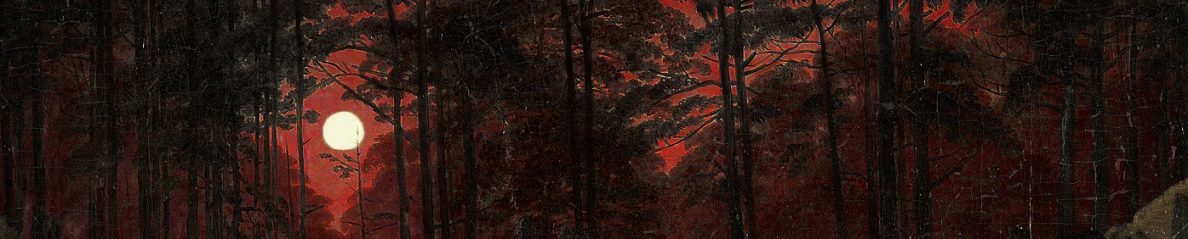
Charles Kuwasseg (1833-1904) was a French landscape artist, and the son of Austrian painter Karl Joseph Kuwasseg. Once a sailor, he later received his formal training in art under Jean-Baptiste Durand-Brager and Eugène Isabey. Influenced by the Barbizon School, he painted land and seascapes around the coasts of Brittany and Normandy, and scenes of Paris. The four paintings below showcase his skill in evoking the atmosphere of life by the sea.
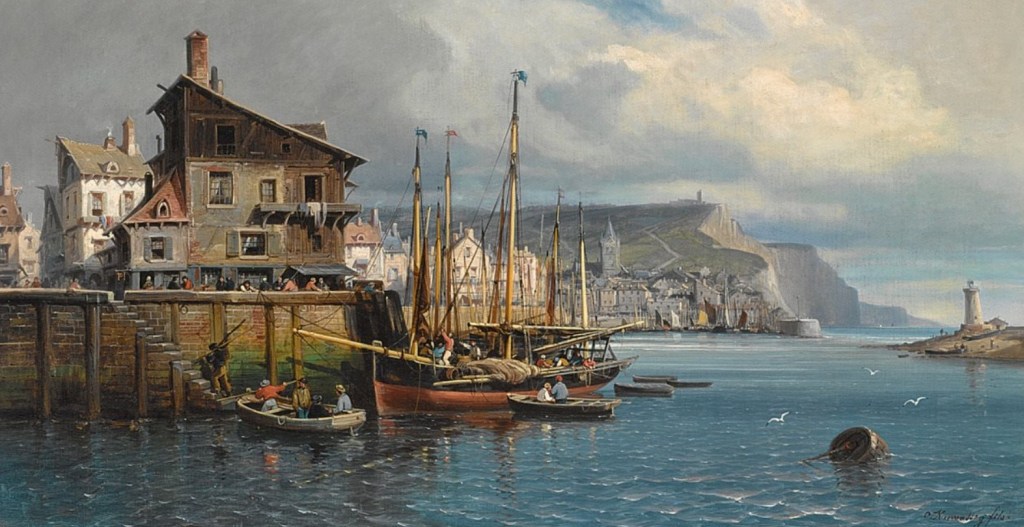
Buildings or dwellings near water often take the central stage in Kuwasseg’s works, and this further emphasises the intimate relationship of a man with the sea in his paintings. The buildings’ close proximity to water means that we can deduce that water and its mood govern virtually all the aspects of these people’s lives. In line with the Barbizon school, the realism here is offset by romantic artistic overtones. There is much colour, but also softness of form.

Charles Kuwasseg also travelled while he painted, and spent some time in Italy, Holland and Belgium. His artwork A View of Camogli shows the town of Camogli, near Genoa, northern Italy. The town has a rich naval history, and once was deemed to be the “city of a thousand white sails” because of its fleet of a hundred Tall Ships. However, now it is mainly a fishing village and tourist resort. On this painting, we can make out the distinctive bell tower of Camogli’s Basilica of Santa Maria Assunta, a church dating back to the twelfth century. It is an atmospheric painting with a picturesque view.

Kuwasseg‘s marine background meant he understood water, and his depiction of it impresses in particular. In his artworks, water often reflects the mood of skies, mirroring it, but there are also surprising contrasts seen at times. In the artwork above, despite the stormy clouds gathering to the right, the serenity of the evening is conveyed by the still waters and warm colours of the Mediterranean sunset.

Bathed in rosy colours, this artwork shows activities of a French coastal town. A multistore timber building rises above the waterfront, while at the sea level, we see town folk gathering, and the fishing boat preparations are underway. This is Kuwasseg’s typical painting – scenic with muted tones, and yet full of atmospheric details. Even though Kuwasseg is known for his depiction of coastal life, it is actually his painting that shows city life without any water that first introduced me to him – see Antwerpen by Charles Kuwasseg.
 Thoughts on Papyrus

I really like the play of the light on the sails in A View of Camogli. The boat is at sea so wouldn’t have been sitting still, maybe it was docked and then painted at sea but it doesn’t seem that way. I suspect he just had a remarkable memory. Glad to see these, was recently in London and got a bit tired of all the paintings of Venice. The seascapes of Dutch art are quite beautiful but also can get a bit tedious too. These paintings were very fresh to me, thank you.
LikeLiked by 1 person
Thanks for pointing out to me the light in A View of Camogli. Now I see the painting and the boat slightly differently. It became even more interesting to me. Once I went through some intense Canaletto obsession, but now I really enjoy digging up these lesser known artists too.
LikeLike
These scenic seascapes are intriguing, echoes of many different periods of such pictorial views from the 16C onwards. It’s weird too, sections look almost AI-generated, as if culled from absorbing several treatments of the subject over the centuries. The name Kuwasseg is totally unfamiliar to me, I must investigate more!
LikeLiked by 1 person
I see, it does look like it, doesn’t it? And, yes, Kuwasseg is certainly worth knowing and exploring further.
LikeLiked by 1 person
Atmospheric and Moody. Love these!⚓️🚣♂️🌅
LikeLiked by 1 person