

Waiting for the Barbarians [1980] – ★★★★
What does J. M. Coetzee’s third book Waiting for the Barbarians have in common with Dino Buzzati’s novel The Tartar Steppe (1940)? Arguably, much more than their shared source of inspiration – C.P. Cavafy’s poem titled Waiting for the Barbarians (1904), whose first two lines go like this: “What is it that we are waiting for, gathered in the square?/The Barbarians are supposed to arrive today.” The ironic poem tells of the idleness and passivity of authorities who wait for the realisation of their grandiose expectations – the coming of the Barbarians. While Buzzati’s book primarily focuses on the self-imposed inertia and what it may mean to an individual spirit, similar to Mann’s novel The Magic Mountain, Coetzee book emphasises the ignorance of a blood-thirsty, ruthless power out of touch with reality and the way of life of its own people, but adamant to prove itself in the face of any, however slight and imaginary, hint of an external threat.
Coetzee’s story is about one unnamed aging magistrate stationed at a frontier settlement. When Colonel Joll from Empire’s army visits this forgotten military outpost, he unleashes an unprecedented level of terror on the supposed enemy of the Empire – the Barbarians, and the magistrate is one of the first to witness the extent of Colonel’s frenzy to protect the country from its emerged enemy. The “enemy”, it turns out, is singled out indiscriminately from the surrounding population: “did no one tell him [the Colonel] these prisoners are useless to him?,” wonders the magistrate, “did no one tell him the difference between fishermen with nets and wild nomad horsemen with bows?”. In the course of this “slaughter of the innocent” in the name of the Empire’s protection, the magistrate meets and then starts a relationship with one of Colonel Joll’s victims – a woman from a distant indigenous population. However, his trying to penetrate this injured woman’s mind only leads him to confront his own inability to face the enemies within: the hidden guilt and the fear of finding out the worst.
The first-person narrative, as the magistrate tells us his tale, gives much immediacy to the story, but though frank, it does not invite warmth. The magistrate tries to put himself in the shoes of the victims of the senseless oppression, enticing us to follow suit, but isn’t he blinded by his own goals, desires and inadequacies? The onlookers are destined to just look, but do nothing in the face of gross injustice, concludes Coetzee, while he shows that this magistrate only appears to be the voice of objective wisdom in the reigning chaos and the madness of the masses. In fact, the magistrate is just an ambivalent bystander, controlled by his own immediate desires, whims, and deeply-ingrained prejudices. Even his sympathy for the suffering of others is framed as a response to escape his own increasingly uncomfortable and stressful situation – the shame of it all: “when so men suffer unjustly…it is the fate of those who witness their suffering to suffer the shame of it”.
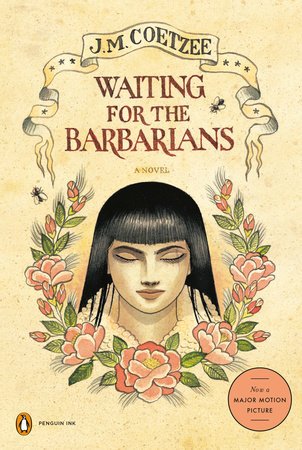
Waiting for the Barbarians has clear, glaring themes: the nature of responsibility, complicity and complacency, the internalisation of guilt and the politics of fear. This South Africa-born author’s not so subtle criticism of the brutal, ignorant and cowardly colonial power and its abuses is on full display, “Empire dooms itself to live in history and plot against history…by day, it pursues its enemies…by night, it feeds on images of disaster…”, and so is his indignation at the dominant force’s misshapen attempts at reparation. The magistrate, faced with Colonel Joll’s unreasonable orders and the tortures of the innocent, finds himself in a stifling situation, caught between the two opposing forces, that of the “enemy” and the “defender”, the “abuser” and the “victim”. He may be torn between the factual “savagery” of his official duty and his apparent sympathy for the defenceless underdog, but his perspective change is not so innocent, let alone heroic, because he remains on the side of the law, and his interest in the captive injured woman is not without its egoistical and sexual considerations. The innocence is stolen and can never be returned, but the magistrate’s position and response is not righteous – it is nihilistic.
The author makes little attempt to hide his stark symbolism, either. Apart from the hunting of animals standing for the killing of human beings, vision and blindness are powerful book metaphors. The first line of the book states: “I have never seen anything like it: two little discs of glass suspended in front of his eyes in loops of wire”. Colonel Joll arrives to the magistrate’s outpost wearing a pair of sunglasses, a rarity in the region, and while his glasses may stand for not seeing things around as they truly are or having “immunity” from being affected by the infliction of violence, they may also signify being blinded by prejudice, hatred and vengeance. The indigenous woman is also then marked by this hatred, ignorance and blindness, both figuratively and literally, as her eyesight fails after her torture. “So this is what it is to see!”, cries once our unreliable narrator, as he inwardly battles with seeing and not seeing, realising and not realising, admitting and not admitting the horror of the unfolding situation.
It is not so much the poem by Cavafy that looms over Coetzee’s work, but the prose of Italian literary master Buzzati. Like in Buzzati’s The Tartar Steppe, the prime juxtaposition in the novel is the generational divide, for example between the old and young commanders, and the modern and outmoded thinking, and the external threats end up to be no more than weather elements. There is the same “flat, sandy landscape”, an inhospitable environment, in both of these authors’ works, with the meaning to the soldierly life given by the impotent wait for the Barbarians, and then by venturing out on an expedition that brings unfortunate results. If Buzzati’s hero undergoes a transformation from one lively, human and free-thinking soldier to a stern, zombie-like official drowning in his routine (a change from an active participant (of his own life) to a mere bystander), the change in the narrator in Coetzee’s novel happens the other way around. The unnamed magistrate sheds his uniform when he starts to question what should never be questioned – the orders from above. His transformation is from a simple bystander to an active participant.
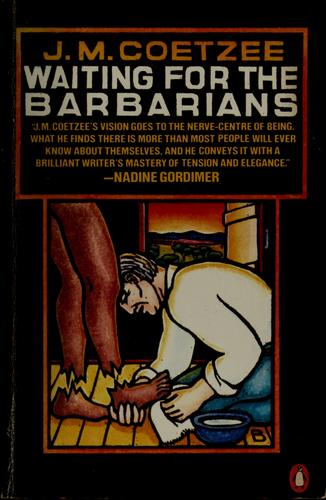
There is no Kafkaesque uncertainty or subtlety in the novel, but there is much dread for things to come, and true horror is closer to home that one believes it to be. While Coetzee introduces this exciting narrative of a “stranger comes to town” (despotic and cruel Colonel) at the start of his book, he soon drops this narrative, which would have established the antagonistic relationship between Colonel and our magistrate. And, instead of the satire of the state of “working expectancy”, and governmental tyranny and sense of efficiency, the author favours the dissection of our magistrate’s internal dilemmas and sexual life. The growing sexual impotency of the magistrate mirrors his growing inability to handle injustice that he sees, but, even if Colonel’s actions in the first chapters did cast the shadow over the whole narrative, this is not enough to sustain it to the end. Coetzee, in his circular-structured narrative, is determined to drag and repeat the same theme he established at the start of the book, and, so, as its main character, the story also hits inertia half way through the book, and it would only regain its impetus when Colonel Joll appears on the scene once again.
🏰 Finishing Waiting for the Barbarians is like coming out of surgery, performed expertly, but also unevenly, with some rudimentary, but flashy surgical tools, and perhaps finding out later it was a botched one, after all. The trauma remains, but much needed comfort does not come at the door. It was all cerebral, direct and professional, but also blunt and soulless. Coetzee’s images and themes will linger in the mind, but the novel’s haunting aftertaste still simply reminds of another author’s work.
 Thoughts on Papyrus
such a good review !!! i love your blog
LikeLiked by 1 person
That is the best review I have read Of Coetzee’s novel. Thoughtful, wise…smart. Cavafy also wrote about making the journey long, and Coetze manages to stop at every port.
This is a real review!
LikeLiked by 1 person
Thank you, and for dropping by, and, this is a curious observation re Cavafy & Coetzee that does ring very true.
LikeLike