


A People’s History of Tennis [2020] – ★★★★1/2
Berry’s book is a fun, eye-opening and frank account of the history of tennis that puts real people front and centre.
“Lawn tennis was different. It was played “as much with the head as the hand” and it encouraged playfulness and enjoyment of performance” [David Berry, Pluto Press, 2020: 23].
This new non-fiction book is about the history of “lawn tennis”, as viewed through the prism of class and gender politics. Rather than being just a sport for the privileged and well-off, David Berry argues that tennis has also historically provided important battlegrounds for “freedom” movements, for the rights of women, immigrants, black people and people from the working class segment of the population. Referring to the sport’s “amateur” beginnings and explaining the business side of the game, Berry talks about tennis between the wars, about the history of tennis clubs, as well as details the rise of first tennis stars that helped to transform tennis from an amusing hobby played on the British Isles to a global phenomenon and industry worth millions of pounds. Often referring to Wimbledon, the oldest and most prestigious tennis tournament in the world, Berry demonstrates with a great narrative flair the constant battle to shed away the “exclusivity” of tennis, a sport which remains one of the few in the world that, from its very origin in the nineteenth century, was designed to be played by both men and women.
Apparently, “the first game of lawn tennis, at least in public, was played on Wednesday 6 May 1874…in Knightsbridge” [Berry, Pluto Press, 2020: 9] and the inventor of “lawn tennis” was Walter Wingfield, a man who wanted to come up with some game that would overtake in popularity both croquet and rinking. His new game of “lawn tennis” had some similarities with a game called real, royal or court tennis that originated in France in the thirteenth century. With some changes, Wingfield’s game had an unprecedented success both at home and internationally, first appealing in particular to gentlemen of certain “intellectual” professions that saw tennis as one undemanding sport through which they can reaffirm their individuality and indulge in some social networking. It was in 1877 that the All England Club at Wimbledon decided to host its first lawn tennis tournament.
I appreciated reading about the first women tennis players, especially about Maud Watson (1864 – 1946), who became Wimbledon’s first Women’s Singles Champion and about Charlotte Dod (1871 – 1960), one of the greatest British sportswomen. Berry’s book demonstrates the injustice faced by women in tennis, and the discrimination/prejudice they had to endure echoes to the twenty-first century: it was only in 2007 that Wimbledon became “the last Grand Slam tournament to concede to equal pay for women and men” [2020: 171].
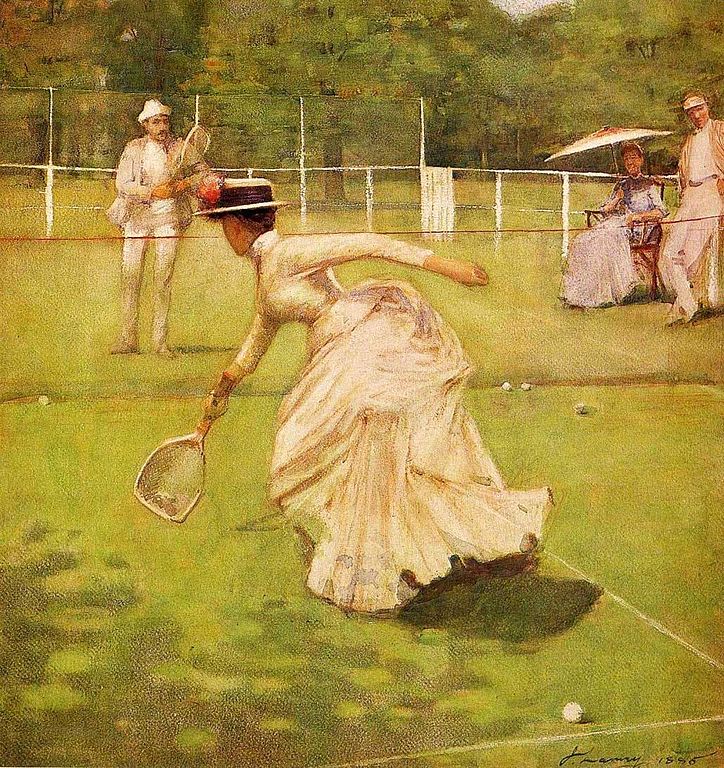
A Rally [1885] by Sir John Lavery
Always seen as a sport for the privileged, the book talks about various historical initiatives to bring tennis to the public. The introduction of well-maintained public tennis courts in the 1920s was one such initiative, but the UK abandoned that idea later with one very unfortunate consequence: “The potential of park tennis to produce a stream of hungry talent in Britain was ignored by the Lawn Tennis Association and was the principal reason why there was no British women’s champion at Wimbledon between…1937 and…1961 and no men’s champion after Fred Perry in 1936 until Andy Murray in 2013” [David Berry, Pluto Press, 2020: 110]. The appalling “exclusivity” of the British tennis had continued for decades and decades. The class distinction was at the heart of it. In the past, all tennis clubs barred working-class people from becoming members, and there was such a thing as the Workers’ Wimbledon, last hosted in 1951. With absolute frankness, David Berry shows how tennis and the middle-class were at one point virtually indistinguishable: “If you were middle class in Britain in the 1930s you joined a tennis club. It wasn’t simply that tennis at this time expressed middle-class identity. It forged it” [Berry, Pluto Press, 2020: 72]. In Woody Allen’s film Match Point (2005), a man from humble origins tries to climb the social ladder by giving tennis lessons to his posh clientele in central London.
Discrimination in tennis extended not only to women and people from the working class, but also to immigrants and black people. The book details how Cas Fish and his Dolphin Squad tried to produce the first black tennis champion, but with no success: “black population was keen on football but had no interest in tennis”, was the view historically, and the author adds “perhaps not surprisingly as they had no way of learning it” [Berry, Pluto Press, 2020: 137]. Black players faced much prejudice and racism in this sport: “in British tennis, black players are noticeable by their absence. The astounding success of the Williams sisters at Wimbledon does not seem to have inspired a new generation of young black women in Britain to take up the game in the way it has in America” [Berry, Pluto Press, 2020: 146]. David Berry goes on to say that this is because of a number of factors, including the expense, the burden of social obligations, but also because of racism: “racism in tennis [in the UK] has never gone away despite the acclaim given at Wimbledon to black champions…what goes unreported are the everyday experiences of racism from top black players not getting product endorsements, to those on the lower rungs of the professional ladder not able to find a family to look after them during a tournament” [Berry, Pluto Press, 2020: 146].
Historically, there was also prejudice towards those who played tennis for pay (“professionals”), rather than for fun (“amateurs”). “Amateur” players then fought against draconian rules not to earn money from the sport. The last part of the book talks about modern tennis, mentioning such names as McEnroe, Borg and the Williams sisters and how they transformed tennis. The game itself has changed: “elite tennis is now dominated by supremely fit athletes backed up by half a dozen therapists who ensure all injuries are dealt with quickly and efficiently” [2020: 188].
Lastly, I appreciated all the literary references given by the author in his book. The rising popularity of tennis was reflected in literature of that or this period, and some of the books mentioned include Edith Wharton’s The Age of Innocence, Forster’s A Room with a View and Julian Barnes’s The Only Story. The only weakness is that A People’s History of Tennis is badly in need of illustrations, and it has some repetitions, which might have been inevitable since the book structure followed such headings as “players”, “socialists”, “outsiders” and “feminists”, rather than a strictly chronological order.
🎾 The merit of A People’s History of Tennis is that it is a non-fiction that often reads like one of the most exciting narrative stories, providing a fascinating insight into “a sport…that [although historically] dominated and controlled by the privileged” [2020: 209] still had its share of fascinating “quiet revolutions” that eventually led to social change.
 Thoughts on Papyrus
This book looks so cool! I really enjoy playing tennis, so it would be interesting to learn more about the cultural history of tennis. Great review!
LikeLiked by 2 people
Thank you! I didn’t have high expectations re this book, but I was pleasantly surprised!
LikeLiked by 1 person
I watch Wimbledon too! And I’m getting back into playing too, slowly. I played in high school. Hard to believe I even used to teach too! 🎾👟
LikeLiked by 2 people
Let’s see how many times I can use the word, “too” in a comment🤷🏽☺️
LikeLiked by 1 person
Cool! It’s a great sport and I think so worth all the time and investment! 🙂
LikeLiked by 1 person
ohhh great review!
LikeLiked by 1 person
Great review. Definitely a book I will read. Thank you.
LikeLiked by 1 person
I hope you enjoy it! It was really eye-opening!
LikeLike