“-I’m gonna join the circus and laugh my head off (when I grow up)“. “-You got it backwards, Dill”…”Clowns are sad, it’s folks that laugh at them” (Harper Lee, To Kill a Mockingbird).
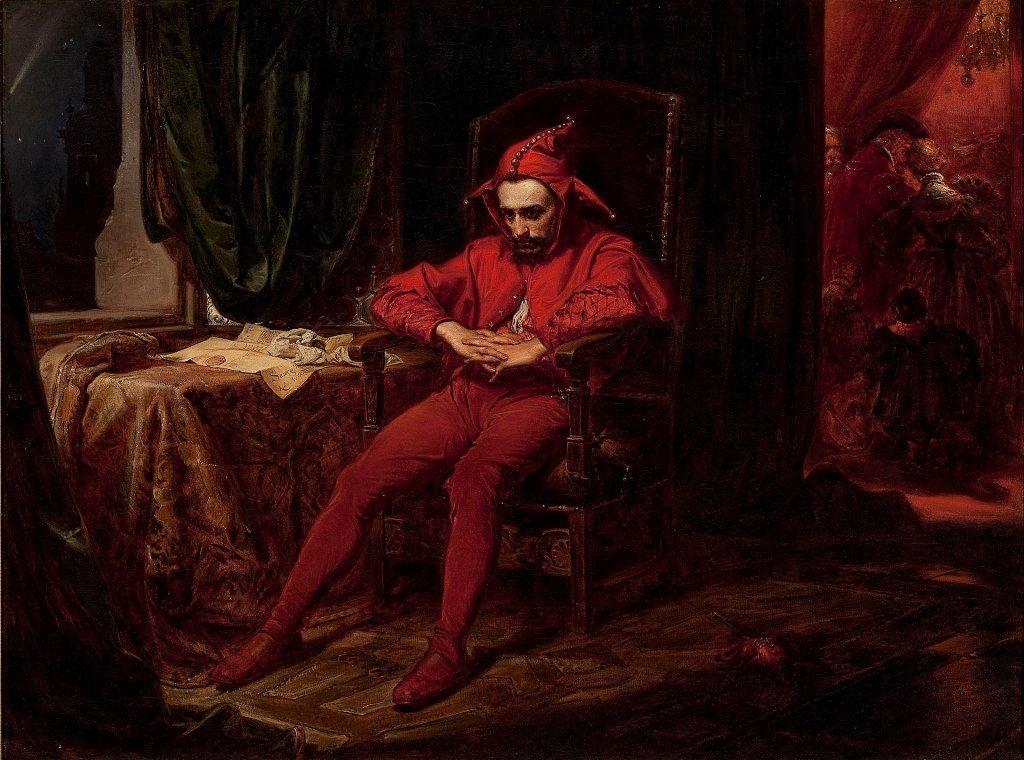
Jesters/clowns are associated with circuses, tricks and laughter, but, behind the scenes, there is at times a different situation. Below are four paintings that depict clowns in a more subdued atmosphere, providing powerful juxtaposition.
Stańczyk during a ball at the court of Queen Bona in the face of the loss of Smolensk [1862] by Jan Matejko
Jacek Malczewski (1854-1929) was a Polish symbolist painter who was part of the patriotic Young Poland movement, and whose work incorporated such motives as Polish history, folk-tales, mythology and Romanticism. Below are three of his artworks considered among some of his most awe-inspiring.
Melancholia [1890/94]
The artist’s best-known painting Melancholia is a work of feverish, staggering genius, which elicits an emotional, instinctual response, even if we are not sure which one. In this painting, whose precise meaning is open to various interpretations, we see “a hallucinatory whirlpool” of different emotions, memories, figures and impressions, with the figure to the right being presumably Melancholia herself, dressed in black. To the left, images of peasants and freedom fighters probably tell us of the unsuccessful Polish uprising of 1863, which resulted in apathy and gloom, again conveyed by Melancholia. The revolutionary colours of white, red and blue are emphasised in the work to underscore the struggle, while the black is also noticeable to hint to us of beauty, freedom marred.


 Thoughts on Papyrus