
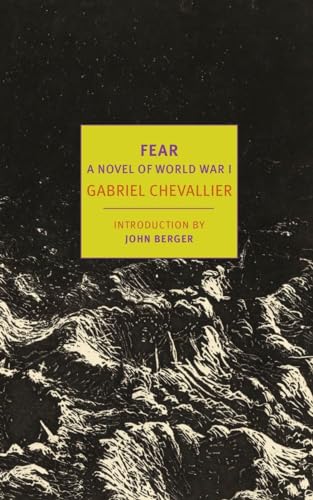
Fear: A Novel of World War I [1930/2014] – ★★★★
“Above all, I must not think…What could I expect? To die? I must not expect that. To kill? That is the unknown and I have no wish to kill…I have no hatred, no ambition, and no motivation. Yet I must attack…”
“…we only have one homeland: the world” [Chevallier/Imrie, 1930/2014: 70, 110].
Gabriel Chevallier (1895-1969) was a soldier in the World War I and this experience shaped his novel Fear, a story where nineteen-year-old Jean Dartemont is cleared by the medical committee to serve in the war against the Germans. Dartemont is curious, but highly sceptical about the war, which he, like everyone else around him, first treats like an exciting explorative adventure, but which soon unveils itself to be what it really is – absolute horror. Fear is a passionate anti-war account, which gets progressively harrowing as the events in Dartemont’s life unfold in a spiralling motion. At the core of the novel is one simple statement – war is not a glorious feat but a dehumanising folly.
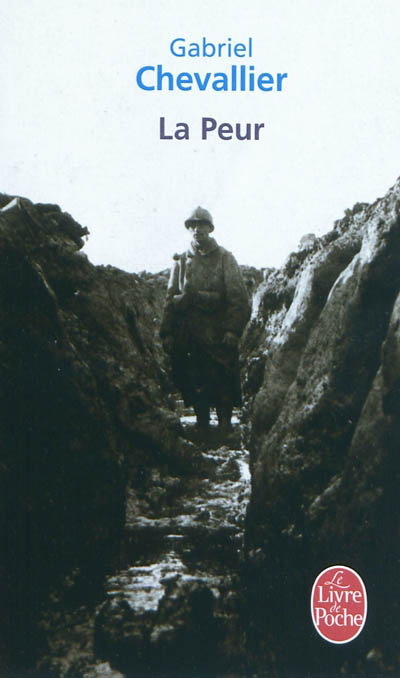
Translated from the French by Malcolm Imrie, the novel is divided into two parts: The Wound, and Dug-In, the latter referring to soldiers who get special jobs in the army, like being runners, secretaries, topographers or cooks, rather than fighting at the front. Dartemont lands one of those after being wounded and spending some time in a hospital.
The horrors of the frontline are central to the book. Chevallier emphasises the sheer chaos reigning among the men, throwing them into the most unnatural of states. And, it is not just war actions that demoralise, but sleeping rough, parasites, nonsensical orders, sadistic generals full of incompetence, and the growing despair. Chevallier’s narrative idea fits perfectly in the context of the World War I, rather than the World War II, since the concepts of officers’ dignity and general honour (the nineteenth century’s aristocratic ideals) could still be felt in the early days of the First World War (see film La Grande Illusion (1937)). However, that does not make the book less relevant. Indeed, the point of the author was to shatter any war illusions. The contrast is being drawn between seeing the war as a fairy-tale combat full of glory with one’s dignity and morality magically remaining intact, and viewing it in its realistic setting: it being a pure nightmare fuel where any societal mode of thinking or high ideals are soon dashed for animalistic survival instincts. In fact, as Dartemont first arrives to the frontline he shares his idealistic feelings in these terms: “I was at the heart of the adventure…I hurried out like an eager tourist, leaving my weapons behind…[the street] was crowded with soldiers…the confusion was a delight”. Naturally, his rosy world-view about the war is shattered later on: “men who had been laughing were now nothing more than hunted prey, undignified animals whose bodies only moved instinctively” [Chevallier /Imrie, 1930/2014: 40, 46].
And then, in 1919, people were unprepared for what they were about to experience. War was still being viewed largely through the prism of the chivalry of medieval knights or Napoleonic colonial “heroism”. World War I soldiers did not know what they did not know. And, one of those things were the effect of a very prolonged exposure to immense danger and ruthless combat on the psyche – shell-shock: “The horror of war resides in [the] growing anxiety. It resides in the continuation, the incessant repetition of danger. War is permanent threat. “We know not the place or the hour”. But we know the place exists and the hour will come. It is insane to hope that we will always escape”. One soldier in the story is described in these terms: “he has one of those lined faces with sad eyes and a desperate smile that mark out a man consumed by an obsession. When fear becomes chronic it turns an individual into a kind of monomaniac…many of the men are sick, without being aware of it, and their febrile state can make them disobey orders or abandon their posts just as much as it can drive them to fatally rash deeds. It is often the only reason for certain acts of bravery” [Chevallier /Imrie, 1930/2014: 203].
One of the most painful passages of the book is the description of André Charlet, a once brilliant student who wrote romantic poetry, but now is reduced to a broken male nurse in a military hospital who eventually goes mad. And, all at the tender age of just twenty-three.
There is this passage by Chevallier on the absurdity of sending to the front someone still in their teens: “If I must die now, I will not say it is awful or terrible, but it is unjust and absurd, because I have not yet attempted anything”. These teen boys did not know life at all at this point, and yet they were already facing the most inhumane of life conditions and death: “it felt as if we had come to some place in the world which was part of a dream, that had gone beyond all the limits of reality and hope”. It is fear, the title of the book, that corrupts and debases them the most: “our pounding hearts tore at our bodies, tried to burst out of our chests. Terror suffocated us, like an attack of angina. And our souls were on our tongues, like bitter communion wafers, and we kept gulping them down, kept swallowing, because we did not want to spit out our souls” [Chevallier /Imrie, 1930/2014: 37, 64, 65]. The soldiers in Dartemont’s unit go as far as intentionally maiming themselves just to escape the front: “war has accustomed them to seeing what is monstrous as natural.”
And, again and again, the author contrasts any pretences of bravery and societal views of war including that of honour, duty, bravery and glory with the actual dehumanising conditions on the ground, where fear, absolute horror and chaos seen around, as well as moral and psychological exhaustion lead to widespread apathy and degradation. The author does well to deconstruct the battlefield’s own internal logic which no civilian can hope to get. The only light at the end of the tunnel is the sense of the camaraderie established among soldiers which sees them through the darkest days. This is because the bond formed with those you stand shoulder to shoulder about to die is one of the strongest. Nothing unites men quite like their shared fear and mutual prospect of death. The reasoning is that you both have seen and experienced the worst, and nothing worse is left for both of you to experience on this earth. The bond is also intimate because no one else experienced it. This knowledge alone binds people irreversibly because no one else gets this level of intensity.
Perhaps the narrative is too straightforward. There is no pretence in the account at subtlety, symbolism or even sarcasm. Every horror is laid open for us to swallow and digest, and we could be exhausted by the end, too. This off-hand approach is far less thought-provoking than that offered by other classics on this topic, but it also has its benefits – its unapologetic frankness and authenticity, which makes it akin to a non-fiction memoir. The point is not to “grip” the reader as such, but to provide the truth behind the war. Of course, Chevallier overstates his message and there is more telling than showing in his narrative, but then again – can something so grave and important be overstated?
“Can anything be more ridiculous than that a man should have the right to kill me because he lives on the other side of the sea, and because his ruler has a quarrel with mine though I have none with him”, Pascal, Pensées. This preface of the book sets its tone and message, and by the book’s end, we can probably arrive at the same conclusion all by ourselves. Chevallier touches on every aspect of the war, from surprise attacks to internal despair and prolonged mental exhaustion. This novel about the ins and outs of a new soldier’s life in France during the First World War is just the book to read in these troubling times in the world.
 Thoughts on Papyrus
My grandfather fought in WWI. As far as I know, he never talked about it later. He was first generation Hungarian-American, and that’s what men did.
Those men paid for the world we live in now – it would have been a very different one had the other side won.
But who can say it was worth it?
LikeLiked by 2 people
Yes, sacrifices must never be forgotten, and we must believe it was worth it. The first war was an entirely different animal from the second, of course. From Chevallier’s account, it seemed most genuinely expected most rules of honour to be followed like it was some medieval jousting. Sad.
LikeLiked by 1 person
It seems so obvious that countries would use the latest technology availably to them – now it’s drones; then it was tanks vs. horses.
LikeLiked by 2 people
A very good and pertinent review. My grandfather and his younger brother were both killed in WW1. My mother was a small child, and forever troubled, as her mother never got over her husband’s death. In turn, our family was impacted by our mother’s early trauma, and we never knew what it was to have the love of a grandparent. Wars are senseless in my opinion.
LikeLiked by 2 people
Thank you, and for sharing your story. Yes, very senseless, and generational trauma is real. For my part, I can only say the same about the WWII effect, but I certainly felt it a lot in my family.
LikeLiked by 1 person
A Non Fiction book which I have found very interesting is “The Gift of Fear” by Gavin De Becker which would probably give a deeper psychological nance to this. Good review!
LikeLiked by 2 people
Thanks a lot for this recommendation. I will certainly try to seek it out.
LikeLike
How relevant, disgustedly. Wars don’t happen unless people fight in them… I’d rather face the firing squad. It’s easy to say that… Rumor is The USS Gerald Ford aircraft carrier is now sidelined for at least 14 months because of multiple infrastructure failures, including with the plumbing, and there was a laundry room fire (official cause stated). It gives me hope thinking the sailors sabotaged the ship to avoid participating in another bullshit conflict, to avoid killing innocent people.
LikeLiked by 1 person