
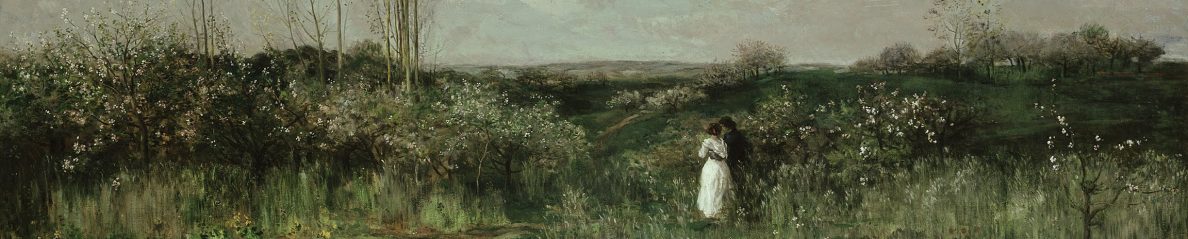
“-I’m gonna join the circus and laugh my head off (when I grow up)“. “-You got it backwards, Dill”…”Clowns are sad, it’s folks that laugh at them” (Harper Lee, To Kill a Mockingbird).
Jesters/clowns are associated with circuses, tricks and laughter, but, behind the scenes, there is at times a different situation. Below are four paintings that depict clowns in a more subdued atmosphere, providing powerful juxtaposition.
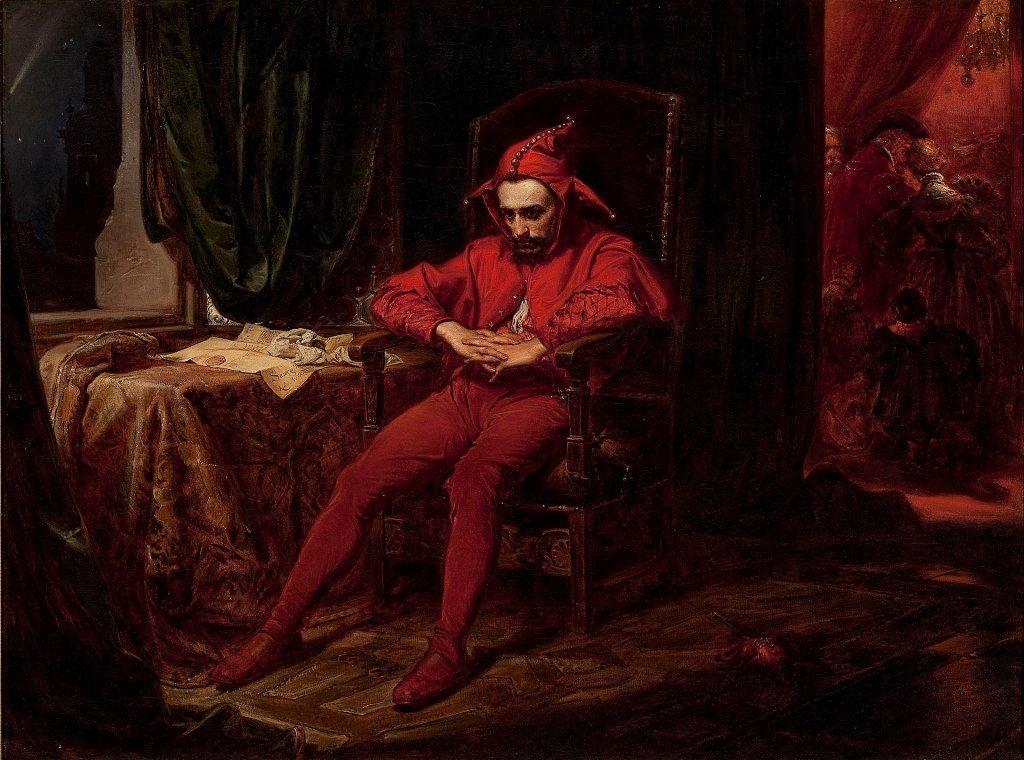
Stańczyk (1862) by Jan Matejko
All powerful works of art are based on equally powerful contrasts, and this painting by Polish artist Jan Matejko is the testament to this sentiment. A jester at the court of Queen Bona is seen sitting in a chair with his hands clasped and a gloomy, vacant expression on his face, while in another room the ball is in full swing – the merriment is ongoing and the party-goers are making an uproar. The jester has just read the shocking news of the city of Smolensk falling to Moscow in the Muscovite–Lithuanian War (1512–1522). We see the crumpled letter on the table, illuminated by light that also falls on the jester, whose face is modelled after the artist, and who seems to be the only one realising the significance of the events occurred. Through the window, we see the dark night enveloping Krakow’s Wawel Cathedral, while the shooting comet is also seen, making its way to earth and signalling a bad omen.
Through the clever play of light and shadow, the artist conveyed the feeling of the rug being pulled out from one’s feet and one’s life seemingly coming to a screeching halt, while the rest of the world seems oblivious to the fact, carrying on in a good cheer. The high-backed chair also reminds of a throne, symbolically linking the jester to the King of his own land (of promise) contemplating his own (imaginary) Kingdom finally falling and all hope being lost, while also indirectly symbolising once strong but now misplaced confidence about the war’s outcome and independence being torn to shreds.
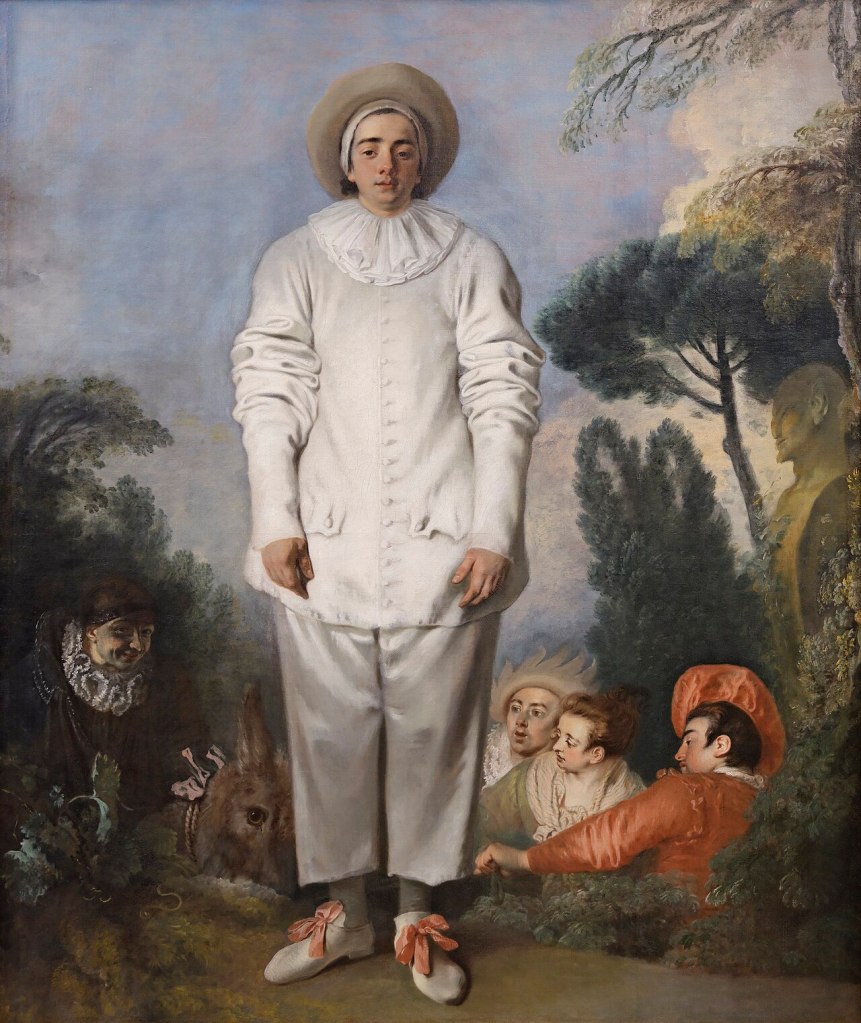
Gilles (1719) by Jean-Antoine Watteau
Gilles (Pierrot) is presented here tired and unhappy. Watteau plays on the contrast between the clown’s costume which should signal to us merry times to come (Gilles was still presented in Watteau’s time as the slightly mischievous butt of all jokes) and Gilles’ own facial expression that displays apathy and disinterest. Gilles’ white costume makes him look almost like a ghost, while his oversized satin shoes with pink ribbons only emphasise the clown’s discomfort and awkwardness. Watteau was a master of mixing red, black and white combinations, and he lets Gilles get “exposed” to us by drawing our attention and making us trace our eyes from the very top – the pristine white (Gilles’ fancy collar) – all the way down to the much dirtier shades of white. It is at this ground level that the “exposure” element of the painting becomes even more pronounced because of the audience – the rest of the Commedia dell’Arte troupe: lovers Lelio and Isabella, Capitano, dressed in red, and Dottore with his stubborn donkey. This makes Gilles, with his dangling arms, seem even more like a lone, theatrical piece on display. There is this air of total resignation coming from the painting.
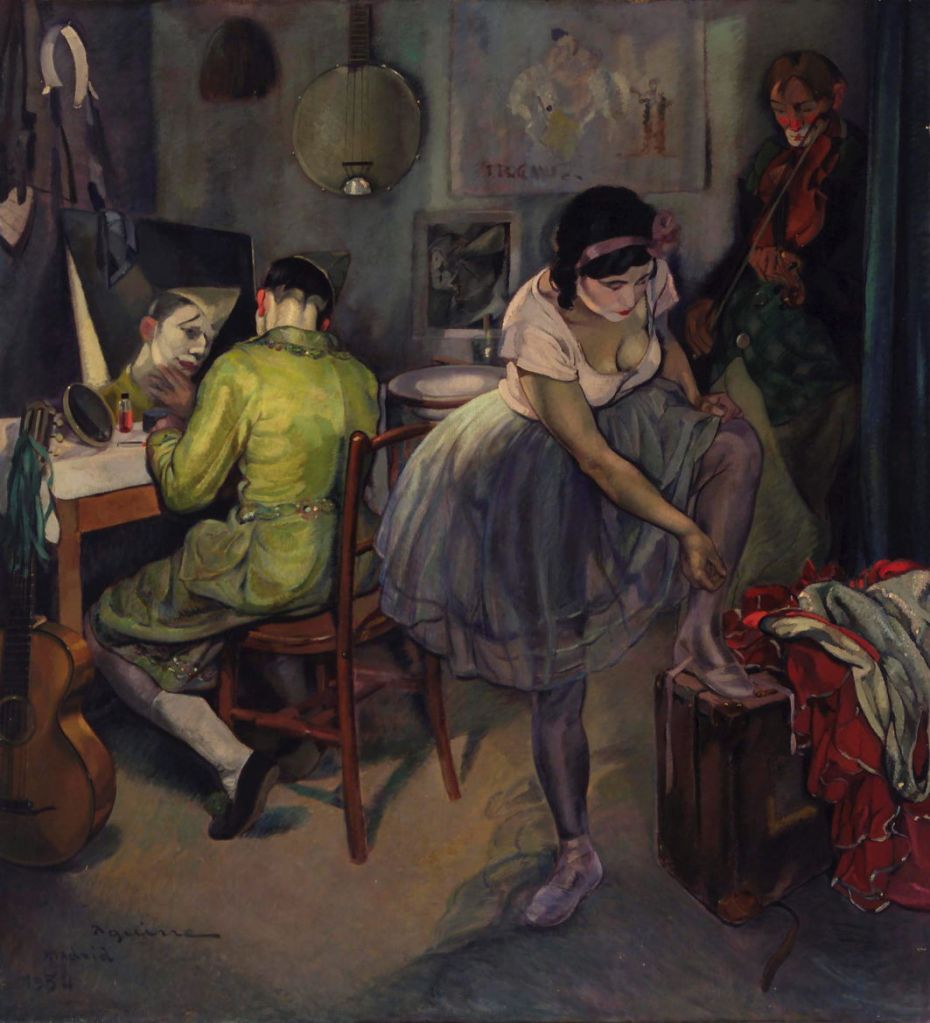
Clowns (1934) by Lorenzo Aguirre Sánchez
Spanish painter Lorenzo Aguirre Sánchez (1884-1942) depicted the insecure and uncertain life of performers in his artwork Clowns. In a cramped dressing room, three performers are putting finishing touches to their persons or repertoire. The female performer, a ballerina, seen with her foot on her luggage (a sign of her precarious, mobile lifestyle and transient existence) has to share the room with her two male colleagues: a musician and a clown, who is seen checking out his make-up in the mirror. None of them look particularly jolly about going on stage. Sánchez depicted this melancholy scene to contrast with all the bright lights, laughter, and applause undoubtedly to take place just some minutes later. The artwork is on display at the Museo de Navarra, Pamplona, Spain.
La Famille du Saltimbanque: L’Enfant Blessé (1873) by Gustave Doré
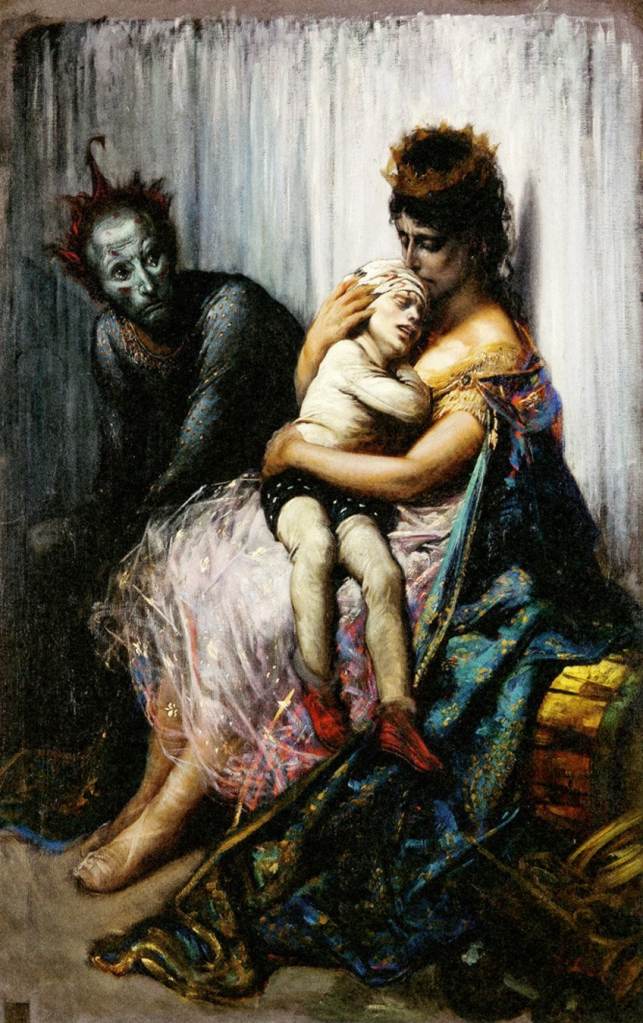
This is the first version of the two paintings created by Doré in 1873 and 1874. It depicts a family of performers (acrobats, magicians) grieving for their fatally injured child who is also a performer and met with an accident during his (tightrope) performance. Apparently, Doré read about the accident in a newspaper and this prompted him to depict the scene. It shows the side of street performing most people do not want to think about – the dangers associated with certain tricks/stunts and the extent people would go to earn their bread (the precarious living of artists). The scene, echoing the one from the Pietà, shows the family paying the ultimate price: the life of their small child, and this is what the artist had to say about it himself: “I wished to depict the tardy awakenings of nature in those two hardened, almost brutalised beings. To gain money they have killed their child, and in killing him they have found out that they had hearts…” It is a deeply sad, disturbing artwork, which is more intimate than the second version created since it omits animals and makes the father more “involved” in the tragedy through his greenish costume (symbolising sadness), teary eyes and closer proximity.
The painting is housed in the Denver Art Museum.
 Thoughts on Papyrus
That first one is so striking and feels so modern, despite the setting, the letter, the costume… lovely round up!
LikeLiked by 2 people