

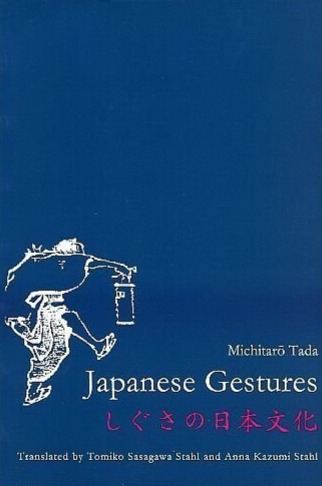
Japanese Gestures: Modern Manifestations of a Classic Culture [2004] – ★★★★
It is known that the Japanese communicate ideas through manners, as well as through language, and this book by prominent Japanese critic and academic Michitarō Tada cuts to the core of understanding Japanese mentality and culture as expressed through gestures, manners, and facial expressions. Much of the Japanese culture reveals itself through little nuances and details, rather than through sweeping generalisations, and in just around forty-two short chapters Tada elucidates the peculiarities of the Japanese, shedding light on their intricate traditions and behaviour. From posture, squatting and “standing to attention”, to smiling, laughing and crying, the book provides plenty of insight into the Japanese mannerism, while also talking about such concepts as mimicking, spontaneous gift-giving, and aizuchi (“unconscious” agreement with the speaker). Below I will focus on only three points discussed, having grouped and categorised them myself.
Imitation
“Japanese arts and learning were formed and established through their copying the “predecessors of culture” [Michitarō Tada/Tomiko Sasagawa & Anna-Kazumi Stahl, Three Forks Press, 2004: 12].
In Japan, imitation does not carry the same negative connotation it does in the West. Imitation is the sign of deep admiration, and is often encouraged – with variations. As Oscar Wilde once said: “Imitation is the sincerest form of flattery“. Japanese culture was also developed in large part through imitation, for example, of Chinese scripts, thought and religion. It is even believed that the famed Japanese trait of brilliant “originality” and “inventiveness” exists only because imitation is hardly ever criticised, is expected and even praised. “It is imitation through which originality arises” [Michitarō Tada/Tomiko Sasagawa & Anna-Kazumi Stahl, Three Forks Press, 2004: 10]. It is a view supported by evidence. Tezuka Osamu(1928 – 1989), the legendary manga creator, was heavily inspired by Disney and the Mickey Mouse comic strips, and it is impossible to think about Japanese director Akira Kurosawa (1910-1998) without also recalling both Shakespeare and Russian literature (Throne of Blood (Macbeth), Ran (King Lear), Ikiru (The Death of Ivan Ilyich), Donzoko (Gorky’s The Lower Depths), etc.) The tradition of continuous improvement on what already exists fits perfectly with the Japanese qualities of adapting, adopting, merging and perfecting. Where the western mind sees the sharp contrasts: imitation vs. originality, individual vs. society, black vs. white, the Japanese mind often sees just connection, and at times – completion. Tada also talks about imitation in the context of the Japanese often imitating each others’ gestures, and doing so freely and unashamedly.
The Gaze
The gaze is another aspect where the west and east see the picture differently. Lowering or averting one’s gaze is expected in Japan (Asia), whereas in the west it may be interpreted as a sign of rudeness or even deception. In Japan, if you are bashful (hanikami) or showing signs of embarrassment, it is being viewed as a sign of respect, integrity and self-deprecation (especially for women), but in the west, this timidity or shyness is discouraged and is seen as something to be “overcome”. Tada goes on to say that the “bold stare” may be viewed as shyness too, when it comes to men, when they are “internalising their fear” of others. However, apparently, Japanese yakuza (mafia) was used to punish people for their stares being too direct (“insolent?”) [Michitarō Tada, Three Forks Press, 2004: 60]. Nevertheless, the Japanese gaze has become more direct and that means “modern”, as more and more Japanese have adopted more westernised gestures in their everyday life.
What was more surprising to learn from the book was that placing Japanese flower arrangements in a house alcove is meant to divert visitors’ eyes from their hosts, easing the interaction. As the author states, this is because there is nothing more troubling than “having no place for our eyes to look” when we visit someone’s home and are confronted with our hosts.
The Japanese communication style is nuanced, subtle and often silent –with layers of meaning beneath some of the most apparently incidental, slight or “unimportant” of gestures.
The Other
In the society deeply rooted in hierarchy and once confined to one small island (sakoku policy), there seems to be a lot to lose (at least psychologically) between two people in their interaction, no matter how brief or incidental their meeting ends up to be. Thus, the two had to be extra careful and constantly read the room, noticing subtle signs and aura shifts. One book chapter focuses on “najimu” (“to get familiar”), stating that appropriate conditions (not just desire or will) must exist for some intimacy to appear between any two people. In these circumstances, “both parties happen to enjoy a certain nearness…whereby both put out those small indications of their will and feelings, which each individual senses and notices, and in response to which they both change in a gradual, [subtle] way”. Tada emphasises that this process is not realised by recognition. “It is established, in fact, by the moderate distance between them, simultaneously with the acknowledgement of their unity or fusion. For it is in that distance, in the space between one individual and another, that God wells up” [Michitarō Tada/Tomiko Sasagawa & Anna-Kazumi Stahl, Three Forks Press, 2004: 113]. This is beautifully put, and appears also something that is difficult to articulate with any sense, in line with Japanese idiom “whoever says doesn’t know and whoever knows doesn’t say” (in that case, referring to the aroma of a rose).
🎍 Tada comes across as a vouched traditionalist, which makes the reading all the more fascinating as he subtly pokes fun at, what he views, modernisation and young generation embracing western communicative patterns. Many chapters boil down to the vagueness and indirectness inherent in Japanese interactions, ensuring the smoothness of societal operation, and reducing conflict and discomfort pertaining to more blunt or direct wording. If one’s relationship with another is not defined through explicit, strict wording, then, theoretically, it could be anything, and that knowledge “frees” people, absolving them of responsibility.
Some chapters are more persuasive and insightful than others (for example, I personally wanted for the author to establish more connections between laughter, embarrassment and attempts to diffuse tension). Still, Tada’s short, punchy chapters sustain interest. The author often proposes his own theories about the origin or explanation of this or that gesture, providing plenty of examples and anecdotes from his own life. Of course, one of the merits of the book is that it is not yet another collection of watered-down musings of some foreigner who is trying to grasp the mysteries of the Japanese psyche, but the perspective of a Japanese man – his enthusiastic offerings about his own nation’s idiosyncrasies.
 Thoughts on Papyrus
Thank you for your very interesting article. Approaching such behaviors allows us to open ourselves up to other ways of relating to the world, ourselves, and others.
LikeLiked by 1 person
A most interesting post. As someone who has lived in Japan, I came across such customs, and formed my own theories about them at the time. I could have done with reading Michitarō Tada’s book.
LikeLiked by 1 person